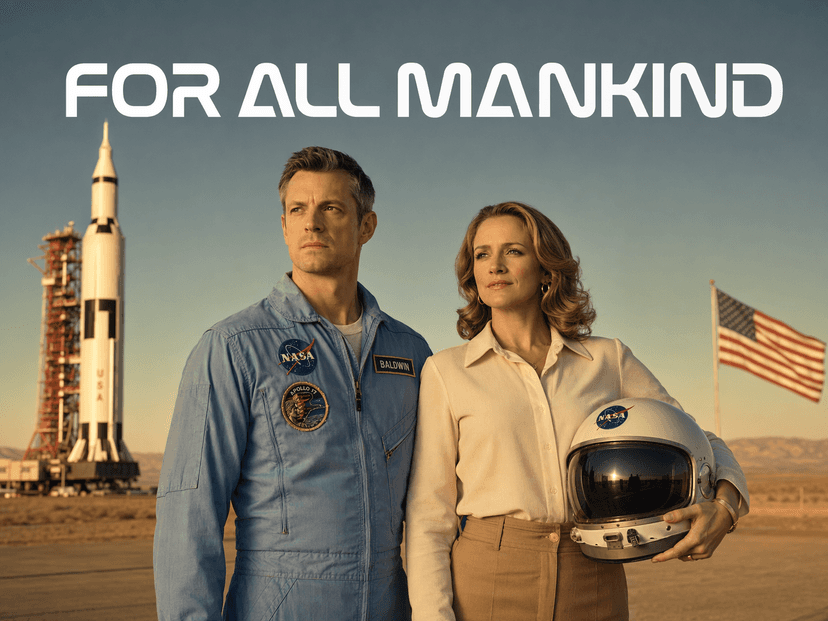
2019 - Present

For All Mankind is an Apple TV Plus alternate-history drama from Ronald D. Moore, Matt Wolpert, and Ben Nedivi that begins with one simple counterfactual. In June 1969, a Soviet cosmonaut steps onto the lunar surface before Neil Armstrong does. The United States doesn't win the Moon. The space race never ends.
Four seasons have aired since 2019. A fifth is confirmed, and a Soviet-side companion series called Star City is in development. Each season jumps roughly a decade. Season one covers the late sixties and early seventies. Season two moves to 1983 and a militarised Moon. Season three lands in 1995 with the first crewed Mars missions. Season four takes us to 2003 and a working colony called Happy Valley, plus the messy politics of helium-3 mining on the lunar surface. That decade-per-season structure is unusual on prestige TV and it is one of the show's most distinctive choices.
I came to this expecting a stiff NASA procedural and got something much weirder and more ambitious. It is part workplace drama, part political thriller, part family saga, and part alt-history thought experiment about what the twentieth century might have looked like if the Cold War had kept its foot on the accelerator.
Joel Kinnaman plays Ed Baldwin, the Apollo astronaut who becomes the show's through-line across all four seasons. He is the kind of competent, taciturn man Kinnaman does well, and the writers use his long run on the series to let Ed age, corrode, soften, and harden again.
The ensemble around him is where the show really earns its stripes.
Michael Dorman
Gordo Stevens
Sonya Walger
Molly Cobb
Krys Marshall
Danielle Poole
Casey W. Johnson
Danny Stevens
Edi Gathegi
Dev Ayesa
Cynthy Wu
Kelly Baldwin
Svetlana Efremova
Galina
Dan Donohue
Russ Jerecki
It is a deep bench. Nobody is wallpaper. Even the bit parts have names and interior lives. That kind of ensemble writing is rare and For All Mankind pulls it off for four straight seasons.
The premise sounds like a space-nerd gift basket but the show's actual subject is the cost of ambition. Every character on For All Mankind wants something enormous and unreasonable, and the series is very clear-eyed about what that costs them in marriages, kids, reputations, and bodies. Moore's fingerprints are all over that DNA, and if you know his work on Battlestar Galactica you will recognise the same interest in institutions under pressure and the compromises their people make to keep them running.
There is also a smart alt-history game underneath the drama. The butterflies from that first Soviet moon landing keep rippling out. Ted Kennedy's career takes a different turn. Reagan comes in different. The ERA passes. The oil crisis never happens. Nixon does not resign for the reasons you remember. None of this is treated as gimmick. It is treated as texture, the way The Man in the High Castle treats its own what-ifs, only looser and more optimistic about what human beings can build when a rival is breathing down their neck.
Production design is where the show quietly does its most impressive work. Season one looks like a 1969 you half-remember from archive footage. Season two gets the analogue sheen of early-eighties Reagan-era American grandeur. Season three nails the terrible fashion and optimism of the mid-nineties. Season four takes us into a lived-in 2003 that feels both familiar and strange because the history is wrong.
The show sells all of this without the chrome-clean futurism most space shows reach for. Control rooms have cigarette smoke and bad coffee. Lunar habitats look like they were assembled by people cutting corners on a government budget. The Mars colony of Happy Valley feels like a trailer park someone welded to a rocket. I find that grounded aesthetic much more compelling than the polished look you get in something like Foundation or The Expanse, both of which I also enjoy but for different reasons.
Critics like it. Audiences like it. It has a loyal following that grew season on season as word got around, and the fourth season managed the rare trick of being many fans' favourite. The show has earned VFX and production-design nominations and turned in one of the most consistent-quality prestige TV runs of the past five years.
Where it has not yet had the mainstream breakout of something like Severance or The Last of Us, it has instead built a reputation as a writer's show and an engineer's show. The people who love it love it a lot. Apple clearly agrees, given the green light for a fifth season and the Star City spin-off that will finally give us the Soviet-side point of view we have been circling for years.
What keeps me coming back is the way the show treats competence as dramatic material. Most prestige TV is interested in broken men doing bad things. For All Mankind is interested in very good engineers, pilots, and managers trying to do something difficult and expensive, and in the ways their ambitions warp them and the people who love them. It is allergic to cynicism without ever being naive. Characters lose. Plans go wrong. Moon missions fail. People die. The dream keeps going anyway.
If you like the ensemble sweep of The Americans, the procedural texture of Chernobyl, or the institutional drama of Mad Men, you are going to find a home here. Four seasons in, For All Mankind is one of the most quietly ambitious shows on television and the one I recommend most often to people who say nothing decent is being made any more.
Jodi Balfour
Ellen Waverly Wilson
Jeff Hephner
Sergei Nikulov
Coral Peña
Aleida Rosales
Shantel VanSanten
Karen Baldwin
Joel Kinnaman
Ed Baldwin
Wrenn Schmidt
Margo Madison
Sarah Jones
Tracy Stevens