2015 - 2019

The Man in the High Castle ran on Amazon Prime Video for four seasons between 2015 and 2019, forty episodes across roughly four years, adapted loosely from Philip K. Dick's 1962 novel by creator and initial showrunner Frank Spotnitz, with Ridley Scott executive-producing. The premise is the one every alternate-history writer eventually circles. What if the Axis powers had won? The show answers in 1962. The Greater Nazi Reich runs everything east of the Rockies. The Japanese Pacific States run everything west. A thin, paranoid strip called the Neutral Zone sits between them, and nobody in either regime much likes that it exists.
Into this world falls a set of films. Newsreels, really, smuggled hand-to-hand, showing a history where the Allies won. The films are called The Grasshopper Lies Heavy, and they do what illicit objects in Philip K. Dick stories always do. They make people question whether the world they live in is the only one.
Alexa Davalos carries most of the story as Juliana Crain, a San Franciscan who stumbles into one of the films and finds her life narrowing around it. Rupert Evans plays Frank Frink, her partner, a Jewish artist hiding his heritage in a regime that would have him killed for it. Luke Kleintank is Joe Blake, a young American caught between loyalties he didn't choose. DJ Qualls, as Ed McCarthy, is quietly one of the show's most surprising assets, a gentle comic presence in a story that genuinely needs one.
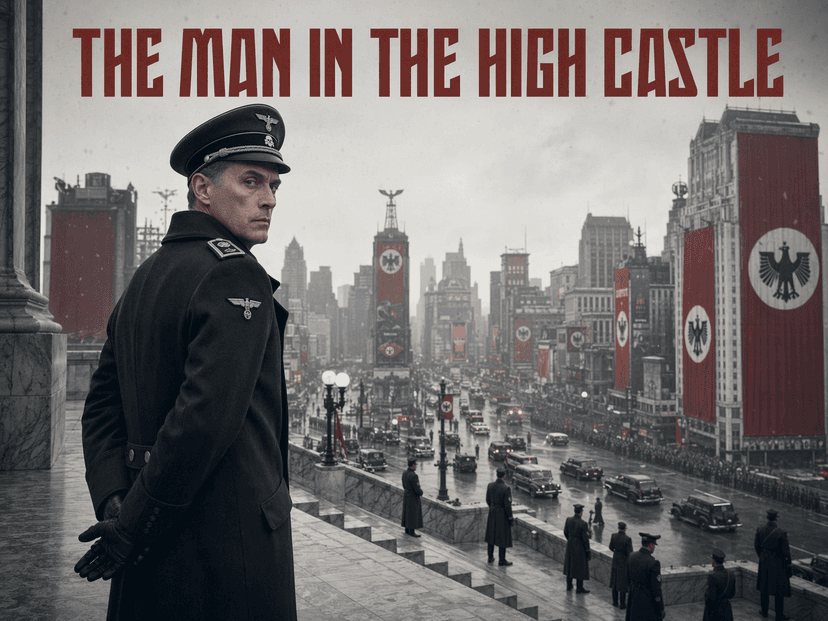
The performance everyone remembers is Rufus Sewell's. As Obergruppenführer John Smith, Sewell plays an American SS officer whose home life would not look out of place on a cereal advert. Wife, kids, tidy suburban house in New York. It is the most unnerving work of his career, and I put the show's best scenes behind his suburban dinner-table moments rather than any of the big-plot set pieces. He plays Smith as a man who has made peace with his own monstrousness by compartmentalising it behind perfect posture and a loving-father voice, and the gap between those two men is where the show does its best thinking.
On the Japanese side, Cary-Hiroyuki Tagawa plays Trade Minister Nobusuke Tagomi with the stillness of a man who has spent decades learning not to show what he is feeling. Joel de la Fuente, as Kempeitai Chief Inspector Kido, is the show's most unshakeable presence, a policeman who is not a villain in the way Smith is, but a man built entirely of duty. The two actors do more with silence than most series manage with dialogue.
Around them:
DJ Qualls
Ed McCarthy
Chelah Horsdal
Helen Smith
Callum Keith Rennie
Gary Connell
Stephen Root
Hawthorne Abendsen
Bella Heathcote
Nicole Dörmer
Rufus Sewell
Obergruppenführer John Smith
Brennan Brown
Robert Childan
Alexa Davalos
Juliana Crain
On paper this is an alternate-history thriller. In practice it is about complicity. Spotnitz and his writers are less interested in the Reich's spectacular evil than in the ordinary people who have chosen to live inside it. Juliana's question is what you do when you see evidence the world should be different. The Smith family instead asks how far a person can tilt before they fall, and Kido, hardest of all, forces the question of whether duty is a virtue when the thing you are dutiful to is rotten.
The Philip K. Dick ancestry shows in the metaphysics. The Grasshopper Lies Heavy films are not a McGuffin. They are an argument that reality itself is porous, that parallel worlds exist, that people can slip between them. The show takes Dick's multiverse seriously and makes it a plot device, not just a theme. By the later seasons you are watching a spy thriller, a family drama, and a genuinely strange piece of speculative fiction at the same time, which is more than it ever quite manages to reconcile but gives it a flavour nothing else on television had.
The visual work is the most immediately impressive thing about the show. Nazi New York, with swastika banners draped over Times Square. A Japanese-occupied San Francisco with bilingual street signs and sumo posters. A burned-out Neutral Zone that looks like a western. The production designers commit to the world with a seriousness that makes the discomfort real. You are meant to be unsettled by how ordinary the imagery has become to its characters, and the show knows exactly what it is doing every time the camera lingers on a child's Hitler Youth uniform or a shopfront portrait of the Führer.
The pace is deliberate, sometimes too deliberate. Seasons one and two are tight. Season three wobbles. Season four loses the plot in places and then finds a surprisingly moving ending. This is a show you settle into rather than one that drags you along, and for some viewers that will be a feature and for others a deal-breaker.
Amazon pitched the show as its first real prestige drama, and for a while it was exactly that. The pilot was reportedly the most-streamed pilot in Amazon history at the time. Rufus Sewell picked up critical plaudits that made him a late-career headline act, and the show drew comparisons to Hunters and The Americans for its comfort with moral murk, and to Chernobyl and For All Mankind for the precision of its period world-building. It is arguably the clearest televised companion to Counterpart, the other great parallel-worlds drama of the decade, though the two shows get to their multiverse from opposite directions.
Awards recognition was less generous than the reviews, but the show has quietly become a touchstone for how seriously streaming television can treat a high-concept premise. It built an audience that stayed.
The premise is lurid enough that it could have been a pulp curiosity. Frank Spotnitz and his cast refused to let it be. The choice to spend as much screen time with Smith's family as with the resistance, to let Kido be a human being rather than a caricature, to treat The Grasshopper Lies Heavy as a real philosophical problem rather than a gimmick. All of those choices added up to a show with more moral weight than its logline suggested. Rufus Sewell's performance alone would be reason enough to watch. The world around it is the rarer thing, a television alternate history that commits completely to its own premise and trusts the audience to sit inside the discomfort.
Four seasons, some wobble in the middle, a finale that earns more of its weight than it had any right to. Worth the time.
Jason O'Mara
Wyatt Price
Joel de la Fuente
Chief Inspector Takeshi Kido
Cary-Hiroyuki Tagawa
Trade Minister Nobusuke Tagomi
Rupert Evans
Frank Frink
Luke Kleintank
Joe Blake