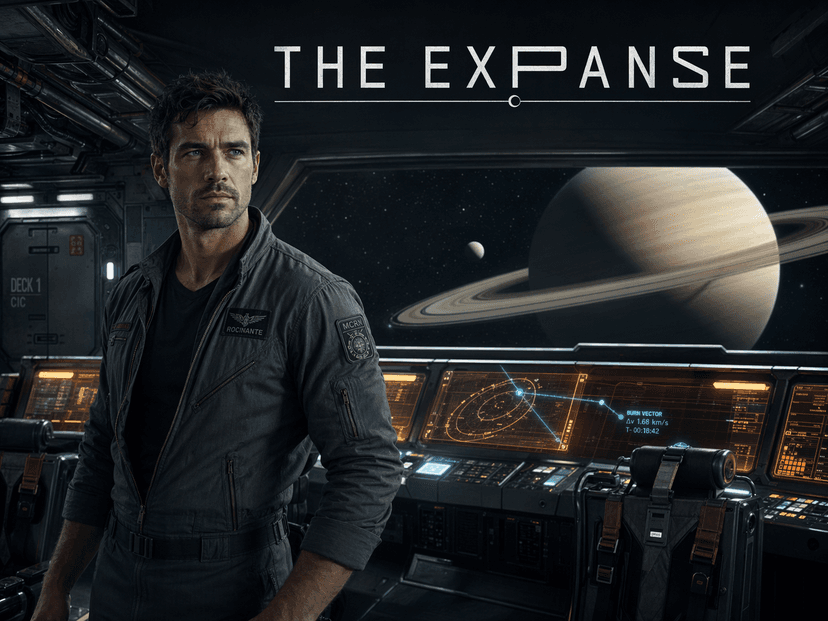
2015 - 2022

The Expanse is the best hard-sci-fi show of the last twenty years and I am not hedging on that. Six seasons, 62 episodes, 2015 to 2022. It started on Syfy, got cancelled after three seasons in one of the more notorious decisions in recent TV history, then got resurrected by Amazon Prime Video after a fan campaign that included a banner flown over Amazon HQ. You can feel the show tighten up after the move. More money, more scope, a clearer runway to finish the story.
It is set two centuries in the future. Humanity has spread across the solar system and sorted itself into three factions: Earth under the UN, Mars under the Martian Congressional Republic (the MCR), and the Belt, the working-class diaspora that mines ore and ice in the asteroid belt and the outer planets. Earth is a bloated bureaucratic superstate that still holds most of the system's political weight. Mars runs as a disciplined terraforming project with the best military around, and it resents Earth for everything Earth has by accident of birth. The Belt is poor, angry, and organised around the Outer Planets Alliance, the OPA. Then an ice hauler picks up a distress call near Ceres. Four crew survive. And something is found floating in the dark that rewrites every political assumption the inner planets have been running on.
The show is adapted from the novels by James S.A. Corey, the shared pen name of Daniel Abraham and Ty Franck. It was developed by Mark Fergus and Hawk Ostby, the writing duo behind Children of Men and Iron Man. Franck spent years in George R.R. Martin's orbit before the books took off, and that pedigree shows in how the series handles political plotting across factions.
The Rocinante crew is the emotional spine. Steven Strait plays Jim Holden, the accidental captain with a messiah complex he keeps trying to talk himself out of. Dominique Tipper is Naomi Nagata, Belter-born engineer and the moral centre of the ship. Wes Chatham plays Amos Burton, the mechanic with a code nobody else can quite read, and somehow he turns what could have been a blunt-instrument character into one of the most quietly devastating portrayals on the show. Cas Anvar appears as pilot Alex Kamal through season five, though he was removed from the production before the final season after sexual-misconduct allegations. Thomas Jane opens the show as Belter detective Joe Miller, a gumshoe in a grimy noir half of the story that eventually threads into the spacefaring half.
Shohreh Aghdashloo is the other gravity well. She plays UN Deputy Undersecretary (and later more) Chrisjen Avasarala, using her real Iranian accent and turning every scene she is in into the best performance on the show. Avasarala swears like a Glasgow taxi driver and out-manoeuvres everyone else in the room. Frankie Adams is magnificent as Bobbie Draper, the Martian gunnery sergeant whose arc is one of the richest on the show. Cara Gee arrives in season two as Camina Drummer, a Belter captain written specifically to carry more weight after Syfy dropped the show.
Frankie Adams
Bobbie Draper
Dominique Tipper
Naomi Nagata
Cara Gee
Camina Drummer
Nadine Nicole
Clarissa Mao
Steven Strait
James Holden
Elizabeth Mitchell
Anna Volovodov
Chad L. Coleman
Fred Johnson
Cas Anvar
Alex Kamal
Chad L. Coleman (The Walking Dead, The Wire) brings a steady, tired authority as Fred Johnson, the disgraced Earther who runs Tycho Station for the OPA. Jared Harris (see him also in Mad Men and Chernobyl) plays Anderson Dawes across the first three seasons, a Belter political operator with his own agenda. Keon Alexander arrives late as Marco Inaros and finds a register of charismatic grievance that is genuinely frightening. Nadine Nicole plays Clarissa Mao. Elizabeth Mitchell (Juliet from Lost) turns up in season three as Anna Volovodov.
Strip away the spaceships and The Expanse is a class story. The Belt is the engine room of the solar system. Belters grow up in low gravity, which reshapes their bones and makes them too tall to ever live on Earth or Mars. They speak Belter Creole, an invented working-class patois stitched together from English, Russian, Hindi, and half a dozen other languages, and they are treated by the inner planets roughly the way extraction-economy colonies have always been treated by the imperial core. The show is not subtle about this and it is better for that. You watch a Belter kid coughing in a rust-red corridor on Ceres and the politics does the heavy lifting for you.
On top of the class story sits a first-contact story. An alien technology older than human history is introduced early and the entire series works through what humans do when they get their hands on something they do not understand. Weaponise it, mostly. The show's moral argument is that the real test of a civilisation is not what it invents, but whether it can keep its worst impulses in check when handed something new. The Expanse thinks the answer is usually no. It thinks it with a lot of warmth about individual people, though.
This is the rare sci-fi show that takes physics seriously. Ships accelerate for days and then flip and decelerate. Gravity is a consequence of thrust, not a setting. Combat in space is slow, quiet, and brutal in the way a collision is brutal. When a character takes a hit of the wrong drug or gets caught in an evasive burn, the g-force does what g-force actually does. I found myself bracing in my chair during the burn sequences, which is not a sentence I expected to write about a TV show.
The production design is grimy and specific. Ceres looks lived-in and corporate. The Rocinante is a working ship, not a sleek prop. The UN scenes do high-society handwringing in Mumbai and New York. Mars military command looks austere and Soviet. Belters are marked by subtle height and spine adjustments and by a complex sign-language shorthand they use when voice is risky. The sign language alone is more worldbuilding than most sci-fi shows manage across a run.
Critical love was constant. The Expanse routinely shows up on best-sci-fi-TV-of-all-time lists and the showrunners ended it on their own terms, with a planned arc finish, which almost no genre show on this scale gets to do. Book readers know two more novels (including Leviathan Falls) go past where the show stops, and there has been steady chatter about a Laconia-set continuation. No promises.
Worth naming some peers: if you want the show's closest sibling in tone and seriousness, it is Battlestar Galactica. If you want its cousin in space-age geopolitics, For All Mankind. On the alien-encounter side, The Three Body Problem and Foundation do adjacent ideas differently. And if you loved the corridor-claustrophobic quality of Silo, you will be comfortable here.
It treats you like an adult. That is the short version. Nobody explains the politics to you. Nobody translates the Belter Creole for you the first time you hear it. You pick up the faction loyalties by watching the factions hate each other, and you pick up the physics by watching the physics do its job. When the protomolecule shows up, the show does not hand you a thesis on what it means, it just lets you live with the consequences for a few seasons.
Some traits worth calling out:
"Beltalowda" is not a subtitle. It is a political argument.
I came to The Expanse expecting to bounce off it after the first two episodes and ended up watching six seasons over a couple of months. Miller's noir detective half of season one takes a little patience. Stick with it. Once the two halves converge, the show becomes one of the most assured long-form sci-fi narratives I have watched, and I mean that without any of the usual TV-critic hedging. If hard sci-fi is your thing, this is the one.
Keon Alexander
Marco Inaros
Thomas Jane
Joe Miller
Jared Harris
Anderson Dawes
Shohreh Aghdashloo
Chrisjen Avasarala
Wes Chatham
Amos Burton