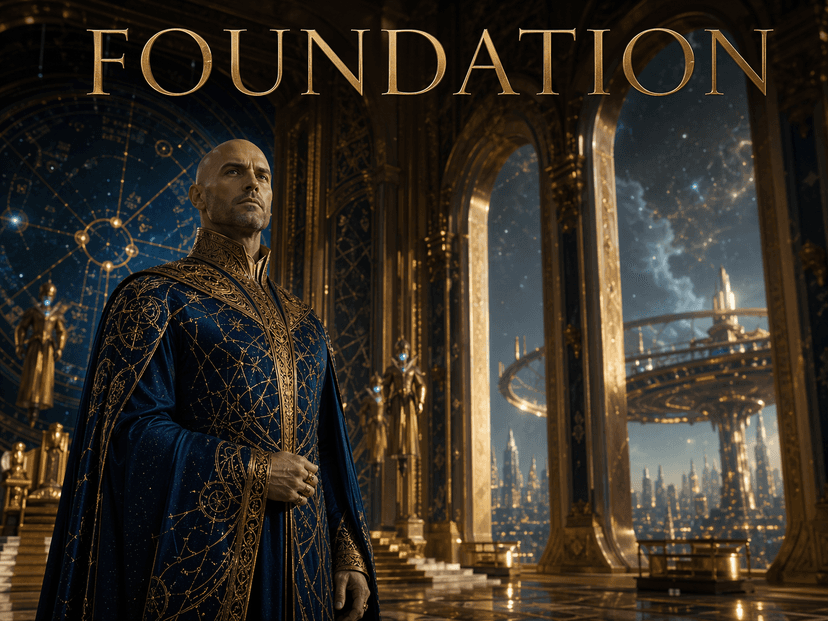
2021 - Present

Foundation is Apple TV+'s biggest swing at prestige science fiction. Season 1 ran from September to November 2021, Season 2 followed in July to September 2023, and Season 3 aired through July and August 2025, with a fourth in production. David S. Goyer, the Dark Knight trilogy screenwriter, developed the show for television, with Josh Friedman initially attached before leaving over creative differences. Apple reportedly spends north of $45 million per episode from the second season onward, which is blockbuster-film money per instalment, and it shows up on screen in every frame.
The source material is Foundation, Isaac Asimov's cycle of novels written between 1942 and 1993. Hollywood spent decades calling these books unadaptable, and not without reason. The novels are less stories than essays in galactic history, structured around ideas rather than continuous characters: psychohistory, the Seldon Plan, the Foundation, the Mule. Whole books skip forward centuries. Protagonists die off-screen between chapters. There is barely any dialogue. Generations of screenwriters looked at the material and ran.
Jared Harris leads as Dr. Hari Seldon, the mathematician who invents psychohistory, a science that predicts the behaviour of large populations across millennia. Seldon calculates that the Galactic Empire will collapse within five hundred years, triggering a thirty-thousand-year dark age, and argues he can shorten that collapse to just a thousand years by founding a community of scholars on a distant planet called Terminus. This is the Foundation. Around him, Lee Pace stalks the imperial capital of Trantor as Brother Day, the adult clone of Emperor Cleon I, part of a three-man genetic dynasty that has ruled for four centuries.
Asimov wrote the books during World War II and the early Cold War. You can feel those anxieties in the bones of the story. What happens when a functioning civilisation notices its own rot? Who gets to be the custodian of knowledge through a long dark age? Can prediction ever substitute for belief? The show keeps faith with those questions, even while inventing characters and dynasties the books never imagined.
Two ideas do most of the heavy lifting. The first is psychohistory itself, which argues that individuals are unpredictable but billions of individuals, in aggregate, are not. The second is the genetic dynasty of the Cleons, three clones of the same man at different life stages, passing power among themselves forever. Neither is a Star Wars pitch. Both reward patience.
This is intellectual science fiction dressed in blockbuster clothes, and it has frightened off a real number of viewers expecting lightsabres.
If has a clear relative on the rated-shows list, it is the fallen-empire mood of and the intellectual cold of . It sits a long way from the pulpier space fun of its streaming peers.
Leah Harvey
Salvor Hardin
Dimitri Leonidas
Hober Mallow
Alfred Enoch
Raych Foss
Lou Llobell
Gaal Dornick
Laura Birn
Eto Demerzel
Lee Pace
Brother Day
Synnøve Karlsen
Song
Holt McCallany
Bel Riose
The ensemble has grown every season. The anchor pieces are Harris as Seldon, who plays at least three distinct versions of the character across timelines and media, and Pace as Brother Day, whose imperially sneering performance is widely rated the best thing on the show. He delivers exposition like a man insulting you in slow motion. The Cleon dynasty is filled out by Terrence Mann as Brother Dusk, the elder clone ageing out of power, and Cassian Bilton as Brother Dawn, the young clone being groomed for his turn. The three actors pass physical tics and speech rhythms between each other so that Cleon I haunts every generation.
Laura Birn plays Eto Demerzel, the Empire's ancient robotic attendant and one of the show's most important invented-for-TV figures. She does the impossible job of making a servant who has been loyal for thousands of years feel like she has agency.
The Foundation side of the story belongs to Lou Llobell as the young mathematician Gaal Dornick, Seldon's protegee, and Leah Harvey as Salvor Hardin, her estranged daughter and Warden of the First Foundation. Salvor is a major genre-bending expansion from the novel. Alfred Enoch, Daniel MacPherson, Isabella Laughland, Kulvinder Ghir, Dimitri Leonidas, and Holt McCallany show up across seasons as priests, privateers, imperial generals, and fellow travellers. Pilou Asbaek arrives in Season 3 as the Mule, which anyone who has read the books will know is not a small thing.
Small note for fans of Chernobyl. Yes, that is the same Jared Harris, and he is doing similar work here. Watching him hold an audience by quietly explaining mathematics is a reliable pleasure.
Visually Foundation behaves like a feature film that refuses to end. Trantor is a layered megacity with a sky-hook elevator climbing out of its atmosphere. Terminus is a cold frontier planet with a mysterious black polyhedron on its surface known as the Vault. Starships are enormous, lived-in, and often genuinely strange in silhouette. The cinematography favours wide establishing shots that make humans look small, then closes in on faces during the political scenes. One visual that stays with me is the imperial Trantor throne room, all polished obsidian floors and purple light, where Lee Pace paces like a wolf.
Sound design is another thing the show does properly. Bear McCreary's score runs from full choral dread during Empire scenes to spare piano motifs during Foundation scenes, and the two palettes do genuine narrative work.
The tone keeps shifting across seasons, which is by design. Season 1 is origin and prophecy. Season 2 is political thriller with heist beats. Season 3 pivots harder toward character and mythology as the Mule enters the board. If the pacing sometimes feels uneven, that is because the show is trying to compress centuries without losing its people.
Hallmarks to look for:
Reception has been polarised from day one, and the split tells you something about how prestige adaptation works now. Devotees of Asimov's novels initially went to war with the show for its liberties. The books have almost no women. Gaal is expanded, Salvor is invented, Demerzel is rewritten, the Cleon dynasty is new, timelines are compressed. The term most adaptation watchers have landed on is "inspired by, not faithful to", and it applies.
Among viewers without an Asimov shelf at home, reception has climbed across each season as the show's own mythology has paid off. The Apple original strategy has kept it alive where a network would have cancelled it by Season 1's midpoint. At 45 million dollars an episode, it has every right to look like the most expensive prestige drama on streaming, and it does.
Critically, Lee Pace has been the universal pick for best performance. Harris is the one that keeps a certain kind of viewer tuning in for the long haul.
Foundation is a show I respect more than I love, and that is genuine praise. A lot of streaming science fiction is dressed-up action television. This one is trying to put a real set of ideas on screen at blockbuster scale without apologising for being about ideas. It does not always land. Some seasons sag in the middle. Some invented characters work better than others. But when it lands, it is doing something no other show on television is trying to do.
If you liked the corporate-dystopia unease of Severance, you will find a lot to chew on here. Silo shares the collapsing-world texture. Westworld asks similar philosophical questions and is closer in ambition than most viewers expect. Fans of Battlestar Galactica in particular will recognise the pattern of a genre show smuggling theology and politics into space opera. For viewers who enjoyed For All Mankind as a patient multi-decade sci-fi project, Foundation is the wilder cousin. And if you want pure apocalyptic scope, Snowpiercer shares the genre, though Foundation plays at a far longer time horizon.
I would not recommend it to a viewer who wants light weekend television. I would recommend it to anyone who has ever stayed up too late arguing about Succession-grade power games. Or to anyone who loved a hard sci-fi novel as a teenager. Anyone who has ever wondered what it looks like when a writers' room treats mathematics as drama will be at home. The show trusts you. That is rarer than it should be.
Kulvinder Ghir
Cleric Poly Verisof
Cassian Bilton
Brother Dawn
Terrence Mann
Brother Dusk
Jared Harris
Dr. Hari Seldon
Isabella Laughland
Brother Constant
Pilou Asbaek
The Mule
Daniel MacPherson
Hugo Crast
Cherry Jones
S3 ensemble