2019 - 2019

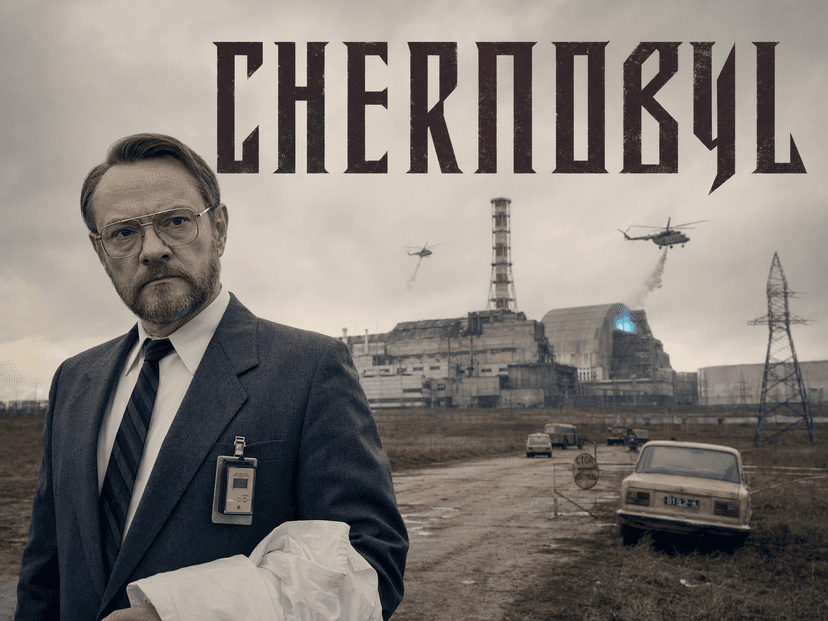
Chernobyl is the five-part HBO and Sky Atlantic miniseries that aired across May and June 2019, written by Craig Mazin and directed by Johan Renck. Five episodes. No filler. It dramatises the April 1986 explosion of Reactor 4 at the Chernobyl Nuclear Power Plant in Soviet Ukraine, the chaos of the first hours, the weeks of cleanup that followed, and the official inquiry that tried to make sense of why it happened.
The premise is history. You know how this ends before you press play. What Chernobyl does is take a story the West mostly remembers as a footnote and drag you inside it. The control room at the moment of the explosion. The fire brigade arriving at a roof that is killing them. An apartment window in Pripyat where a young wife watches the plume and thinks the colours are beautiful. Jared Harris as nuclear physicist Valery Legasov, Stellan Skarsgård as Council of Ministers deputy chairman Boris Shcherbina, and Emily Watson as Ulana Khomyuk, a composite scientist Mazin created to represent the dozens of Soviet researchers who worked the accident in real life.
Shot mostly in Lithuania at the then-still-operational Ignalina plant (an RBMK reactor of the same type as Chernobyl's) with additional work in Ukraine, the series carries a visual authenticity that CGI cannot fake. Soviet tower blocks, corridors, and signage, all shot on location rather than reconstructed. The world the show inhabits is the world as it actually was.
Jared Harris carries the whole thing. Legasov is not a heroic part in any conventional sense. He is a middle-aged academic forced into a room full of generals and commissars and told to explain what cannot yet be explained, and Harris plays him as a man who understands the science is going to kill him and the politics might kill him faster. It is one of the most controlled lead performances in modern prestige television.
Stellan Skarsgård as Shcherbina is the other axis. He arrives as the Party man assigned to keep Legasov in line, the state's eyes and ears, and what Skarsgård does with the role across five episodes is properly great acting. The transformation from enforcer to ally is earned slowly, in small gestures. Emily Watson as Khomyuk is the moral conscience of the series, the scientist who asks the questions the state does not want asked.
The supporting ensemble is where the show widens into something bigger:
Jessie Buckley
Lyudmilla Ignatenko
Sam Troughton
Aleksandr Akimov
Mark Lewis Jones
Andrei Glukhov
Robert Emms
Leonid Toptunov
Emily Watson
Ulana Khomyuk
Adam Nagaitis
Vasily Ignatenko
David Dencik
Mikhail Gorbachev
Paul Ritter
Anatoly Dyatlov
Adrian Rawlins rounds out the ensemble. Every face in this show looks like it belongs to 1986 and not 2019, which is rarer than it sounds.
The surface story is a nuclear accident. The actual story, the one the show keeps circling back to, is what it costs when a system refuses to admit a problem exists. Mazin's script makes this explicit in its opening minutes and closing minutes, and everything in between demonstrates it. The reactor did not fail because the technology was uniquely bad. It failed because people with authority over the technology had been trained their entire careers not to report bad news up the chain. When Legasov says "the cost of lies" at the end, it is not a speech. It is a diagnosis.
That makes Chernobyl a Soviet story on the surface and a universal one underneath. If you have watched Dopesick, you have seen the same shape applied to Purdue Pharma and the opioid crisis. If you have watched The Wire, you have seen the same institutional failures rendered through Baltimore's police, schools, and docks. Chernobyl makes the theme explicit in a way those shows almost never do, partly because its characters live inside a system where speaking plainly is itself a dangerous act.
What is the cost of lies? It is not that we will mistake them for the truth. The real danger is that if we hear enough lies, then we no longer recognise the truth at all.
That line, delivered by Harris in voiceover, is the show's whole argument in 40 words.
Renck, best known before this for music videos and a handful of Breaking Bad episodes, shoots the disaster with a muted, de-saturated palette that feels more like a documentary than a drama. Natural light where possible. Long static shots. No score-driven emotional cues telling you how to feel. Hildur Guðnadóttir's Emmy-winning soundtrack was recorded inside a functioning power station in Lithuania, layering the mechanical groan of the real thing under the action.
The set pieces land because the show refuses to sensationalise them. The fire on the roof of Reactor 3. The hospital scenes in Moscow. The evacuation of Pripyat. The miners working underground in conditions no human should have to work in. The section of the series that has become known online as the Bridge of Death. Each of these is staged with a kind of documentary restraint that makes the horror feel larger, not smaller.
There are specific sequences I do not want to describe in detail for readers who have not seen it yet. The show deserves that courtesy. The short version: it earns every difficult moment by refusing to editorialise over it.
Chernobyl swept the 2019 Emmys, taking Outstanding Limited Series, Outstanding Directing for Renck, and Outstanding Writing for Mazin. It sits at the very top of most "greatest miniseries" lists, usually in conversation with Band Of Brothers, The Pacific, and The Night Of. It briefly pulled the highest audience score on IMDb of any television series in the platform's history.
Its cultural footprint outside television was bigger than almost any HBO drama in memory. Visits to the actual Exclusion Zone spiked. Ukrainian and Russian historians pushed back, sometimes fairly and sometimes not, on the show's compressions and composites. Belarus banned it. The Kremlin reportedly considered commissioning a counter-narrative. You don't get that kind of reaction from a show that missed.
For viewers used to American or British institutional drama, it also opened a door. If the Soviet setting was the hook, shows like The Americans offer a tonally adjacent deep dive on the same era from the inside.
Chernobyl works because it trusts its audience. It refuses to translate Soviet officialdom into something more palatable, refuses to cast its Russian and Ukrainian characters with Russian accents (everyone speaks in their own regional British or Scandinavian voice, and after about ten minutes you stop noticing), and refuses to give you a tidy ending. The KGB is present throughout but rarely loud. The real antagonist is always the system itself.
Five episodes. No wasted minutes. One of the strongest things HBO has made and the benchmark against which every prestige miniseries since has been measured. I would recommend it to anyone who can take a serious story told seriously. You will not be the same person when you finish it, which is a thing you can only say honestly about a handful of television shows.
Jared Harris
Valery Legasov
Con O'Neill
Viktor Bryukhanov
Barry Keoghan
Pavel
Adrian Rawlins
Andrei Stepashin
Fares Fares
Bacho
Alan Williams
Zborovsky
Stellan Skarsgård
Boris Shcherbina