2004 - 2010

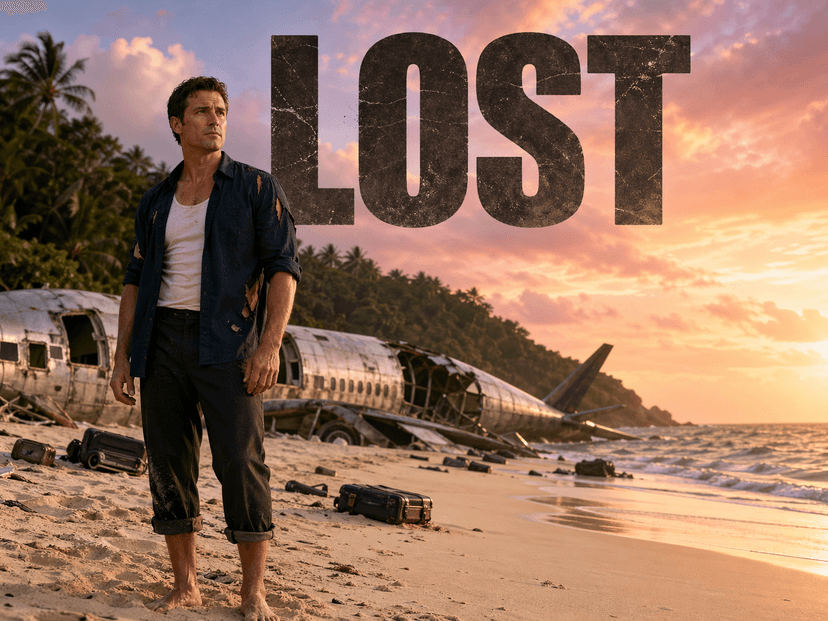
Lost premiered on ABC in September 2004 and ran for six seasons and 121 episodes before wrapping in May 2010. It was created by J.J. Abrams, Damon Lindelof, and Jeffrey Lieber, and for most of its run it was the most talked about drama on broadcast television. The premise is a single sentence pitch. A commercial airliner, Oceanic Flight 815, goes down in the middle of the South Pacific, and the forty-odd survivors pull themselves out of the wreckage onto a tropical beach that is not what it seems.
From there the show does something network TV had never really committed to before. It treats its own mysteries as the plot. Polar bears in the jungle. A pillar of black smoke that thinks. A hatch buried in the ground. Six numbers, 4 8 15 16 23 42, that keep showing up in places where six random numbers have no right to show up. The Island, as the survivors start calling it, rewards curiosity and punishes assumption, and that is also a fair description of how the show treats you.
The ensemble was the other reason Lost worked. Matthew Fox carried the lead as Jack Shephard, a spinal surgeon suddenly in charge of a beach full of strangers. Across from him, Terry O'Quinn played John Locke, a man with a wheelchair in his backstory and the closest thing the show has to a true believer. Their philosophical argument about what the Island is and what the survivors should do about it is the spine of the series. O'Quinn won the Emmy for it in 2007.
Around those two, the show built out what might be the deepest bench in 2000s network TV:
Season two brought in Michael Emerson as Ben Linus, a part originally written for a short arc that expanded once the writers saw what Emerson could do with it. He won his Emmy in 2009. Henry Ian Cusick arrived at the same time as Desmond Hume, a Scotsman whose introduction is one of the great TV reveals of the decade. Seasons three and four added Elizabeth Mitchell as Juliet Burke, Nestor Carbonell as Richard Alpert, Jeremy Davies as Daniel Faraday, Ken Leung as Miles Straume, and Jeff Fahey as Frank Lapidus, the helicopter pilot who walks onto the show in cargo shorts and immediately feels like he has been there for years. Mark Pellegrino and Titus Welliver arrived later still, playing figures the show had been building toward since the pilot.
Matthew Fox
Jack Shephard
Terry O'Quinn
John Locke
Evangeline Lilly
Kate Austen
Jorge Garcia
Hugo "Hurley" Reyes
Daniel Dae Kim
Jin-Soo Kwon
Yunjin Kim
Sun-Hwa Kwon
Naveen Andrews
Sayid Jarrah
Dominic Monaghan
Charlie Pace
Plot and mystery get the press, but Lost is a character show first. Every episode picks one survivor and drops into their life off the Island through flashback, and by the end of season one you understand why these particular forty-odd people are a group worth spending six years with. The flashback structure mutates across the run into flashforwards and then into something stranger, and each variation is a deliberate formal choice tied to what the story is doing thematically at that moment.
The ideas the writers keep returning to are faith and doubt, fate and chance, fathers and sons, forgiveness and the chance to start again. Jack and Locke argue about whether the Island has a purpose or is just rock and jungle that happens to be weird. The show never really lets either of them win, and that refusal to resolve is the point.
Lost is a religious show about whether religion is a trick. Run that through good actors and a mystery plot and you get six seasons of television people still argue about.
Shot in Oahu for the entire run, Lost used the Hawaiian jungle as a character. The cinematography leans on wide greens, grey ocean, and warm firelight at night, and a lot of the show's mood comes from how cheap and how total that contrast feels. Michael Giacchino wrote the score, and his use of solo strings over the closing moments of an episode became a signature. When a Giacchino cue starts up under a long lingering close-up, you know an act break is coming and you know you will be sitting with it all week.
The production also played with form in ways that broadcast drama rarely allowed. Pre-credit cold opens in black. Episodes told backwards. A whole hour built around characters the show had not introduced yet. Not every experiment lands, but the willingness to experiment is part of why the show is remembered.
Lost won the Primetime Emmy for Outstanding Drama Series for its first season. It collected Golden Globes, SAG awards, Peabodys, and a pile of individual acting Emmys across the run, and at its peak it was averaging over twenty million viewers an episode in the US. It was appointment viewing in a era just before streaming made appointment viewing optional.
The finale is where the conversation gets complicated. When The End aired in May 2010, half the audience loved it and half felt cheated that certain questions never got the answers they had been chasing for six years. Damon Lindelof spent the next decade fielding questions about it. I am in the camp that thinks the finale works on its own terms and that the people who wanted a physics lecture were always going to be disappointed, but I will not pretend the criticism has no legs.
What is not in dispute is the cultural footprint. Lost invented the modern mystery-box drama as a format. Every show since that drops an audience into a high-concept puzzle and trusts them to stick around owes it a debt. Westworld is Lost with robots. Severance is Lost in an office. Manifest is Lost with the plane landed. Stranger Things took the ensemble-plus-mythology structure and ran with it. The DNA is everywhere.
Watch Lost now and the pilot still plays. That first hour, directed by J.J. Abrams himself, is maybe the most expensive and confident opening episode any network show has ever shot, and sixteen years on it has lost none of its pull. The mid-run sags a little. Season three takes a while to find its feet and there is a stretch of back half filler that the writers have openly admitted was a scheduling problem with the network. Once ABC agreed an end date, the show tightens up and the final stretch is some of the most ambitious broadcast TV of its era.
Cold open. The sound of breathing. A man's eye opens in the jungle.
If that still works on you, and it will, the rest of the show is waiting.
Emilie de Ravin
Claire Littleton
Malcolm David Kelley
Walt Lloyd
Ian Somerhalder
Boone Carlyle
Maggie Grace
Shannon Rutherford
L. Scott Caldwell
Rose Henderson Nadler
Sam Anderson
Bernard Nadler
Michael Emerson
Ben Linus
Henry Ian Cusick
Desmond Hume
Nestor Carbonell
Richard Alpert
Jeremy Davies
Daniel Faraday
Ken Leung
Miles Straume
Jeff Fahey
Frank Lapidus
Mark Pellegrino
Jacob
J.J. Abrams
Co-creator
Damon Lindelof
Co-creator / Showrunner
Jeffrey Lieber
Co-creator
Josh Holloway
James "Sawyer" Ford
Harold Perrineau
Michael Dawson
Elizabeth Mitchell
Juliet Burke
Titus Welliver
Man in Black