2015 - 2017

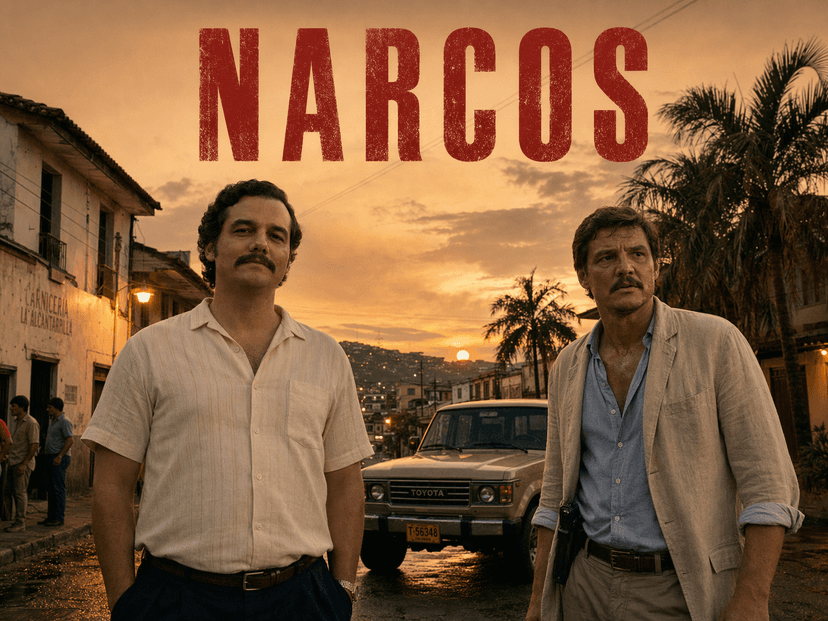
Narcos landed on Netflix in August 2015 and ran for three seasons through 2017, 30 episodes in total, created by Chris Brancato, Carlo Bernard, and Doug Miro. It dramatises the cocaine trade in Colombia across two distinct arcs. Seasons one and two trace the rise and reign of Pablo Escobar and the Medellín Cartel, told largely through the eyes of two DEA agents, Steve Murphy and Javier Peña, working out of the US embassy in Bogotá. Season three pivots to the Cali Cartel, the so-called "gentlemen of Cali", who ran the cocaine business quieter, smarter, and for a while more profitably than Escobar ever did.
The show is bilingual by design. Roughly half of the dialogue is in Colombian Spanish, subtitled, and that decision is the whole point. Netflix could have made a glossy English-language crime drama about Escobar. Instead they made something that feels closer to the actual texture of the place and the era. Cocaine. American foreign policy. Colombian politics. And very specific people doing very specific things. The war on drugs told from both sides of the wire.
Wagner Moura carries the first two seasons as Pablo Escobar and it is one of the great lead performances of the streaming era. Moura is Brazilian, not Colombian, and had to learn Spanish for the role. He also put on over forty pounds to hit Escobar's late-career bulk. What he does with it is what matters. Moura plays Escobar as a family man, a populist politician, a killer, and a cornered animal, sometimes inside the same scene, without ever letting the performance tip into caricature. I spent the first two episodes waiting for it to tip. It never does.
Pedro Pascal and Boyd Holbrook play the American DEA agents. Holbrook's Steve Murphy is the narrator of seasons one and two, a Kentucky-born straight arrow who starts out wide-eyed and ends up compromised by the work. Pascal's Javier Peña is the Mexican-American partner who knows the region, speaks the language, and carries the show into season three as the lead when the Cali arc begins. I'd watched Pascal on Game of Thrones and not quite clocked what he could do. Here I did.
The supporting ensemble is where the show earns its credibility:
Paulina Gaitán
Tata Escobar
Wagner Moura
Pablo Escobar
Boyd Holbrook
Steve Murphy
Juan Pablo Raba
Gustavo Gaviria
Matias Varela
Jorge Salcedo
Damián Alcázar
Gilberto Rodríguez Orejuela
Alberto Ammann
Hélmer "Pacho" Herrera
Francisco Denis
Miguel Rodríguez Orejuela
This is an ensemble picked for regional authenticity, not Hollywood name recognition, and the show is stronger for it.
On the surface Narcos is a cops-and-kingpins story. Scratch it and you find something harder to sit with. The series argues, methodically, that US drug policy from Nixon through Clinton did not just fail to stop cocaine. It actively created the conditions for cartels to become states-within-states, destabilised Colombian democracy for a generation, and killed tens of thousands of people who were not drug dealers. The DEA agents at the centre of the show are not portrayed as simple heroes. They are complicit in bad alliances, questionable tactics, and outcomes that look less and less clean the further you get from Escobar's palace.
There is a recurring idea the show keeps circling back to. Plomo o plata. Lead or silver. The choice every Colombian judge, cop, journalist, and politician was offered by the cartels. Take the bribe or take the bullet. Narcos is interested in what happens to a country when that becomes a default economic reality, and in the Americans who flew down to "help" without understanding any of it.
Visually the show commits to period and place. Medellín in the 1980s. Bogotá. Cali. Miami seen from the dealer's end rather than the Miami Vice end. Production shot extensively on location in Colombia, with the hazy tropical light, rainstorms, concrete government buildings, and humid nightclubs that give everything a specific gravity. The costuming moves from 70s paramilitary to 80s excess to early-90s corporate slick as the Cali era replaces the Medellín one.
The soundtrack leans heavily on the Colombian folk tradition Rodrigo Amarante's title theme "Tuyo" sits inside, bolero-adjacent and genuinely beautiful, one of the best TV title songs of the last twenty years. Episode scores pull from salsa, cumbia, and period Latin pop rather than the usual prestige-drama orchestral template. A small choice that does a lot of work.
Pacing-wise the show runs hot. Ten-episode seasons, very little filler, plenty of voiceover to keep the historical machinery moving. Some of the voiceover is a crutch and a fair criticism says the narration occasionally does the show's thinking for it. The trade-off is clarity. You always know who you are watching and why it matters.
Critics took the show seriously from episode one. Wagner Moura earned Golden Globe nominations for best actor in a drama series two years running. Narcos became a flagship title for Netflix internationally at a moment when the platform was trying to prove it could produce non-English-language prestige drama at scale. It did. Watch what came after and you can see the line running straight through Narcos to Money Heist, Lupin, Dark, and the rest of the Netflix non-English slate.
It also built a small franchise. Narcos: Mexico picked up in 2018 with a fresh cast and a shift north to the Guadalajara and Sinaloa trade, running another three seasons to 2021. If you finish the original and want more, Narcos Mexico is the obvious next stop. For adjacent viewing, the Mexican-set El Chapo covers similar ground from a telenovela angle, and Gomorrah delivers the European equivalent with the Neapolitan Camorra.
The simple version: a true-crime story that respects how complicated the truth is. Narcos refuses to flatten Escobar into a monster or elevate him into a Robin Hood. It refuses to let the DEA off the hook for the damage the war on drugs did to Colombia. It casts regional actors and shoots on location. It commits to subtitles and trusts the audience to keep up. That combination was rare on American TV in 2015 and is still rare now.
The best compliment I can pay it is that after three seasons you understand why someone growing up in a Medellín barrio in 1985 might have seen Pablo Escobar as a saviour, even if you also understand exactly what he was doing.
Fans of Breaking Bad will find the same moral gravity here, told at a higher altitude and with more actual history behind it. Fans of Gomorrah will recognise the refusal to glamorise. And if you liked Ozark for its cartel-adjacent tension, this is the show Ozark is nervously glancing at across the border.
Pêpê Rapazote
Chepe Santacruz Londoño
Pedro Pascal
Javier Peña