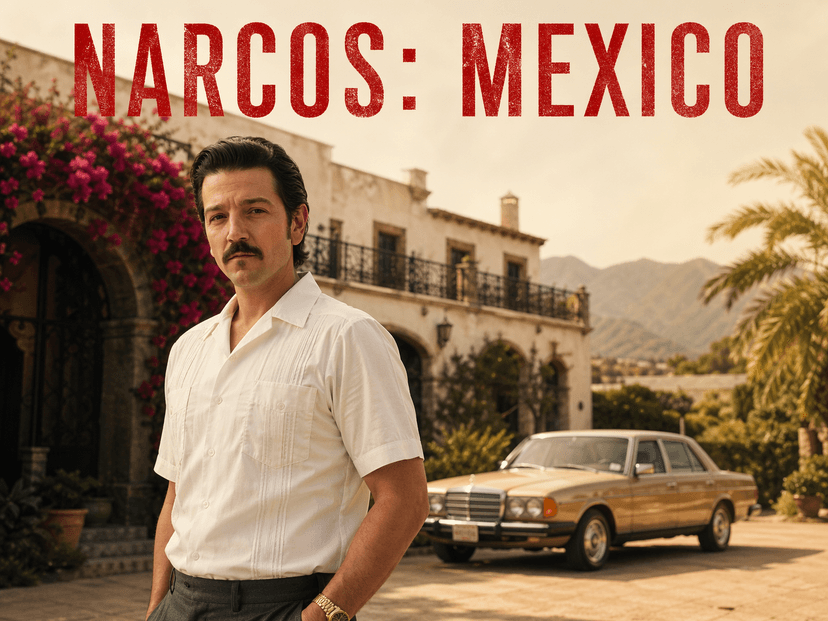
2018 - 2021

Narcos: Mexico arrived on Netflix in November 2018 as a companion piece to Narcos, shifting the franchise's focus from Colombia to the country that became the world's main cocaine corridor in the 1980s. Across three seasons and thirty episodes, the show traces the birth of the modern Mexican drug trade: the rise of the Guadalajara Cartel, and its eventual fracture into the Sinaloa Cartel, the Tijuana Cartel (also known as the Arellano Félix Organization), and the Juárez Cartel, plus the long, mostly losing war the DEA waged across the US-Mexico border.
Chris Brancato, Carlo Bernard, and Doug Miro created the series. They were the same team behind the original Narcos, and the DNA shows: the same docu-dramatic voiceover set over grainy archival footage, and the same willingness to make you root briefly for terrible people before reminding you what they actually do. By season three, Bernard had taken over as sole showrunner and the story had grown into something bigger and colder than the personal saga it started as.
Season one belongs to Diego Luna as Miguel Ángel Félix Gallardo, the soft-spoken Sinaloan who consolidates the country's smugglers into one federation, and to Michael Peña as DEA agent Kiki Camarena, whose investigation closes in on that federation from the Guadalajara field office. Season two follows the consequences of that collision. Season three walks away from Félix almost entirely and hands the story to the next generation: the Arellano Félix brothers and sister in Tijuana, Amado Carrillo Fuentes in Juárez, and a young Joaquín "El Chapo" Guzmán in Sinaloa.
Diego Luna carries the first two seasons. His Félix Gallardo is a quiet, watchful operator, nothing like the flamboyant cartel bosses American TV usually serves up, and that quietness is the point. You spend two seasons trying to read a man who rarely raises his voice and frequently wins arguments by walking out of the room.
Michael Peña is the other anchor of season one. His Kiki Camarena is an idealistic DEA agent who believes the job is winnable and keeps believing it past the point where anyone else would stop. Peña plays him with the plainness of a real person rather than a TV hero, which is a harder performance than it looks.
The Mexican ensemble around them is where the show finds most of its texture:
Alejandro Edda
Joaquín "El Chapo" Guzmán
Scoot McNairy
Walt Breslin
Michael Peña
Kiki Camarena
Mayra Hermosillo
Enedina Arellano Félix
Joaquín Cosío
Ernesto "Don Neto" Fonseca Carrillo
Diego Luna
Miguel Ángel Félix Gallardo
Alfonso Dosal
Benjamín Arellano Félix
Matt Letscher
James "Jaime" Kuykendall
Scoot McNairy arrives in season two as DEA agent Walt Breslin and narrates the show through that season before Luisa Rubino takes over in season three as the journalist Andrea Nuñez, a composite character inspired by reporters at the Tijuana newspaper La Voz. Matt Letscher plays James "Jaime" Kuykendall, the real-life head of the Guadalajara DEA office, recurring across all three seasons as the institutional memory of the American side of the story.
The surface answer is cocaine. The actual answer is plazas, money, and the quiet corruption that makes a cartel possible in the first place. Narcos: Mexico is strongest when it gets bored of gunplay and shows you a lunch meeting between a Federal Security Directorate official and a Sinaloan farmer, or a wire transfer through a bank in Cayman, or a ribbon-cutting where the governor shakes hands with the man paying his campaign debts.
Season one is an origin story about a single federation. Season two is about what happens when the American half of the equation discovers it cannot lose a war. Season three is about fragmentation: how a one-man operation turns into four or five regional fiefdoms and how that multiplication doesn't reduce violence but industrialises it.
I went in expecting a Mexican Breaking Bad and got something slower and harder to digest. If you came to the show looking for cook sequences or Breaking Bad's chemistry fetish, you'll be disappointed. The show is not interested in how the drug is made. It is obsessed with how the drug moves and who gets paid along the way. That is a more political story and a less sensational one, and the show is stronger for the trade-off.
The cinematography leans warm and dusty in the Guadalajara years, then cools into steel blues and fluorescent greens as the story moves north to Tijuana and Juárez in the later seasons. Every season opens with the trademark franchise voiceover delivered over grainy news footage and period photographs, a device that was already familiar from the parent show but still works because it anchors the drama in something that actually happened.
The Spanish-language dialogue is a real strength. Roughly half the show plays in Spanish with subtitles, and the Mexican cast is almost entirely made up of Mexican actors rather than the pan-Latin substitution American productions often fall back on. The accent work is credible in a way that matters. You believe these men are from Sinaloa and Culiacán and Tijuana, not from a casting pool somewhere in Los Angeles.
The violence is handled with restraint most of the time and with brutal directness when it isn't. The show understands that too much stylisation makes the deaths meaningless, and pulls back from it more often than its peers in the genre.
Critics were broadly positive across all three seasons. Diego Luna's central performance drew the strongest reviews, and the show held an 8.3 IMDb score across its run. Industry reception was warmer for seasons one and two than for three, where the absence of Luna's character as the central gravity left some viewers cold even as the storytelling got more ambitious.
The show sits in a crowded subgenre. El Chapo, Telemundo's rival series, ran in parallel for part of the same window and covered overlapping ground from a Mexican production's angle. Conversations about cartel drama on television almost always loop back to Narcos as the founding text and Narcos: Mexico as its more mature sibling. Fans of the broader genre will recognise the interest in institutional corruption from Gomorrah and the moral drift of outsiders pulled into a criminal economy from Ozark.
The real subject is not drugs but the machinery of power that drugs fund.
Narcos: Mexico is the rare prequel-spin-off-companion that earns its existence instead of coasting on the parent show's goodwill. Diego Luna gives it a central performance that holds two seasons together without ever straining for drama, the Mexican ensemble around him is deep and specific, and Scoot McNairy's season-two narration is one of the most enjoyable voice performances of the Netflix era. I binged the first season in a weekend. Season two I took my time with. Season three I watched in two sittings.
If you came through Narcos and wondered what happened north of the border, this is the answer. If you missed the original and want to start here, you can. The show does the homework of introducing the Mexican side of the trade without assuming you've read a textbook or seen a previous season, which is a kindness not every prequel extends.
Tenoch Huerta
Rafael "Rafa" Caro Quintero
José María Yazpik
Amado Carrillo Fuentes