2017 - 2021

La Casa de Papel, known to most of the world as Money Heist, is the Spanish crime thriller that accidentally became a global phenomenon. Created by Álex Pina, it first aired on Antena 3 in Spain across 2017 and 2018 and was, by all accounts, dying in the ratings. Then Netflix bought the international rights, recut the episodes into tighter half-hour blocks, dropped it worldwide, and the thing caught fire. Five parts. Forty-one episodes. At one point the most-watched non-English series Netflix had ever streamed.
The premise is pulp heist cinema stretched into long-form TV. A criminal mastermind known only as the Professor recruits a crew of eight thieves, each assigned a city as a codename. Tokyo. Berlin. Moscow. Rio. Denver. Helsinki. Oslo. Nairobi. Later additions bring in Bogotá, Palermo, and Marseille. The plan in parts one and two is audacious and specific: seize the Royal Mint of Spain, take hostages, hold off the police for as long as it takes to print 2.4 billion euros of their own escape money. Parts three to five raise the stakes with a second job on the Bank of Spain.
The show lives or dies on its ensemble, and the ensemble mostly carries it.
Parts three onwards bring Rodrigo De La Serna as Palermo, an old associate of Berlin with an ego to match, and Najwa Nimri as Alicia Sierra, a pregnant police negotiator who is easily the most enjoyable antagonist of the later seasons. I rate Nimri above the entire core cast for sheer watchability in the back half.
Hovik Keuchkerian
Bogotá
Darko Perić
Helsinki
Esther Acebo
Stockholm / Mónica Gaztambide
Pedro Alonso
Berlin / Andrés de Fonollosa
Úrsula Corberó
Tokyo
Miguel Herrán
Rio
Najwa Nimri
Alicia Sierra
Alba Flores
Nairobi
On the surface this is a caper. Vaults, hostages, standoffs, disguises. Scratch it and what you actually have is a class-war fable dressed up in heist costume. The Professor's core pitch to the gang is that stealing from a mint is not theft because no person loses anything. They are just printing more of the same paper the state prints. Written during the long hangover from Spain's post-2008 economic crisis, the show takes real anger at banks and austerity and funnels it into a gang of masked underdogs thumbing their nose at the establishment.
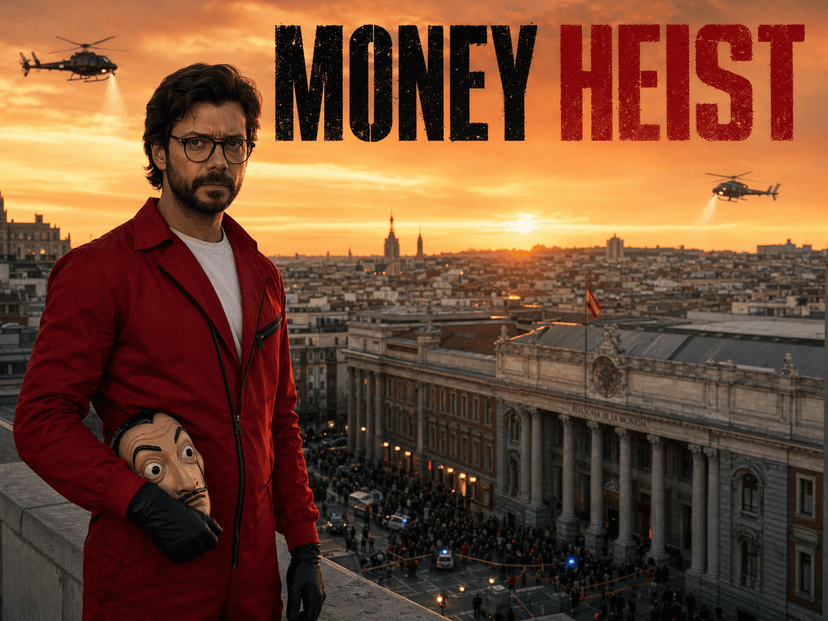
The imagery is inseparable from the politics. Red jumpsuits. Salvador Dalí masks. The anti-fascist Italian partisan song Bella Ciao turned into a defiant anthem blasted in celebration, in grief, in every key moment the show wants to mark. The choice of song tells you exactly where the writers sit.
Then there is the family-under-pressure drama. Romances inside the gang. Old wounds between the Professor and Berlin. Parents worrying about kids they cannot reach. For a show about robbing central banks, a surprising amount of screen time is given to characters crying in stairwells.
Pina and his directors commit hard to a look. The red jumpsuits are iconic for a reason. The masks are genuinely unsettling in wide shots. The flashback scenes on the Professor's training island are shot in a washed-out Mediterranean palette that acts as a visual breather from the fluorescent tension of the vault. The camera likes long tracking moves through corridors. The score goes full operatic when it needs to and then cuts to total silence for the actual key beats.
It is one of the most visually branded shows of the streaming era. You can identify a Money Heist frame from three rooms away.
The show's second life on Netflix is one of the great accidents of modern television. Picked up, recut, repackaged, released, global hit. It won an International Emmy for Best Drama Series in 2018, spawned a Korean adaptation titled Money Heist: Korea - Joint Economic Area, a prequel spin-off titled Berlin, and a reality competition called Money Heist: The Experience. The jumpsuits became a Halloween costume on every continent. Bank-protest iconography absorbed the masks.
Critical opinion fractured somewhere around part three. Fans of the tight, near-claustrophobic mint siege of parts one and two were less sold on the ballooning scope of the Bank of Spain arc, which leans harder into soap plotting and improbable escapes. My own hunch is that parts one to two are a near-perfect heist show and parts three to five are a different, sloppier, still entertaining thing wearing the same jumpsuit.
It works because it takes a structure that should have stayed a film and uses the extra room to let you fall for the crew. You know the Professor is going to be three steps ahead. That is not the question. The question is whether Helsinki can keep Oslo standing, whether Tokyo can stop being her own worst enemy, whether the thing Berlin is hiding will finally cost him. The stakes are emotional more than mechanical, which is why the show still hits even when the plot twists stop making literal sense.
If you liked the crime-caper moral fog of Lupin, you will find the same dressed-up thief energy here. Viewers who got pulled in by the survival-horror social commentary of Squid Game are in the same broad emotional territory, and anyone who came to non-English prestige TV through Narcos should try Money Heist next. For all its wobbles in the back half, it earned its red jumpsuit.
Enrique Arce
Arturo Román
Álvaro Morte
The Professor / Sergio Marquina
Jaime Lorente
Denver
Álex Pina
Creator / Showrunner
Itziar Ituño
Raquel Murillo / Lisbon
Rodrigo De La Serna
Palermo