2019 - 2019

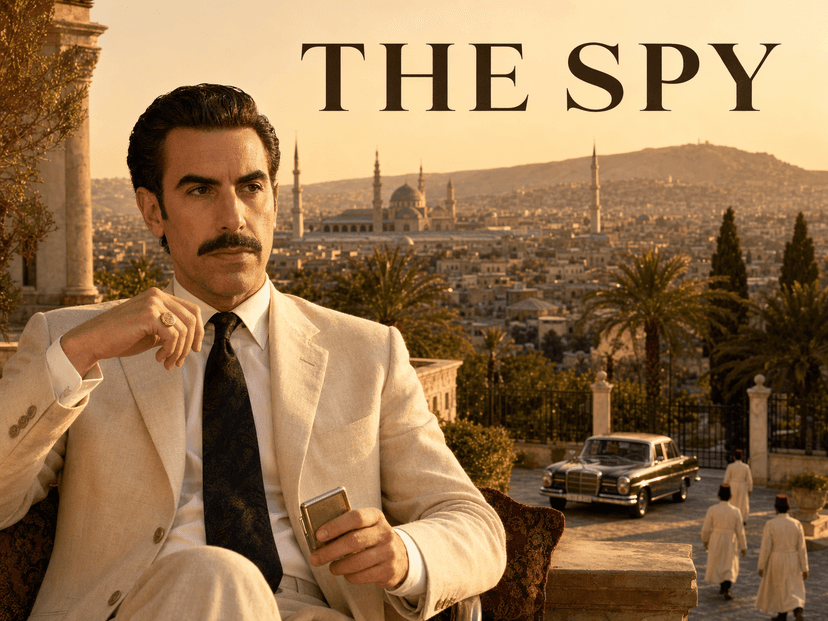
The Spy is a six-episode Netflix limited series from 2019, created, written and directed by Gideon Raff, the Israeli showrunner behind Prisoners of War (the Hebrew original that Homeland was based on). It tells the true story of Eli Cohen, the Egyptian-born Israeli who walked into Mossad as a jilted applicant, walked out a trained field operative, and spent the next several years of his life in Damascus pretending to be a wealthy Syrian expatriate named Kamel Amin Thaabet.
Cohen's mission was to get close to the Ba'ath Party regime and feed intelligence back to Tel Aviv. He did it so well he ended up as a trusted advisor to the Syrian government and, by some accounts, was nearly made deputy defence minister. The intelligence he sent home about Syrian military positions on the Golan Heights is generally credited with shaping Israel's decisive victory in the Six-Day War of 1967, two years after Cohen himself had been captured by Syrian counterintelligence.
Sacha Baron Cohen plays Eli Cohen in a performance that functions as his formal pivot from comedy into serious dramatic work. Not a trace of Borat here. No Ali G, no Brüno. He is quiet, watchful, exhausted. He is a man wearing a second skin for years on end, and you can see the cost building behind his eyes across the six episodes. The Golden Globe nomination he picked up for the role was well earned.
The supporting ensemble does a lot of heavy lifting:
Yael Eitan, Alona Tal, Uri Gavriel, Stanley Townsend and Nassim Lyes round out the Syrian and Israeli sides of the story. Everyone knows what show they are in.
Moni Moshonov
Jacob Shimoni
Hadar Ratzon Rotem
Nadia Cohen
Alona Tal
Julia Schneider
Sacha Baron Cohen
Eli Cohen / Kamel Amin Thaabet
Uri Gavriel
Sheikh Majid Al Ard
Noah Emmerich
Dan Peleg
Alexander Siddig
Ahmed Suidani
Gideon Raff
Creator / Writer / Director
On the surface this is a prestige espionage drama and a thorough, respectful adaptation of one of the most famous true-life spy stories of the 20th century. Read it another way and it is about the permanent damage that deep-cover work does to the person doing it.
Kamel Amin Thaabet is not a mask Eli Cohen can take off at the end of a shift. He lives as Kamel for years. He drinks as Kamel, hosts parties as Kamel. Shares confidences with powerful men as Kamel. By the middle of the series Cohen is no longer sure which version of him is the real one. There are scenes where he returns to Tel Aviv on brief leave and quite literally cannot settle into his own home. Baron Cohen plays those scenes with a kind of shell-shocked numbness.
Nadia's strand of the story adds the second half of the argument. She has a husband who keeps vanishing for months at a time, returning with expensive gifts and no explanations, and she has been explicitly warned off asking questions. It is a study in what happens to the family of a covert operative when the operative's cover matters more than the marriage.
The real trick of the show is that it takes a story whose ending is already in the historical record and still makes you hope, against your better judgement, that it will go differently this time.
Raff shoots the series with a surface gloss that recalls prestige European cinema more than American TV. The Damascus scenes (mostly filmed in Morocco, with some Hungarian interiors) are full of warm courtyards, tailored suits, cigar smoke and expensive whisky. The Tel Aviv scenes are colder, more domestic, and deliberately plain. Two worlds, two colour palettes, one man caught between them.
The pacing is patient in a way modern streaming rarely allows. Episodes breathe. Scenes of dinner-party conversation are given real time to turn. When tension spikes in the final third, it lands harder because Raff has spent hours earning it. If anything the series could have comfortably been eight episodes rather than six. Some beats in the back half feel slightly compressed.
Critics were kind. An 86% Rotten Tomatoes score, broad praise for Baron Cohen's performance, a Golden Globe nomination. In Israel the response was more complicated, partly because Eli Cohen is a national hero and any dramatisation of his story arrives with a lot of baggage, and partly because the series makes respectful but not hagiographic choices. It is interested in the man more than the legend.
The show has held up well. In a streaming era flooded with spy thrillers where the tradecraft is window dressing on an action plot, The Spy still feels unusually disciplined. It is a spy show about the actual work of being a spy. Compare with The Night Manager or A Spy Among Friends for the same register of grown-up espionage storytelling. Fans of Tehran will find similar Middle Eastern political texture. Slow Horses and Spooks approach the genre from a British angle but share the same respect for the unglamorous reality of intelligence work.
The show's biggest risk was asking a comedian to carry six hours of heavy dramatic material about a martyred national hero, and it works because Baron Cohen never overplays it. He trusts the stillness. Trusts the silences, too. He lets Eli Cohen be small and tired. Scared, at the points where a more performative actor would reach for a big moment.
Raff's second gift is pacing. He knows the historical record. He knows the audience largely knows it too. Rather than rushing through the cover story to get to the dramatic crisis, he spends most of the series inside the cover story, because that is where the interesting psychological territory is. The crisis is a consequence, not a surprise.
Watch it back to back with Homeland (which Raff also had a hand in, via the Israeli original) and you see a writer with a genuine, sustained interest in what intelligence work costs the people who do it. For my money, The Spy is maybe the most restrained thing Raff has put his name to. It is also one of the best.
Yael Eitan
Maya
Waleed Zuaiter
Amin al-Hafez
Nassim Lyes
Zaher Ma'azi