2005 - 2013

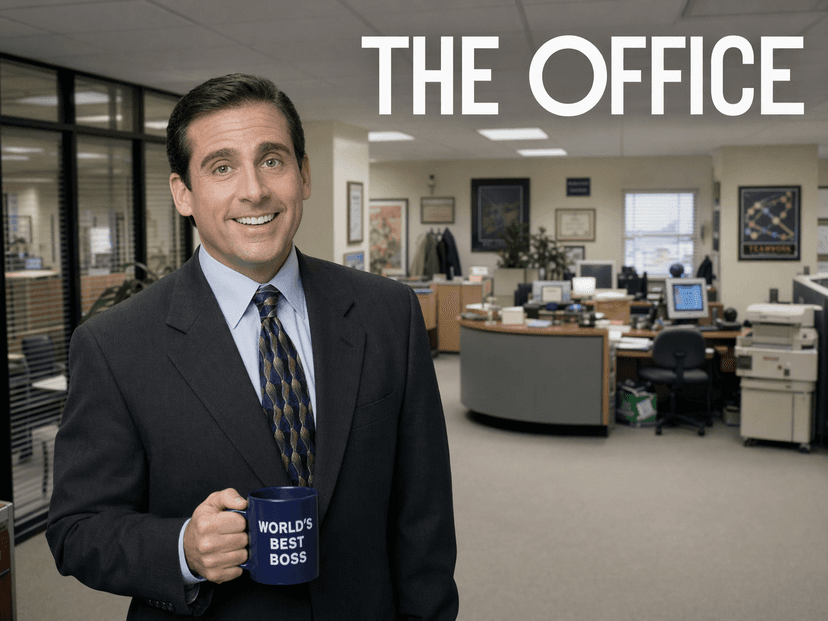
NBC aired The Office from March 2005 to May 2013, running nine seasons and 201 episodes. The show lives inside the fluorescent-lit Scranton, Pennsylvania branch of the Dunder Mifflin Paper Company, a mid-tier paper supplier nobody outside the show has ever needed to think about. A documentary crew has, for reasons never properly explained, decided to film these people at work. For nine years. The conceit is the engine. Every awkward silence gets the same straight-face delivery. The same goes for every glance at the camera. And every cringe. A workplace that does not know it is being watched.
Greg Daniels developed the American version from Ricky Gervais and Stephen Merchant's 2001 BBC original The Office UK, a 14-episode landmark that invented the modern mockumentary sitcom. The pilot here is a near-direct remake and it did not land. If you bailed after episode one in 2005, you were not alone. What saved the show was Daniels and his writers' room quickly deciding that Michael Scott was not going to be David Brent. He would be warmer, needier, lonelier. Steve Carell took that note and built one of the great television performances out of it.
The ensemble is the reason this show still plays twenty years on. Carell anchors the first seven seasons as Regional Manager Michael Scott, a man whose desperate need to be loved by his staff is matched only by his talent for saying the wrong thing in front of HR. Rainn Wilson plays Assistant to the Regional Manager Dwight Schrute, a beet-farming volunteer sheriff's deputy whose loyalty to the company is cult-like. John Krasinski and Jenna Fischer are Jim Halpert and Pam Beesly, the show's sweet centre, a will-they-won't-they that the writers refused to drag out to the point of audience abuse.
Around them: Angela Kinsey as severe Christian accountant Angela Martin, B.J. Novak as temp-turned-whatever Ryan Howard, Ed Helms arriving in season three as Cornell-mouthed a cappella bro Andy Bernard, Mindy Kaling as pop-culture gossip Kelly Kapoor, Phyllis Smith as sweet-natured Phyllis Lapin, Leslie David Baker as the permanently done-with-it Stanley Hudson, Oscar Nunez as dry accountant Oscar Martinez, Brian Baumgartner as chilli-enthusiast Kevin Malone, Kate Flannery as drink-problem Meredith, Craig Robinson as warehouse foreman Darryl Philbin, Paul Lieberstein as HR punching-bag Toby Flenderson (also a writer and executive producer on the show), Melora Hardin as Michael's on-off corporate girlfriend Jan Levinson, and Creed Bratton as himself, a former member of The Grass Roots playing a version of himself with suspicious criminal-past energy.
Later arrivals keep the bench deep. Ellie Kemper joined in season five as receptionist Erin Hannon. James Spader turned up in season eight as the surreal CEO Robert California. Catherine Tate showed up as Nellie Bertram. Rashida Jones crossed over from for a recurring season-three stint as Karen. Ricky Gervais cameos as David Brent himself in one of the most delightful bits of cross-continental fan service in sitcom history.
Steve Carell
Michael Scott
Rainn Wilson
Dwight Schrute
John Krasinski
Jim Halpert
Jenna Fischer
Pam Beesly
Angela Kinsey
Angela Martin
B.J. Novak
Ryan Howard
Ed Helms
Andy Bernard
Mindy Kaling
Kelly Kapoor
Everyone remembers The Office for "That's what she said" and Jim pranking Dwight. Those are the delivery system. The real show underneath is lonelier than people give it credit for. Michael Scott is running away from an empty condo and a void of a personal life by hurling himself at people who would, in another show, be written as antagonists. He loves them. He is terrible at showing it. They slowly, reluctantly, love him back.
The writers understood that a workplace is the second family most adults end up in whether they planned to or not. The show is about that. Co-worker banter, office crushes, the low-grade humiliation of corporate meetings, the way a paper supply company becomes a place where weddings get planned and babies get named. Michael Scott Paper Company, the mid-series subplot where Michael quits to start a rival firm out of his condo, is a tiny perfect arc about what people will risk when the job they built their identity around threatens to disappear.
There is also Threat Level Midnight, the in-show spy movie Michael has been shooting since roughly 1998. An episode finally screens the finished thing. It is a small miracle of committed stupidity and I would rewatch it tomorrow.
Mockumentary as a format is everywhere now. It was not, in 2005. The handheld camera. The talking heads in the conference room. And the zoom-in-on-a-reaction-shot that became a sitcom cliché because of this show. The format gives the writers a cheat code. Every line can be undercut with a face at the camera. Every scene has a second layer. Characters get to comment on their own absurdity without breaking the fourth wall exactly, because the fourth wall is the documentary crew and they are always there.
The show's tonal palette is narrow and perfectly tuned:
The editing rhythm, the low-fi soundtrack, the beige carpet and fluorescent ceiling tiles, all of it is designed to look like the place you worked at the job you had after university and cannot quite believe you stayed at for three years.
The Office was a ratings disappointment for most of its NBC run and a streaming phenomenon after. It topped Netflix's most-watched list for years, became the comfort-rewatch show for an entire generation, and generated a quote-economy on the internet that rivals The Sopranos and Game of Thrones for sheer memetic penetration. Carell won a Golden Globe. The show won an Emmy for Outstanding Comedy Series in 2006. The Dinner Party episode regularly shows up on all-time-best-sitcom-episode lists and deserves the slot.
The show is not flawless across nine seasons. The consensus is that seasons two through seven are the peak, with a slow decline after Steve Carell's departure at the end of season seven. The final two seasons have their moments but most fans agree the show's centre of gravity left when Carell did. That is a fair read. It is also the kind of decline that only looks bad because the top of the run was so high.
The best workplace comedy American television has produced, and a lonelier show than its reputation suggests.
The best test I have for a sitcom is whether I still laugh at episodes I have seen five times. The Office passes it. The writing is generous. The performances are loose in the good way. And the show has an unusual amount of heart for something so willing to lean into cringe. I have rewatched the Christmas episodes more times than I can count. The dinner party, the parkour cold open, the fire drill, Stress Relief part one, all of them still hit.
If you like this register, Parks and Rec is the obvious neighbour, made by some of the same writers and sharing the same warm-hearted small-town DNA. The Office UK is the colder, sharper original and worth a watch even if you know the American version backwards. Ricky Gervais's Afterlife comes from the same creative mind in a very different register. And Mythic Quest is probably the closest thing to a modern Office that has been made since, same workplace-family structure, different offices.
Dunder Mifflin: Limitless paper in a paperless world.
Phyllis Smith
Phyllis Lapin
Leslie David Baker
Stanley Hudson
Oscar Nunez
Oscar Martinez
Brian Baumgartner
Kevin Malone
Creed Bratton
Creed Bratton
Kate Flannery
Meredith Palmer
Craig Robinson
Darryl Philbin
Paul Lieberstein
Toby Flenderson
Melora Hardin
Jan Levinson
Ellie Kemper
Erin Hannon
James Spader
Robert California
Catherine Tate
Nellie Bertram
Rashida Jones
Karen Filippelli
Greg Daniels
Developer / Executive Producer
Ricky Gervais
David Brent (guest)