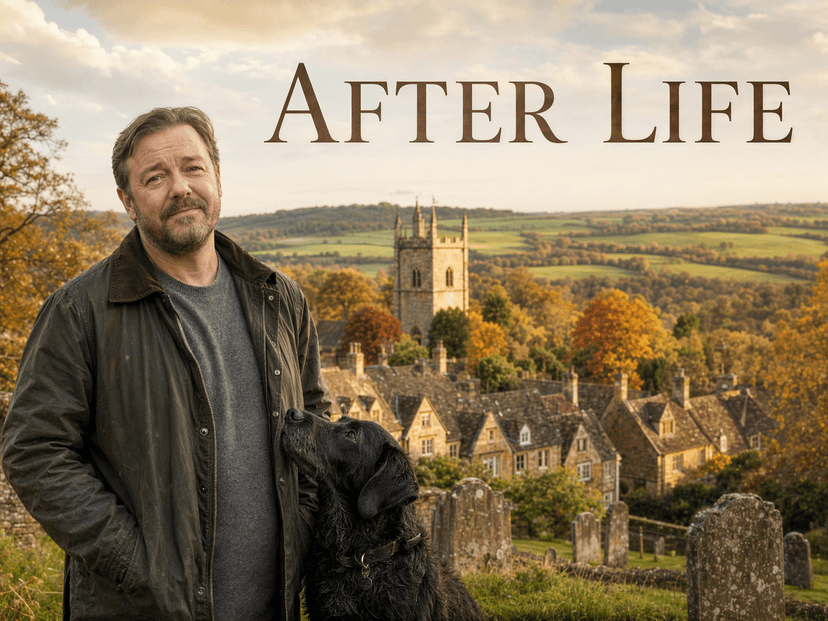
2019 - 2022

After Life arrived on Netflix in March 2019 and ran for three seasons, wrapping on New Year's Day 2022 after eighteen half-hour episodes. Ricky Gervais created it, wrote every episode, and directed the lot as well as starring in it. He has described it as the most personal thing he has ever made. The premise is blunt. Tony Johnson is a features writer at the fictional Tambury Gazette, a free provincial weekly in a small English town. His wife Lisa has died of breast cancer. Tony is left alone in a small house with a rescue dog called Brandy, a growing drink problem, and a plan to kill himself. What stops him, episode by episode, is the inconvenient fact that people and animals keep needing him.
The series became Netflix's most-streamed British original comedy on release and turned a sleepy market town into a regular pilgrimage site for fans. Hemel Hempstead and Camber Sands stand in for Tambury. It sits somewhere between sitcom and drama, with a streak of eulogy running through it. You will hear it called a grief comedy. Accurate, but it undersells how often the show risks sentiment and gets away with it.
Gervais anchors every scene as Tony, sometimes to the show's cost and always to its point. He writes this one. He leads it. He is also the man you spend most of your runtime with, on his own in the kitchen or out on a park bench or sat at a graveside. It is not a performance in the traditional sense. I think it is closer to Gervais stripped of the arch comic distance of Extras or The Office (UK), and it works when you stop waiting for a punchline and start listening.
The cast around him is where the show earns its keep.
Penelope Wilton
Anne
Diane Morgan
Kath
Ashley Jensen
Emma
David Bradley
Ray
Tom Basden
Matt Braden
Ricky Gervais
Tony Johnson
Mandeep Dhillon
Sandy
Tony Way
Lenny
The weekly-newspaper device means Tony and Lenny spend most of the series visiting local eccentrics to write soft features about them, which gives the show a low-key anthology structure inside its own arc. One week it is the woman who claims her rice pudding contains Jesus. The next is a nine-year-old guitarist. Then a widower with a stamp collection. Some of the warmest writing Gervais has ever done lives in these interviews.
The premise is grief. The thesis is kindness. Gervais has been open that the show came out of his own fears. His parents died before he wrote it, and he has spoken in interviews about his terror at the idea of outliving his partner Jane Fallon. After Life puts that fear on screen directly. Tony's argument for the first season is that nothing matters once the person you love most is gone, so you can behave exactly as you like. The show spends three seasons quietly taking that argument apart.
What it puts in its place is not religion. It is not therapy, and it is not ambition either. It is the people who happen to be nearby and the small ways they need you. The dog that needs feeding. The postman who keeps turning up whether you want him or not. The widow on the bench. The colleague you secretly respect. And that is a very old argument well made, and it tends to be the only kind worth making.
Visually the show is restrained. Flat English light. Muted interiors and a provincial high street that could be any small town in the south of England. The camera work is unshowy. The score leans heavily on a sparse piano theme by Andy Burrows and on needle-drop soul and folk choices that keep landing on the beat. Half-hour episodes. No subplots that fail to pay off. A runtime of nine to eighteen hours depending on which season you are in, compressed enough that a binge-watch feels like a short novel.
The tonal control is the trick. Gervais lets a scene sit in bleakness long enough that you worry there is no way out, then finds a gag, then earns a tear, then moves on. When it misses it tips into sentimental. When it lands it is as good as British comedy-drama gets.
Critical response was divided at launch. Some reviewers found Tony's early cruelty hard to sit with. Others, including viewers who had been through bereavement themselves, responded with a warmth rarely seen for a Netflix release. By the second season most of the doubters had come round. The third was received as a graceful ending to a very short project, and Gervais has said repeatedly that the show will not return.
The commercial numbers were extraordinary. It became one of Netflix's most-watched British productions. It prompted a surge in donations to suicide-prevention charities including CALM. There is now a real-life bench in Camber Sands placed in its honour. For a show about sitting on a bench talking about death with a widow, that is about as on-brand as a legacy gets. I put this in the quietly great tier of streaming releases, regardless of genre.
After Life is Gervais without the armour. If you only know him as the awards-show provocateur or the Wernham Hogg boss, the Tony performance will surprise you. Fans of grief-shaped television should put this next to Six Feet Under, the obvious comparison on theme and a completely different show in execution. If you responded to the small-town kindness of Ted Lasso or the warmth underneath the mouth of Derry Girls, you will find a similar generosity here, administered in a different key.
Three seasons. Eighteen episodes. One of the shorter prestige-tier runs of the streaming era, and one of the more quietly durable. I would recommend it to anyone who can sit with the subject matter. Bring tissues. And a dog, if possible.
Kerry Godliman
Lisa Johnson
Roisin Conaty
Roxy
Joe Wilkinson
Postman Pat
Paul Kaye
Dr Matthew Shrink