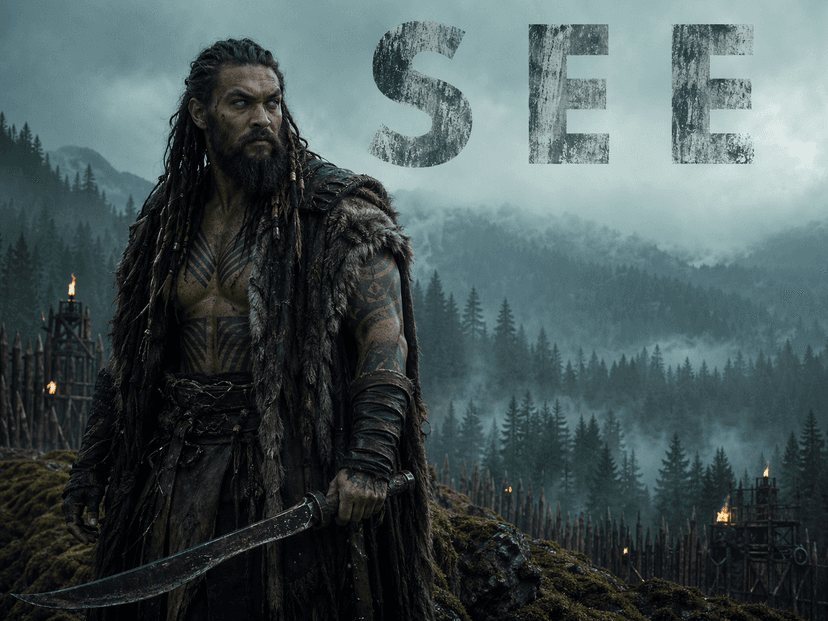
2019 - 2022

See premiered on Apple TV+ on 1 November 2019 as one of the streamer's launch titles, ran for three seasons and twenty-four episodes, and wrapped on 14 October 2022. Steven Knight, the Peaky Blinders creator, dreamt the thing up. Francis Lawrence directed the pilot and a chunk of the first season, Ridley Scott executive produced, and Anders Engström handled a majority of the later episodes. Apple threw proper prestige money at it.
The premise is a genuinely original swing. Six hundred years in the future, a virus has wiped out most of humanity and left the survivors permanently blind. Twenty generations of tribes have adapted, built cities, fought wars, raised children, and died without ever seeing a face. Sight is a myth. To most, it is heresy. Then a pair of twins, Kofun and Haniwa, are born in a mountain tribe called the Alkenny with the old gift returned. Word travels. Queen Sibeth Kane of the Payan Kingdom dispatches her Witchfinders to destroy them. Baba Voss, the tribe's warrior chieftain, runs.
That is the engine. The rest of the show is the chase, the war, and the political aftershocks across a continent where nobody can see you coming.
Jason Momoa carries See. He is Baba Voss, Alkenny chief, adoptive father of the twins, a man built for this kind of mythic action role in a way very few working actors are. Momoa did most of his own fighting, training for months with stunt coordinator Terry Notary to choreograph combat sequences performed entirely with eyes closed or unfocused. Watch the action scenes and you can see the difference. He is listening more than he is looking, head cocked, knife held out like a cat's whisker. It is a properly committed physical performance.
Around him, a proper ensemble.
Hoeks in particular is a force. Her Sibeth is one of the stranger, more magnetic villains of the Apple era, zealot and stateswoman and something worse.
Francis Lawrence
Director (Pilot)
Yadira Guevara-Prip
Bow Lion
Sylvia Hoeks
Queen Sibeth Kane
Alfre Woodard
Paris
Hera Hilmar
Maghra Kane
Christian Camargo
Tamacti Jun
Archie Madekwe
Kofun
Dave Bautista
Edo Voss
The blindness conceit is not a gimmick. It is the whole thesis. See asks what a society built without the dominant human sense actually looks like, and then commits to answering that question with unusual seriousness. Combat is tactile and close-quarters. Diplomacy happens by touch and voice. Maps are woven, not drawn. The show has its own sign language, developed with consulting linguist David Peterson (the man behind Dothraki on Game of Thrones), and sighted characters communicate with each other through finger spelling on palms when hidden listeners are near. That detail alone is quietly brilliant.
Underneath all that, the show is about the return of a technology humanity has decided it cannot handle. Sight, here, functions the way nuclear fire or artificial intelligence function in other sci-fi. It is power. It rewrites hierarchies. It frightens the old order, and the old order responds with violence. See is closer to Foundation or The Last of Us in that respect than to pure sword-and-sorcery. It is a post-apocalyptic political show with a metaphysical twist.
It is also, thank god, unbothered by contemporary message-making. The women in charge are in charge because they are the kind of women who would be. The men are men. Nobody is lecturing anybody. The conflicts are about power, faith, family, and territory, the old stuff, and the show trusts you to handle it without signposting.
Directing a show in which most of the characters cannot see is a genuinely hard problem. The See production design solves it by leaning into texture. Fabric, wood, rope, leather, wool. The sets feel woven. Characters run their hands over things constantly. Close-ups linger on fingertips. Wide shots emphasise the land as something to be walked across, not stared at. It was shot in British Columbia and the Pacific Northwest, with mountain forests and granite rivers doing most of the heavy aesthetic lifting.
The fight choreography is the other signature. Baba Voss fights blind. So does Tamacti Jun, and so do the Witchfinders when they finally close on their prey. None of them look like cheating sighted performers trying to pretend. The camera gets in close and you feel the sound-work of the fights more than you watch them, which is the point. When a sighted character enters one of those sequences later, the power imbalance is immediate and appalling.
Critics started out sniffy. Early reviews called the premise overwrought and the pacing slow, and there was a lot of bemused writing about the sheer audacity of the concept. By season two, with Bautista onboard and the Trivantes storyline expanding the map, the reviews turned. Rotten Tomatoes logged season two at 83 per cent, and Apple reported it had become the platform's most-watched drama up to that point. Season three closed the story out on its own terms rather than being axed mid-air, which, for a big-swing Apple TV+ original, is not nothing.
Industry people noticed the stunt work. Momoa's training regime became a press story in its own right, and the show picked up craft nominations for its sound design and production work. It never became a water-cooler hit on the scale of Ted Lasso or Severance, but it built a devoted audience, and the final season landing so neatly gave it a coherence a lot of prestige sci-fi lacks.
See is the kind of show that, from a logline, sounds faintly ridiculous. Post-apocalyptic blind world, warrior dad with a knife, twins born with the eye-magic, queen wants them dead. And yet. The worldbuilding is rigorous, the cast is stacked, the action is actually innovative rather than just loud, and Jason Momoa turns out to be exactly the right man for the role. I came in expecting a cheesy fantasy romp and left thinking Apple had made one of the more interesting genre swings of its early years.
If you liked Raised By Wolves for its big swing on a strange idea, or The Last of Us for its post-apocalyptic family core, See is very much in that conversation. It is also, probably, the best thing Steven Knight has done outside the Peaky Blinders universe. Three seasons, no wasted episodes, a proper ending. Worth a look.
Tom Mison
Lord Harlan
Jason Momoa
Baba Voss
Trieste Kelly Dunn
Bow Lion (S1)
Bobby Schofield
Boots
Nesta Cooper
Haniwa
Ridley Scott
Executive Producer
Steven Knight
Creator