2020 - Present

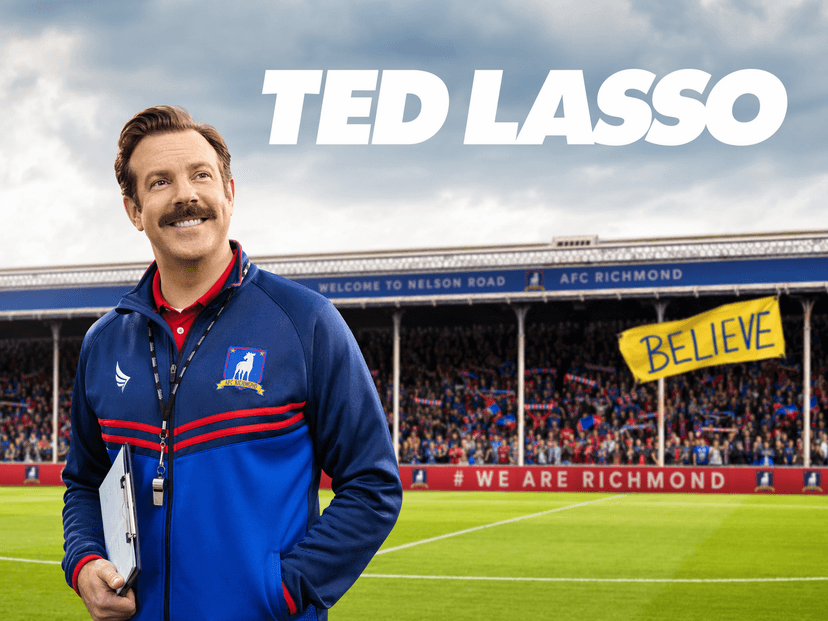
Ted Lasso landed on Apple TV+ in August 2020, right in the thick of the first pandemic summer, and it became the thing a lot of us needed without quite knowing we needed it. The premise started as a joke. Back in 2013, NBC Sports ran a series of promos for its Premier League coverage in which Jason Sudeikis played a cartoonish American football coach hired to manage Tottenham. The bit was silly. It did not suggest a show, let alone a show that would go on to win 11 Emmys.
Bill Lawrence, of Scrubs and Cougar Town fame, saw something in it. He, Sudeikis, Brendan Hunt and Joe Kelly developed the sketch into a half-hour comedy about AFC Richmond, a fictional Premier League side, and its new manager: a college football coach from Kansas with no soccer experience and a suitcase full of homemade biscuits. The club's new American owner, Rebecca Welton (Hannah Waddingham), hires him specifically because he knows nothing about the game. She wants the team to fail. It is revenge on her philandering ex-husband Rupert, who used to own it.
Three seasons aired between 2020 and 2023. A fourth is confirmed and expected in 2026. The show has been "ended" and then un-ended enough times that any confident statement about its future should be taken with a pinch of Kansan salt.
Sudeikis is the centre, but Ted Lasso is one of those rare comedies where the supporting bench is deeper than the lead. Hannah Waddingham won an Emmy for Rebecca, a part written for stage presence and then given to an actress with actual stage presence (she was the Lady of the Lake in Spamalot in the West End). Brett Goldstein came into the project as a writer and submitted a self-tape for the part of Roy Kent, an ageing footballer whose public vocabulary is roughly 40% the F-word. He also won an Emmy. Juno Temple plays Keeley Jones, Roy's on-again off-again partner, a brand strategist who is sharper than everyone gives her credit for.
Nick Mohammed has the hardest job on the show. His Nate Shelley begins as the shy kit man, gets promoted, and over seasons two and three carries the most uncomfortable arc Ted Lasso tries. Phil Dunster as Jamie Tartt gets the show's clearest character arc. He opens season one as a preening Manchester City loanee and by the end is something different.
Around that core are the people who make the Richmond dressing room feel like a real dressing room. Jeremy Swift plays the gentle, put-upon Higgins. Brendan Hunt gives Coach Beard the best deadpan on television, which is quietly the co-creator move of the decade. Cristo Fernández turns up as Dani Rojas, whose "Football is life!" is the show's single most quoted line. Toheeb Jimoh as Sam Obisanya, the Nigerian forward, gets some of the show's best character writing. James Lance plays Trent Crimm, introduced with the running gag "Trent Crimm, " and gradually promoted to something much more interesting. Anthony Head is the poisoned well as Rupert Mannion.
Nick Mohammed
Nate Shelley
James Lance
Trent Crimm
Phil Dunster
Jamie Tartt
Cristo Fernández
Dani Rojas
Brendan Hunt
Coach Beard
Juno Temple
Keeley Jones
Hannah Waddingham
Rebecca Welton
Anthony Head
Rupert Mannion
People talk about Ted Lasso as a show about kindness. That is half true. The more accurate version: it is a show about people choosing to become better versions of themselves, over time, without a single dramatic breakthrough. Ted's "be curious, not judgmental" is not a sticker on a Pinterest board. It is an operational instruction. He uses it to manage a locker room of men who mostly do not want him there.
The dart-throwing scene in "The Diamond Dogs" is the scene people still cite. A man who has underestimated Ted the entire episode gets flattened at the oche by a story about being underestimated. It works because the show has earned it. No shortcuts.
Where Ted Lasso separates itself from a lot of feel-good comedy is that its characters actually struggle. Ted has panic attacks. Rebecca is working through a divorce. Roy is terrified of retiring. Keeley is building a career in public. Nate's arc in seasons two and three, the heel turn that splits the fanbase, is the show refusing to pretend that kindness always wins by episode's end. Sometimes people hear the kindest things you can say to them and metabolise them into grievance.
The show is shot warm, which is a deliberate choice in a genre that had been drifting cold and wry for a decade. The yellow walls of the clubhouse. The hand-taped BELIEVE sign above the door. The pub owned by Mae. The cramped Richmond Dog Track stadium. The whole production design nods at English football culture without leaning into parody. The writers' room leans British (Goldstein, Mohammed, and others), which keeps the Premier League texture honest. There is a joke about Andrew Flintoff in season one that would not survive a purely American room.
Tonal range is the show's quiet flex. A single episode can contain:
The football itself holds up. The match scenes are not cinematic showpieces on the scale of a Champions League ad, but they are coherent. You can follow the tactics. The commentators are not speaking in code.
Seasons one and two were critical darlings. Eleven Emmys across the run. The show became genuinely culturally load-bearing during the pandemic in a way that is hard to recreate in retrospect.
Season three is more complicated. It is longer, bigger, more ambitious, and in many viewers' reading, more scattered. Subplots sprawl, the Nate storyline stretches past its natural resolution, and the pacing often races the clock. Defenders of the season read it as a mature meditation on endings, on what happens when the thing that was supposed to be temporary becomes permanent and then has to end anyway. Detractors point out that a comedy should probably remember to be funny more consistently than season three does. Both camps have a case.
A show this sincere had to risk being called corny. The miracle is that it almost never lands there.
What Ted Lasso accomplishes across 34 episodes is rare. It is kind without being soft. It is sentimental without being cheap. And it believes in people while being honest about when that belief turns out to be wrong. The Apple TV+ library has other shows in its neighbourhood: the corporate dread of Severance, the alt-history swagger of For All Mankind, and the sharp British comic engine driving Slow Horses. Further afield, if you like the workplace-as-family ensemble thing, the DNA connects back to The Office in the US and The Office UK where the formula was invented.
I will say plainly what Ted Lasso is for me. The only show of the 2020s so far that I would hand to a stranger on a bad day and trust them to come out the other side a little better. It is not the best written comedy of the decade. It is not the most ambitious. What it is, unfashionably, is useful. That is a rarer thing on television than anyone admits.
Jeremy Swift
Leslie Higgins
Toheeb Jimoh
Sam Obisanya
Brett Goldstein
Roy Kent
Jason Sudeikis
Ted Lasso