2005 - 2017

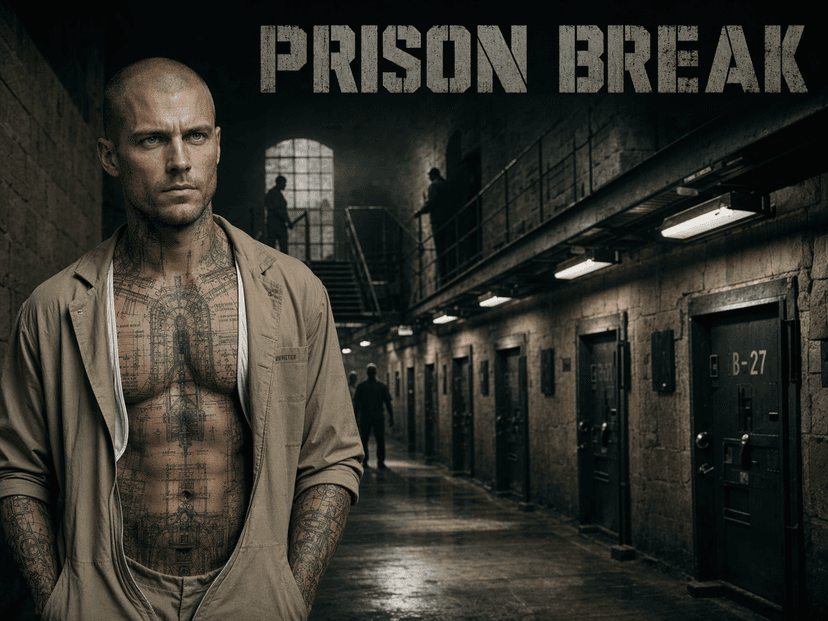
Prison Break arrived on Fox in August 2005 and ran for five seasons and ninety episodes, with the original run wrapping in 2009 before an unlikely revival brought it back for a fifth season in 2017. Paul Scheuring created it, and the premise is one of the cleanest hooks American network TV has produced this century. Michael Scofield, a structural engineer played by Wentworth Miller, deliberately gets himself arrested and sent to Fox River State Penitentiary so he can break his brother Lincoln Burrows out of death row for a murder Lincoln did not commit. Lincoln is played by Dominic Purcell. Michael has tattooed the prison's blueprints onto his torso and arms, disguised as elaborate fantasy imagery. Every line on his skin is a corridor, a vent shaft, a pipe run. He walks into the cage carrying the map.
That premise alone would have carried a season. It carried four, then improbably a fifth, by relocating the escape engine from Fox River to Sona in Panama, to various cross-country chases, and eventually to Ogygia in Yemen. The show's genre is thriller with a heavy conspiracy underlay. The wrongful-conviction plot quickly opens out into a much larger web involving a shadow organisation called the Company, which I will say nothing more about.
Miller and Purcell anchor the show and they make an odd-couple pairing that works. Miller plays Michael as a man running constant mental calculations, cool on the outside, haunted underneath. Purcell plays Lincoln as a blunt instrument with a conscience. They do not look like brothers. They sell it anyway.
Around them, Fox River becomes one of the most memorable ensemble settings in network TV of its era. Robert Knepper as Theodore "T-Bag" Bagwell is the show's breakout villain, a soft-voiced racist rapist whose charisma is genuinely unsettling. Knepper turned what looked on paper like a two-episode stock villain into a five-season headline act. For my money he is the reason a lot of people kept watching after the original escape plan was done. Amaury Nolasco plays Fernando Sucre, Michael's cellmate, whose whole arc is trying to get home to his girlfriend. Peter Stormare is John Abruzzi, the mob boss who runs the prison work detail. Wade Williams is Captain Brad Bellick, the guard you love to hate. Rockmond Dunbar is Benjamin Miles "C-Note" Franklin, ex-military and the heart of the crew.
Sarah Wayne Callies plays Dr Sara Tancredi, the prison medic and the governor's daughter, who ends up as Michael's emotional counterweight for most of the series. Callies went on to The Walking Dead after this. William Fichtner joins in season two as FBI agent Alexander Mahone, a damaged pursuer who basically becomes the show's third lead from season two onwards. Fichtner is reliably one of the best character actors working and he is outstanding here. Paul Adelstein as the government fixer Paul Kellerman is genuinely creepy across 51 episodes. Marshall Allman plays Lincoln's teenage son LJ, Robin Tunney plays Lincoln's defence lawyer Veronica Donovan, and Chris Vance enters in the Sona era as the slippery Australian James Whistler.
Amaury Nolasco
Fernando Sucre
Dominic Purcell
Lincoln Burrows
Chris Vance
James Whistler
Robin Tunney
Veronica Donovan
Marshall Allman
LJ Burrows
Paul Adelstein
Paul Kellerman
Wade Williams
Captain Brad Bellick
William Fichtner
Alexander Mahone
Strip the thriller mechanics away and Prison Break is about two brothers and the things one will do for the other. That simple emotional engine is why the more outlandish late-season plots keep working on the people who stay with it. You are not really watching to see how the next escape plan comes together. You are watching because Michael gave up his freedom for Lincoln on the very first episode and kept choosing him.
It is also a show about institutional rot. The conspiracy is not a single bad man. It is a network of bureaucrats, spies, and capital that can put an innocent man in the electric chair without breaking a sweat. That element is closer in spirit to 24 and Homeland than to a standard cops-and-cons procedural.
A few of the things Prison Break does better than its peers:
The look of season one is iconic. Pale blue filter, fluorescent prison strip lights, rusted metal, and concrete. The wardrobe is blue prison shirts and Michael's skin, which the camera returns to again and again. Ramin Djawadi's theme, a slow tolling piano melody, got an Emmy nomination in 2006 and is still one of the most recognisable TV cues of the 2000s. This is the same Djawadi who later scored Game of Thrones and Westworld.
The show also loves its Easter eggs. Origami flowers, numbers written on walls, tattoo details that fans paused and screengrabbed for years. "Break it down" became the crew's catchphrase and the show's whole philosophy. Every obstacle is a problem to decompose into smaller problems.
Later seasons lose some of that tight visual grammar when the action moves outside the prison. Season three's Sona, shot in a decommissioned open-air Panamanian yard, is grittier and hotter and arguably more dangerous-feeling than Fox River. The 2017 revival in Yemen is more conventional action-thriller, and the show never quite recovers its season-one atmosphere once the original walls are gone.
Prison Break debuted to 10.5 million viewers and averaged 9.2 million across season one, a monster number for Fox at the time. Metacritic put season one at 65 and Rotten Tomatoes at 79 percent, with the consensus calling it confident pulp with a crackerjack premise. The Ramin Djawadi Emmy nomination for main title theme music is the show's headline award credit.
Critically the show's reputation follows a specific curve. Season one is widely treated as excellent. Season two works for a lot of people as a different, leaner thriller. Seasons three and four are where the wheels get shaky, and the 2017 revival has defenders and detractors in roughly equal measure. None of that has dented the cultural footprint. Michael Scofield's tattooed body remains a shorthand image for mid-2000s network TV event storytelling, and the show's rabid international fanbase, particularly across the Middle East and Europe, kept it alive as a reference point long after the first run ended.
Prison Break works because it commits to its premise without apology. A man tattoos a prison's blueprints on himself and breaks his brother out. That is the pitch and the show delivers it with a straight face, in 22 full network episodes, with a huge cast of memorable inmates and a crawling sense of dread. It is not subtle. It is not especially literary. It is compulsive in a way very few shows achieve, and I still put season one up alongside the best single runs of network-TV plotting from the 2000s.
If you like it, the obvious next stops on this site are the paranoid institutional thrillers of 24 and Homeland, the prison-world intensity of Oz, and the long-running mystery-box construction of Lost. If it is the Michael-Scofield-as-tactician angle that hooked you, the pulp crime thriller Banshee is a good chaser. And The Night Of is what you watch when you want a slower, sadder, more serious look at what actually happens to a man inside.
Paul Scheuring
Creator / Showrunner
Wentworth Miller
Michael Scofield
Rockmond Dunbar
Benjamin Miles "C-Note" Franklin
Robert Knepper
Theodore "T-Bag" Bagwell
Peter Stormare
John Abruzzi
Sarah Wayne Callies
Dr Sara Tancredi