2001 - 2010

24 landed on Fox in November 2001, two months after 9/11, and detonated. Created by Joel Surnow and Robert Cochran, the show ran for eight seasons and 192 episodes through 2010, returned as the limited series 24: Live Another Day in 2014, and spun off into 24: Legacy in 2017 with Corey Hawkins taking over the lead. There was also an Indian radio and TV adaptation, 24: India. For the best part of a decade this was the defining action show on American television.
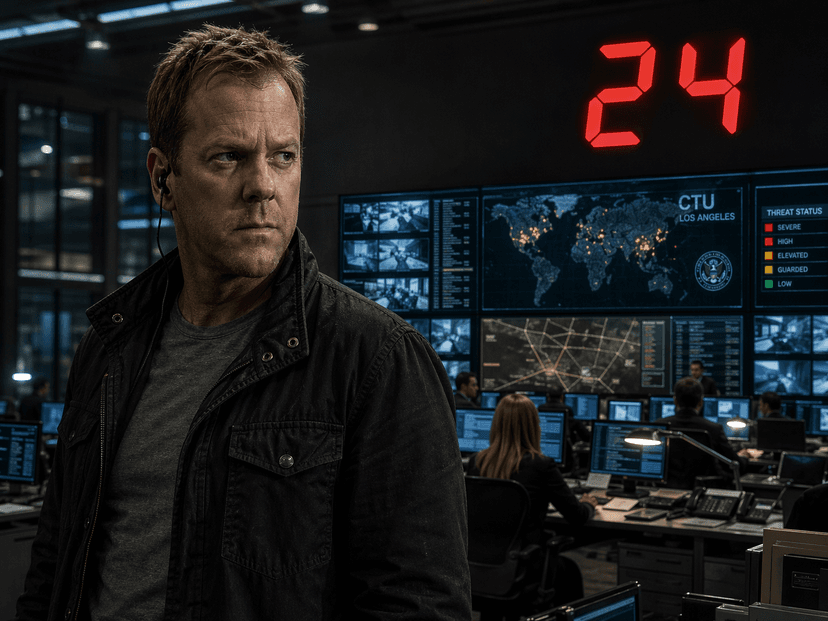
The hook is a formal gimmick that turned out to be far more than a gimmick. Each season covers one 24-hour day. Each episode is one hour of that day. Scenes are separated by an on-screen digital clock ticking down. No flashbacks, no jumps forward, no breathing room. When Jack Bauer tells you something is happening in ten minutes, you watch those ten minutes happen.
The premise. Jack Bauer, a Counter Terrorist Unit agent in Los Angeles, is the only man standing between the United States and a catastrophic attack on any given day. Kiefer Sutherland plays him. The show commits to the clock with a discipline that shouldn't work and somehow does.
Kiefer Sutherland carries this show on his back for eight seasons plus the revival. His Jack Bauer is a growl, a run, and a refusal to go home. It is one of the most fully owned lead performances on network TV this century, and it won him an Emmy and a Golden Globe for Season 5.
The ensemble around him is better than the show is sometimes given credit for:
The later seasons bring in serious talent, too. Gregory Itzin's weaselly, Nixonian President Charles Logan is one of the great TV villains of the 2000s and earned him an Emmy nomination. Cherry Jones plays President Allison Taylor in Season 7 with a steel that earned her an Emmy win. Jon Voight shows up in Season 8 as a corporate antagonist and chews the furniture beautifully.
Xander Berkeley
George Mason
Leslie Hope
Teri Bauer
Kiefer Sutherland
Jack Bauer
Carlos Bernard
Tony Almeida
Elisha Cuthbert
Kim Bauer
Sarah Clarke
Nina Myers
Gregory Itzin
President Charles Logan
Reiko Aylesworth
Michelle Dessler
The plot is about terrorism. The show is about men under impossible pressure making awful choices and wearing them on their faces.
Jack Bauer is not a hero in any comfortable sense. He is a man who has spent too many days doing things nobody should have to do, and who keeps getting called back because there is nobody else. The show is interested in the cost of that. His family life fractures. His colleagues get pulled into the same spiral. The President's office, across multiple administrations, becomes a machine for forcing decent people into terrible compromises.
24 was accused, often fairly, of normalising torture in the years immediately after 9/11. The show used "enhanced interrogation" as a plot accelerator more or less every season, and it did not hide behind euphemism. I think the more honest reading is that the show is ambivalent about Jack rather than approving of him. He is shown to be broken by what he does. Later seasons, particularly Season 7 with its Senate hearings subplot, literally put him on trial for it. That does not settle the debate, but it does complicate the easy "Bush-era propaganda" reading that dogged the show for years.
The split screen is the show's visual signature. Three, four, sometimes five panels at once, cross-cutting between Jack in a warehouse, Chloe at a terminal, the President in the Oval Office, a suspect in transit. Sean Callery's percussion-led score. The silent ticking clock between scenes, sometimes three or four times an episode, which somehow never stops being tense.
Early seasons shoot Los Angeles like a panic attack. Later seasons move to Washington, then New York, then London for 24: Live Another Day, and the change of scenery freshens a formula that could have calcified. The real-time conceit also forces a kind of economy most TV drama never has to learn. When an episode ends on a cliffhanger, it is genuinely ten minutes until the next one in the story. No weeks, no months, no "three years later". Just the clock.
24 won the Emmy for Outstanding Drama Series in 2006 and picked up a pile of acting Emmys across its run. It was a ratings monster and a critical hit in roughly equal measure for seasons one, two, four, five, and seven. Seasons three, six, and eight are where most fans and most critics agree the formula wobbles, though even the weaker years have standout hours.
The influence is everywhere. Homeland would not exist in its form without this show, nor would Jack Ryan or The Night Agent or Tehran. The modern streaming thriller owes 24 its real-time urgency, its paranoid institutional setting, and its appetite for moral grey. Sutherland's own follow-up, Rabbit Hole, is a direct descendant. Legends is another one.
"A show that, at full power, was the best action drama on television and one of the most ambitious formal experiments any network has ever greenlit."
24 works because the clock is not a gimmick, it is a discipline. The real-time rule forces the writers into hard corners every hour, and the way they climb out of those corners is the whole appeal. It works because Sutherland is a better lead than the genre usually gets. And it works because the supporting cast, particularly Rajskub, Haysbert, Itzin, and Jones, refuse to treat any of this as pulp.
Watch season one on its own and it plays like a tight, urgent thriller about a kidnapping and a political assassination plot. Watch seasons four and five and you get peak 24, as confident and propulsive as the show ever was. Watch all eight plus Live Another Day and you are signing up for roughly 200 hours of a man refusing to sleep. I would not recommend that to everyone.
But for anyone who has wondered where the modern prestige thriller actually came from, this is the shape it was cut from. The clock is still ticking.
Mary Lynn Rajskub
Chloe O'Brian
Cherry Jones
President Allison Taylor
James Morrison
Bill Buchanan
Dennis Haysbert
President David Palmer