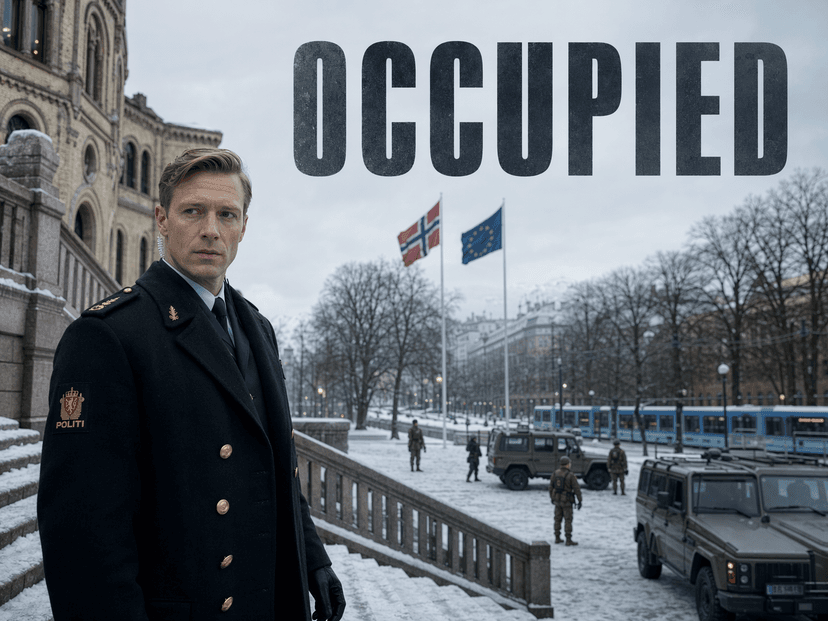
2015 - 2020

Occupied (Norwegian title: Okkupert) is a three-season political thriller that ran from 2015 to 2020, produced for Norway's TV 2 and picked up globally by Netflix. Twenty-four episodes. Norwegian with subtitles, and well worth the reading.
The premise is simple and cold. A newly elected green government in Oslo, led by Prime Minister Jesper Berg, decides to shut down Norwegian oil and gas production overnight and switch the country to thorium-based nuclear power. The United States has withdrawn from NATO. The European Union, panicking about winter energy supply, asks Russia to step in and restart the pumps. What follows is not a war, or not one a newspaper would print under that word. Russian troops arrive in small numbers. Logistics workers. Quiet advisors with credentials you cannot check. Security personnel around key installations. The Norwegian government stays in place. The flag stays up. Everyone agrees, officially, that this is a temporary energy partnership.
The show was the most expensive Norwegian TV production ever made at the time of release, and the money is on the screen. The scale of Okkupert is closer to a feature film than a typical Scandinavian crime drama, and that ambition runs through every frame.
The creators, novelist Jo Nesbø (of the Harry Hole series and The Snowman) together with Karianne Lund and Erik Skjoldbjærg, set themselves a hard question. What does occupation look like when nobody fires a shot? When the tanks do not roll, the parliament keeps sitting, the cafes stay open, and the person pouring your coffee might be PST or might be an FSB asset and you cannot tell the difference?
The answer the show gives is that occupation in a silk glove is harder to resist than a bombed capital, because there is nothing to point at. Jesper Berg, played with quiet weariness by Henrik Mestad, spends three seasons trying to work out what compromise he can live with and what line, if crossed, turns collaboration into betrayal. Hans Martin Djupvik, the PST security officer played by Eldar Skar, keeps being asked to make the same decision at a smaller scale and with more immediate consequences. Bente Norum, a restaurant owner played by Ane Dahl Torp, gets the civilian version of the same problem, where keeping her business open means catering to the Russians who are slowly buying the neighbourhood.
This is a show about sovereignty as a series of small erosions. Every character picks their own line in the sand and every character watches the tide come in over it.
The ensemble is drawn almost entirely from Norwegian theatre and film, with a scattering of Russian, Lithuanian and Baltic performers playing the occupying side. The core group:
Selome Emnetu
Hilde Djupvik
Vegar Hoel
Thomas Eriksen
Janne Heltberg
Anita Rygh
Jo Nesbø
Creator
Ane Dahl Torp
Bente Norum
Eldar Skar
Hans Martin Djupvik
Ingeborga Dapkūnaitė
Irina Sidorova
Ragnhild Gudbrandsen
Wenche Arnesen
Mestad in particular is a find for viewers who have only seen him in his Lilyhammer supporting turn. Here he is the lead of a prestige drama and he carries it with a kind of bruised decency that keeps you watching even when his decisions frustrate you.
Visually, Occupied is cold and clean. A lot of high grey skies, glass government buildings, winter fjords, and the particular Oslo light that seems to make every face look a little more tired than it should. The cinematography leans documentary more than it leans thriller, and the show earns its tension from rooms and conversations rather than chases.
The score is sparse. Dialogue often lands with no music under it at all, and when the score does arrive it is usually a low drone rather than anything lush. Fans of Chernobyl's sonic restraint, or of Slow Horses and its willingness to let a scene sit in its own silence, will feel at home here.
It is the kind of show where a single parliamentary committee meeting can feel more dangerous than a gunfight, because everyone in the room knows what is really being discussed and nobody is going to say it out loud.
The pace is unhurried, and it rewards patience. Plot developments land over whole episodes, not whole acts. I would call it slow-burn if I had not been told to avoid the phrase, so let me say instead that it moves at the speed of real political drift.
Critics internationally were kind to it from day one. The Daily Telegraph called the pacing sufficiently frenetic and the show bang on trend. Netflix marketed it as the European answer to Homeland, which is unfair to both shows but not a bad commercial hook.
The most interesting reception was diplomatic. On release, the Russian embassy in Oslo put out a statement calling the premise a fantasy of an eastern threat that does not exist, and reminded Norway of the Soviet Army's role in liberating Finnmark in 1945. Given how the decade that followed the premiere has gone, the show's reading of Russian hybrid operations aged into something closer to reporting than speculation.
For a country with five million people and a TV 2 budget, Okkupert punches well above its weight internationally. It sits comfortably alongside Das Boot and The Defeated in the conversation about the best European drama of the 2010s, and it opened the door for a generation of Norwegian series that followed.
Most political thrillers need a villain in the room. Occupied has no villain in the room. The Russians here are not cartoon Bond henchmen. They are professional, patient, polite enough to pass for allies, and working from a playbook the Norwegian government cannot quite call out without sounding paranoid. Some of them even have a point.
That ambiguity is the show's great trick. The dilemma sits with the Norwegians, not the occupiers. Do you keep the lights on and the gas flowing and tell yourself this is temporary? Do you resist, when resistance might get people killed for a principle that might not hold anyway? Do you collaborate with good intentions, and if so, at what point does that become the same thing as collaboration without them?
Occupied is one of the two or three smartest political dramas of its decade. It speaks directly to questions about energy and sovereignty, and to the slow-war tactics that Europe is still working through. Watch it with subtitles on, two episodes at a time, and give it the attention it asks for. It will pay you back.
Erik Skjoldbjærg
Creator / Director
Henrik Mestad
Jesper Berg