2018 - 2018

McMafia is an eight-episode crime drama that aired on BBC One in the UK from 1 January 2018 and on AMC in the US from 26 February 2018. It was developed by Hossein Amini, the screenwriter behind Drive and The Two Faces of January, with James Watkins, director of Eden Lake and The Woman in Black, who handled the majority of the first season himself. The title and premise come from Misha Glenny's 2008 non-fiction book McMafia: A Journey Through the Global Criminal Underworld, a deeply reported account of how organised crime went transnational after the fall of the Soviet Union.
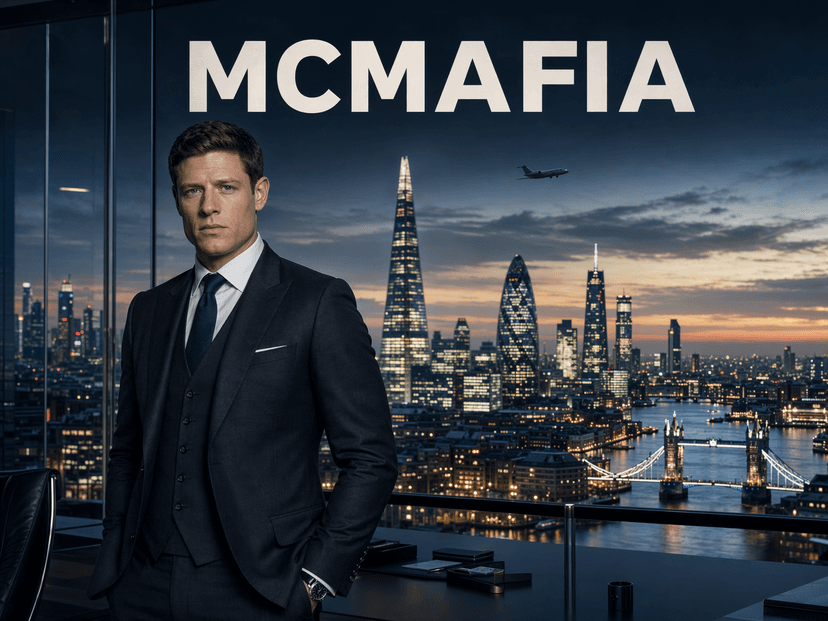
James Norton plays Alex Godman, an Oxford-educated London hedge-fund analyst in his early thirties. He has the accent and the manners. The girlfriend works in banking and the career is in a London hedge fund. English in every way that counts. The quiet fact of his life is that he is the son of Dimitri Godman (David Strathairn), an exiled former Russian mafia boss, and the nephew of Boris Godman (David Dencik), another figure from the same old world. Alex has spent his adult life keeping a careful wall between himself and that inheritance. Then the wall comes down. A long-standing feud with Moscow oligarch Vadim Kalyagin (Merab Ninidze) reaches into London and pulls Alex, finally, into the business his father tried to leave behind.
The hook is not the violence. It is watching a respectable man work out how flexible his morals really are.
Norton carries the show. This was his first lead role in a major international series, coming off a memorable guest stint as the villain Tommy Lee Royce in Happy Valley and a run as the vicar-detective in Grantchester. McMafia is what turned him from "the British actor who was very good in that thing" into a lead who could front a prestige drama. He plays Alex as a man running a constant internal audit of his own complicity. Cold on the surface. Very busy underneath.
Around him is a genuinely international ensemble that the show takes seriously rather than using as flavour.
Merab Ninidze
Vadim Kalyagin
Kirill Pirogov
Russian cast
James Norton
Alex Godman
Aleksey Serebryakov
Ilya
Juliet Rylance
Rebecca Harper
James Watkins
Co-creator / Director
Faye Marsay
Katya Godman
Hossein Amini
Co-creator / Showrunner
You do not usually see this much acting muscle across this many passport offices in one show.
Glenny's book was about systems. It argued that once the Berlin Wall fell and Soviet state structures collapsed, organised crime globalised at the same speed global capital did. Not the gangster as romantic outlaw. The gangster as logistics operator. Money moves through the same banking rails legitimate capital uses, and so do drugs and people. The shell companies and shipping lanes that let a multinational run will, if you let them, let a crime syndicate run just the same.
McMafia inherits that argument and lets it drive the show. Alex is a hedge-fund man, and his comparative advantage when he finally steps into the family trade is not that he can shoot anyone. He can read a balance sheet. His edge is knowing how to layer a transaction and move value across borders, and knowing how to dress up illegitimate work inside legitimate-looking vehicles. The show is genuinely interested in these mechanics. Episodes trace the flow of a single piece of cargo, or a single transfer, across three countries.
That gives the series a distinct moral weight. You are not asked to root for a charming killer. You are asked to watch an intelligent person work out whether he can live with being the money man for other people's violence. My read is that the show respects the viewer enough to let that answer arrive slowly, uncomfortably, and mostly unspoken.
Watkins and Amini wanted McMafia to sit in the tradition of John le Carré adaptations rather than in the tradition of The Sopranos, and that is exactly where it lands. The tempo is quiet. The camera is patient. A lot of the drama happens in conversation rooms, boardrooms, the back of cars, and the long walks between them. Filming moved from London to Moscow to Mumbai to Prague to Tel Aviv to Istanbul, and the cinematography treats each city as a specific place with its own light and its own corruption rather than an establishing shot.
This is the register fans of Slow Horses or The Night Manager will recognise. Cool and observational, with a little of the drained look of a winter morning. Violence hits hard when it comes precisely because the show refuses to choreograph it for entertainment.
It is also why McMafia divides people. Plenty of reviewers found it glacial. The word came up a lot in 2018. If you come looking for the muscular pulp of Gomorrah or Narcos, you may tap out by episode three. If you come looking for the slow moral compression of The Americans or a le Carré novel, the patience is rewarded.
Reviews were mixed but serious. Critics respected the ambition and the geographic reach. The research clearly visible underneath the plotting earned a lot of credit too. Norton's performance did most of the rest. The consistent knock was pace. Several UK broadsheets praised the show's intelligence while complaining that the first three episodes ran colder than the audience needed.
Audiences largely followed. UK premiere ratings were strong. Launching on BBC One on New Year's Day was a statement of intent, and the show held a solid if gradually declining audience across its run. AMC's US numbers were more modest.
A second season was announced and planned, with Amini and Watkins attached. It never filmed. By the early 2020s the project had quietly lapsed. Scheduling issues and cast availability got in the way. The wider economics of expensive international co-productions did the rest. In hindsight the single-season form is actually kind to McMafia. The eight episodes tell a complete arc of a man discovering who he is capable of being.
Norton's career took off. Grantchester continued after McMafia aired. Nowhere Special landed him serious film notices. Later work on Thorne and King and Conqueror built on exactly the control he showed here.
McMafia is not for everyone and I wouldn't pretend otherwise. It is cold and careful, built for viewers who want to follow the money rather than watch the fireworks. What it does, though, it does better than almost anything else on television from the same period. It treats global organised crime as the grown-up economic force it actually is. The lead actor is trusted to carry moral ambiguity without winking at the camera. And the transnational ensemble of serious performers gets real work to do rather than local-colour duty.
If you want the international-crime companion piece to The Spy or A Spy Among Friends, or a le Carré-tempo counterpart to the louder pleasures of Peaky Blinders and Kin, this is your show. Eight episodes. One man. A very large problem.
Oshri Cohen
Semiyon Kleiman
David Dencik
Boris Godman
Nawazuddin Siddiqui
Dilly Mahmood
David Strathairn
Dimitri Godman