2010 - 2010

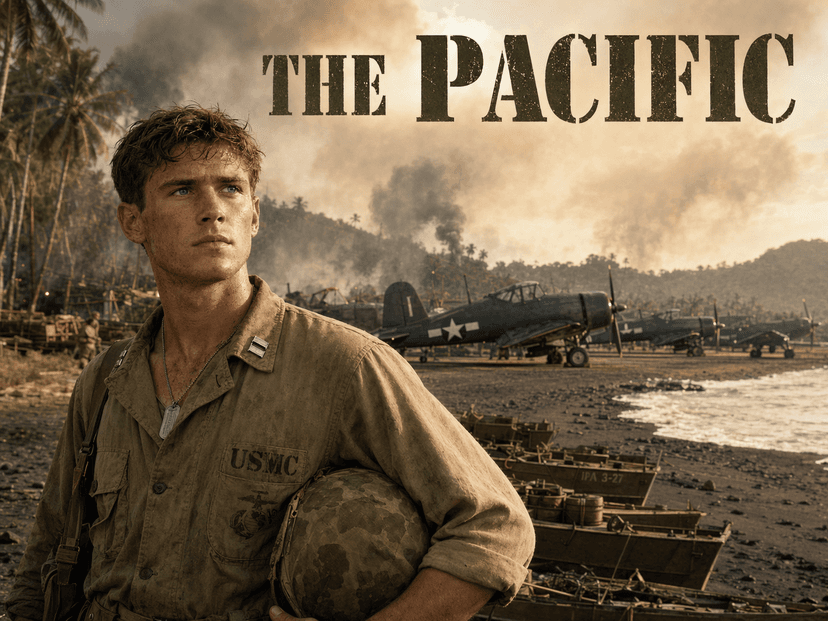
The Pacific is the 2010 HBO miniseries from Steven Spielberg, Tom Hanks, and Gary Goetzman. Ten episodes. A reported $200 million budget. It was pitched as the companion piece to Band of Brothers and sat in development for the better part of a decade while the producers figured out how to tell a war that does not behave like the one in Europe.
Where Band of Brothers follows one unit from jump training to VE Day, The Pacific braids three separate Marine stories. Robert Leckie of H Company 2/1, the writer. Eugene Sledge of K Company 3/5, the gentle Alabama kid who becomes a mortarman. And John Basilone, the Medal of Honor recipient whose war takes a very different shape from the other two. The show draws on Sledge's With the Old Breed, Leckie's Helmet for My Pillow, and the historical record around Basilone.
The campaigns are Guadalcanal, Cape Gloucester, Peleliu, Iwo Jima, and Okinawa. The names belong to a war most American viewers know only as a map. The Pacific fills in what those names actually meant for the US Marine Corps boys tasked with taking them.
The leads are three actors who all grew up on camera and then quietly got very good at being watched. James Badge Dale plays Leckie with a literary detachment that tips into something lonelier as the war goes on. Joseph Mazzello, who some of us remember as the kid in Jurassic Park, carries Sledge through an arc that asks more of him than any role he had taken before. Jon Seda plays Basilone as a man who keeps being asked to be a symbol when all he wants is to be a Marine.
Around them is a wider bench of ensemble work that gets stronger as the show goes on.
Tom Hanks
Narrator / Executive Producer
Annie Parisse
Home-front ensemble
Jacob Pitts
PFC Bill "Hoosier" Smith
Keith Nobbs
PFC Wilbur "Runner" Conley
Ashton Holmes
PFC Sidney Phillips
Tom Budge
PFC Ronnie Gibson
Claire van der Boom
Stella Karamanlis
Rami Malek
PFC Merriell "Snafu" Shelton
Tom Hanks narrates six of the ten episodes. It is his voice, so you settle in.
The easy read is that this is the bleak one and Band of Brothers is the heroic one. The easy read is nearly right. The Pacific is harder. It is more alienating by design. The jungle swallows time. The beaches are islands no one at home can find on a map. The Japanese soldier in this show is not the industrial uniformed enemy of the European theatre. He is often invisible, almost never surrenders, and fights from caves and tunnels and the dark.
What the show is really interested in is what that does to the boys. Leckie writes his way through it. Basilone gets pulled back to America, put in a suit, and turned into a war-bond poster, and he hates every second of it. Sledge arrives at Peleliu as one person and leaves it as somebody else, and the show does not look away from the moment the change begins.
The blunt truth the book With the Old Breed puts on the page, and that Spielberg and Hanks refused to soften, is that the Pacific war produced a specific kind of psychological damage. The Pacific is a 10-hour essay on that damage and on what the men carried home.
Every director on the show (Tim Van Patten, Jeremy Podeswa, David Nutter, Carl Franklin, Tony To, Graham Yost) is working with a palette of mud, ash, sand, and coral. The green is never friendly. The light in the jungle is the light of a place that wants you to leave. The Peleliu episodes in particular are shot with a ferocity that puts them up with anything HBO has ever done.
The sound design matters too. Artillery in The Pacific is not a dramatic thud. It is a physical thing that rewires what it means to be inside a body. The show wants you to understand why these men could not sleep for the rest of their lives.
"This series reminds us of the necessities, and the costs, of service," the Peabody judges wrote when they handed over the award. It is the fairest line anyone has written about the show.
The Pacific premiered in March 2010 to a Metacritic score in the high 80s and 8 Emmy wins, including Outstanding Miniseries. Critics split on one axis. Some thought the three-thread structure cost the show the emotional spine that made Band of Brothers land. Others thought that was the point: the Pacific war was fragmented, disorienting, and did not give its men the clean moral architecture of a march to Berlin.
Fifteen years on, the argument has settled. The Pacific is no longer "the lesser of the two." It is the darker of the two, which is a different claim, and it is the one many ex-military viewers and Pacific historians prefer. With Masters of the Air completing the Spielberg / Hanks trilogy in 2024, you can now watch the three back to back and see three very different wars.
If you want tonal cousins on the site, Generation Kill is the modern-era piece that picks up the thread about what combat does to young American men. And The Terror is the closest thing to it for atmosphere, a different kind of unforgiving theatre in which men are slowly ground down by a place that is not on their side.
The Pacific works because it refuses the easy version of itself. It is not a parade. It is not a highlight reel of noble charges. It sits with the specific horror of island warfare and the specific cost of being 19 years old in a flooded foxhole listening to men die. It asks you to watch Eugene Sledge, the quietest Marine on screen, slowly become somebody harder than the kid his father put on the train.
Joseph Mazzello's performance is the reason I come back to it. Rami Malek's Snafu is the reason I recommend it. James Badge Dale's Leckie is the reason I trust the show as literature, not just as history.
A proper companion piece to Band of Brothers that is not a copy of Band of Brothers. In 10 episodes it argues, without ever raising its voice, that there is no such thing as a clean war. Watch it once. Then, in a year, watch it again. It grows.
Dylan Young
PFC Jay De L'Eau
Joseph Mazzello
PFC Eugene Sledge
Jon Seda
Sgt John Basilone
Josh Helman
Corporal Lew "Chuckler" Juergens
James Badge Dale
PFC Robert Leckie
Martin McCann
Corporal R.V. Burgin
Caroline Dhavernas
Vera Keller