2001 - 2001

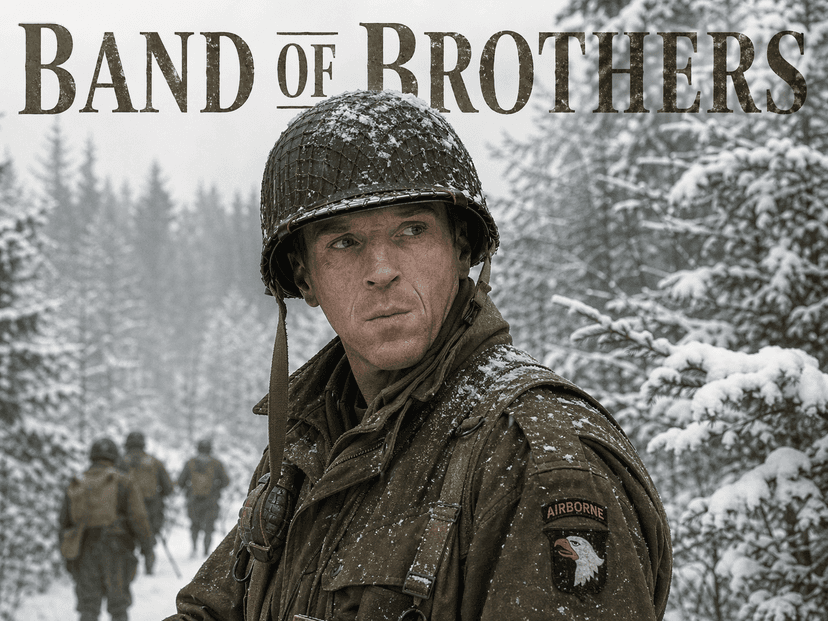
Band of Brothers is the ten-part HBO miniseries from 2001, produced by Steven Spielberg and Tom Hanks as a follow-up to Saving Private Ryan. It adapts Stephen E. Ambrose's 1992 non-fiction book of the same name. The subject is Easy Company, 2nd Battalion, 506th Parachute Infantry Regiment, 101st Airborne Division. These were American paratroopers. Volunteers. The series follows them from jump school at Camp Toccoa in 1942 through to the end of the war in Europe.
If you have never seen it, the pitch is straightforward. Ten hours of television about one infantry company across about three years of war. Each episode runs roughly an hour. Each opens with documentary footage of the actual surviving veterans of Easy Company, filmed decades later, talking plainly about what they went through. You watch the men on screen. Then you meet the men themselves. That framing is a big part of why the show lands the way it does.
The casting is the first thing you notice. Before many of these actors were famous, Spielberg and Hanks quietly assembled a group that now reads like a roll-call of the next twenty years of American and British television.
A partial list of the principals:
The performances stay small. Nobody grandstands. Lewis, in particular, is doing something rare. Playing a genuinely decent man and making him interesting. His Winters barely raises his voice across ten episodes and you never take your eyes off him.
The broad historical arc is a matter of public record and not a spoiler. The company trains in Georgia and England. They jump into Normandy on the night of D-Day as part of Operation Overlord, scattered across the countryside around Sainte-Mère-Église and fighting through the hedgerows toward Carentan. They drop into the Netherlands in September 1944 for Operation Market Garden. They hold the line in the frozen woods outside Bastogne during the Battle of the Bulge. They push into Germany. They stumble into a Nazi concentration camp at Kaufering. They finish the war at Berchtesgaden, taking Hitler's Eagle's Nest.
Richard Speight Jr.
Sergeant Warren "Skip" Muck
Marc Warren
Private Albert Blithe
Neal McDonough
Lieutenant Lynn "Buck" Compton
David Schwimmer
Captain Herbert Sobel
Eion Bailey
Private David Webster
Frank John Hughes
Sergeant William "Wild Bill" Guarnere
Scott Grimes
Sergeant Donald Malarkey
James Madio
Sergeant Frank Perconte
That is the map of the series. What happens to specific men at specific points in that map is where the emotional weight lives, and I will not go anywhere near it here. Newer viewers should go in cold. The show earns every hard moment.
On the surface Band of Brothers is a war series. Beneath that it is a study of a very specific kind of loyalty. These men did not know each other before 1942. They are thrown together by the draft and by volunteering for an experimental airborne unit, and what binds them by the end is a bond the show takes seriously enough to name in the title.
The series is also honest about the cost. It does not glorify combat. It also does not shy away from showing competence, courage, and leadership under unbearable pressure. That balance is rare. Most modern war drama picks one lane. This one walks both. "Currahee!", the regimental cry the men shout on their training runs up the mountain at Toccoa, means "we stand alone together" in Cherokee. That is the show in two words.
Visually the series set a template that a lot of prestige TV still follows. Shot on 16mm with heavy use of desaturated colour, handheld camera work in the combat sequences, long lenses for the character beats. The Bastogne episode in particular, directed by David Leland, is shot almost entirely in greys and blues, snow and shadow. You feel cold watching it. I watched it under a blanket and still felt cold.
The sound design is what holds the whole thing together. Michael Kamen's score is spare. It stays out of the way. When it does come in, usually under a veteran interview at the top of an episode, it hits without reaching. The battle sequences lean hard on silence, ringing ears, muffled voices. The directors, a rotating group including Phil Alden Robinson, David Frankel, Mikael Salomon, David Nutter, Richard Loncraine, Tony To, and Tom Hanks himself on one episode, mostly trust the material to carry the scenes.
Band of Brothers won six Emmys in 2002 including Outstanding Miniseries, plus the Golden Globe for Best Miniseries the same year. It opened two weeks before September 11, 2001, and its reputation grew through the following years as a genuinely serious piece of popular history. It has held up. Most reviewers of a certain age will list it in their top five miniseries of all time and I do the same.
Spielberg and Hanks returned to the same creative approach twice more: The Pacific in 2010, covering the Marines in the island-hopping campaign against Japan, and Masters of the Air in 2024, following the Eighth Air Force bomber crews over occupied Europe. Both are sister series in a loose trilogy and both are worth your time, but Band of Brothers remains the benchmark. For readers who want something thematically adjacent from a different angle, Generation Kill applies a similarly grounded treatment to a Marine reconnaissance unit in the 2003 Iraq war, and Chernobyl shares the same HBO-miniseries rigour on an entirely different kind of disaster.
Twenty-five years on, Band of Brothers has aged almost not at all. I rewatched it last winter across a fortnight and forgot twice that it was made in 2001. The acting looks modern. The combat still hits. The veteran interviews, now that most of those men have died, carry even more weight than they did on broadcast. My grandfather fought in the Pacific, not Europe, and I still find something of him in how these men talk on camera about what they saw. That is not easy to pull off.
It is not perfect. A couple of episodes in the middle are slower than they probably need to be. The Webster-narrated episode, "The Last Patrol", loses a fraction of the ensemble feel. But those are small debts against a show that does the big things right. Ten hours. Real events. Real men. Told with respect and without varnish. "Hang tough", as the old Easy Company salute goes. Almost a quarter of a century on, it still does.
Dexter Fletcher
Staff Sergeant John Martin
Rick Gomez
Sergeant George Luz
Donnie Wahlberg
Lieutenant Carwood Lipton
Matthew Settle
Captain Ronald Speirs
Kirk Acevedo
Sergeant Joseph Toye
Damian Lewis
Major Richard "Dick" Winters
Michael Cudlitz
Sergeant Denver "Bull" Randleman
Ron Livingston
Captain Lewis Nixon
Shane Taylor
Medic Eugene "Doc" Roe