Escape at Dannemora: Boredom Is a Dangerous Thing
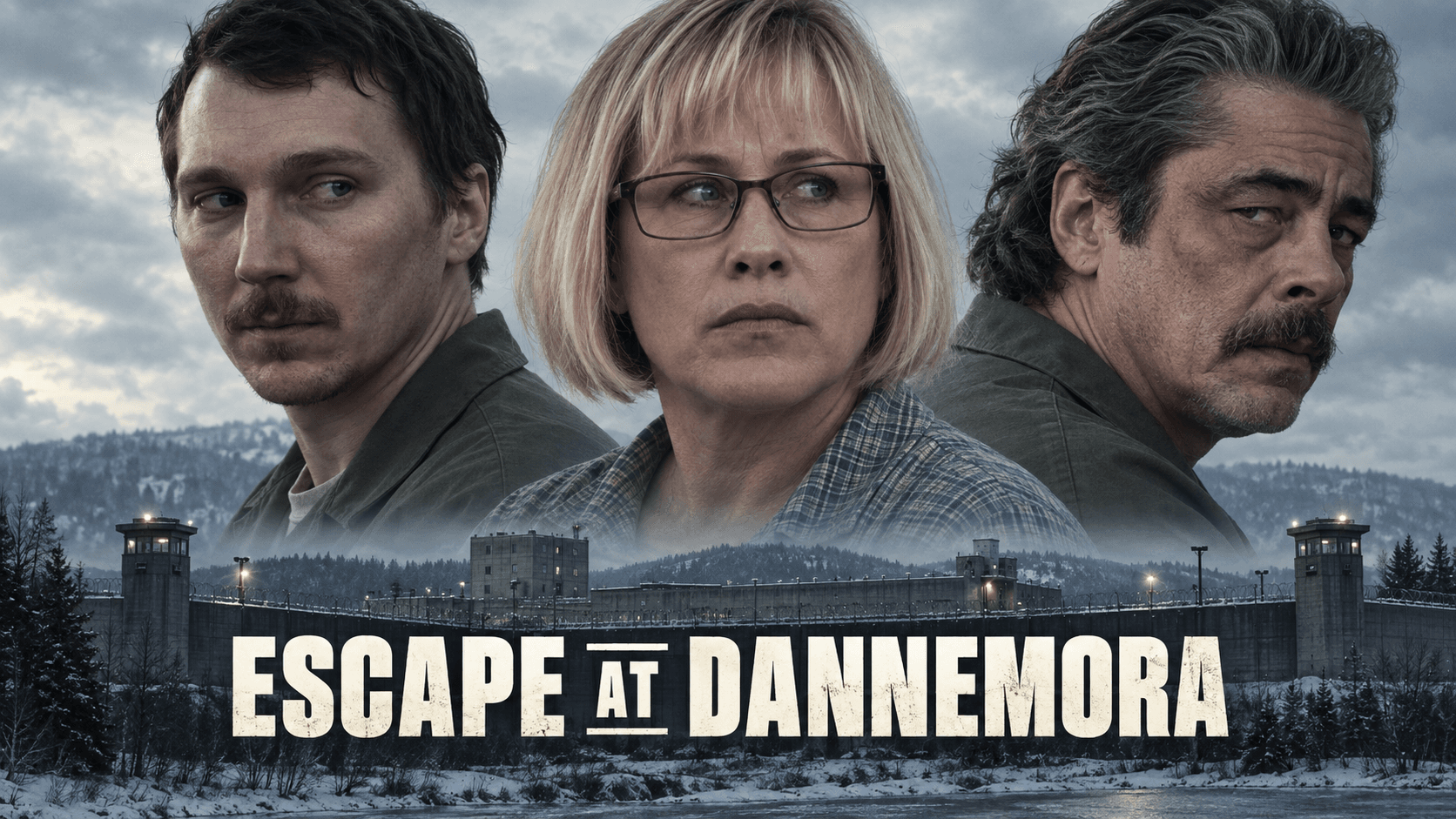
Escape at Dannemora makes a remarkable amount of good television out of people having a thoroughly miserable time. The place is cold, the work is repetitive, and the prospect of tomorrow offers very little that yesterday didn't already provide. Then two prisoners start paying attention. While everyone else is trying to get through another shift, they are looking for a way to change their lives completely.
I really enjoyed this. It is a well-rounded, exceptionally well-acted drama, but the writing is what makes its unpromising little world so absorbing. Boredom, vanity, resentment and the desire to feel wanted all become useful currency. The escape is an ambitious undertaking; the weaknesses that might make it possible are often embarrassingly ordinary.
And Patricia Arquette is tremendous. There are two very good actors playing the prisoners, yet it is her Tilly Mitchell who most often makes a scene difficult to look away from.
Another day at the prison
The seven-part 2018 series dramatises the circumstances around the 2015 breakout from Clinton Correctional Facility in upstate New York. Paul Dano plays David Sweat, Benicio del Toro plays Richard Matt, and Tilly supervises work in the prison's tailoring shop. Ben Stiller directs, with Brett Johnson and Michael Tolkin behind the writing and creation of the series.
That gives you the setup. What makes it worth watching is how convincingly it establishes the lives around the scheme. These people have routines, grudges, small comforts and very limited horizons. The prison feels like a workplace as well as a place of confinement, complete with the sort of familiarity that lets bad habits go unquestioned. A procedure can still exist on paper long after anyone has stopped thinking about why it matters.
I liked how much of the tension comes out of that. There is no need for a succession of brilliant masterminds on both sides. The people with authority have become comfortable, and comfort makes them predictable. The men looking for an opening have a reason to notice what everybody else has learned to ignore.
Outside the prison, life hardly looks exhilarating either. The cold and the worn-down surroundings make the daily grind feel particularly relentless. You can understand the appeal of a little attention or the promise of something different, even when the person offering it is plainly someone you should not trust. That is a much more interesting starting point than simply asking how anyone could be foolish enough to get involved.

Tilly is the reason to watch
Arquette gets so much out of Tilly's dissatisfaction. She is irritable, needy, self-important and vulnerable, sometimes within the same conversation. There is an uncomfortable gap between the life she has and the person she would like to imagine herself being. Arquette lets you see it without turning her into a collection of symptoms.
What I particularly liked was how completely she belongs in this setting. Tilly looks and sounds like somebody who has been going to this job for years. Her impatience has a familiar, well-practised quality. She can make an ordinary exchange feel unpleasant before anything especially unpleasant has been said. Then a little interest changes the temperature, and you begin to see how much that interest matters to her.
It would have been easy to make her a joke. There is certainly room to laugh at her, and some of the awkwardness is painfully funny, but the performance goes further. Her capacity to persuade herself is as important as anyone else's ability to persuade her. She wants a version of events in which she is desirable, significant and entitled to more. Watching her reach for that version is fascinating.
Eric Lange, as her husband Lyle, adds to the sense of a life that has settled into habits neither person seems equipped to improve. Their domestic world is convincingly unexciting. It gives Tilly's restlessness somewhere to come from, without needing her to explain herself in a tidy speech.
For me, Arquette steals the show. Dano and del Toro have the more obvious thriller material, but she makes the ordinary human weaknesses behind it feel every bit as compelling.

Two men with something to work towards
Dano is excellent as Sweat. He has a concentrated, watchful quality that suits a man with very good reasons to keep assessing his surroundings. You get the sense of someone turning a problem over, working out what is possible and taking the practical difficulties seriously. I found that focus very satisfying to watch against the general air of people simply getting through the day.
Del Toro brings a different sort of confidence to Matt. He is more comfortable occupying the space around other people, testing a response and working out what might be useful. The contrast gives the pair texture. Their resourcefulness doesn't have to look identical for you to believe they could find advantages in the same situation.
This was a large part of the appeal for me: two men applying themselves to an audacious objective in a place where so much behaviour has become automatic. Every person has habits. Some want an easier day, some want attention, some enjoy a little status. The writing makes those wants part of the practical problem. A human weakness can be as relevant as a physical obstacle.
There is pleasure in following that kind of thinking. You start considering what a conversation might buy someone, or how a relationship could change the options available to them. The interest lies in the connections between things. A small interaction can matter because of the particular people involved, rather than because the script suddenly declares it important.
That doesn't make Matt and Sweat harmless men to cheer on unreservedly. It does make their determination gripping television. The series can let you appreciate ingenuity without requiring you to forget who is exercising it. Dano and del Toro keep enough unease in their performances for that distinction to remain present.

A slow life makes a good thriller
The pace gives this world time to get under your skin. I wouldn't go into it expecting the constant reversals of an action-heavy prison-break series. A fair amount of the attraction is in watching people talk, misjudge one another and return to routines that have started to feel permanent. That groundwork makes the possibility of disruption much more interesting.
Stiller's direction is a good fit for the material. He allows awkwardness to last. The bleak setting has a purpose beyond making everything look grim: it helps explain why a promise, a favour or an apparent opportunity might acquire such importance. I believed in the dullness of these lives, which made the sudden sense of purpose stand out all the more.
The writing also gives the actors something substantial to work with. Each of the three leads can hold your attention for different reasons, and the relationships between them are more absorbing than a straightforward contest between prisoners and guards would have been. There is enough character here to make the whole thing satisfying, rather than merely a clever plan with people attached.
I would readily recommend Escape at Dannemora if you enjoy deliberate, character-led crime drama. It is one complete limited series, with no long-term viewing commitment or later seasons to catch up on. Arquette would be reason enough to give it a look; the quality around her makes it a much stronger recommendation.
For UK viewing, JustWatch currently lists Paramount+ and its Amazon and Apple channel options, alongside digital purchase options. Availability checked on 20 September 2026; check the current listing before subscribing.
If this sort of institutional pressure appeals, The Night Of is another strong option. Severance takes workplace routine somewhere entirely different, with Stiller and Arquette involved again. For Dannemora itself, the pleasure is watching such an apparently dead-end place produce a story this good.
Keep Reading
More Reviews You Might Like

Severance review: the horror of never leaving work
My spoiler-free Severance review after finishing season two: why its divided lives, performances and unsettling office made me rate it more highly.
Read review
Cape Fear: A Thriller Worth Second-Guessing
The Att reviews Cape Fear (2026): a tense, absorbing thriller with writing that keeps you guessing, and why watching the 1991 film first worked for me.
Read review
Top 10 Gangster Shows Told From Inside the Family
Ten gangster dramas I recommend for their characters, family loyalties and criminal worlds, from The Sopranos and Gomorrah to Kin and MobLand.
Read review
Absentia review: a solid thriller carried by Stana Katic
A spoiler-free Absentia review after all three seasons: Stana Katic carries a solid thriller with a convincing central performance and modest ambitions.
Read review