2017 - 2019

Mindhunter arrived on Netflix in October 2017 and ran for two seasons before going on what David Fincher has called "indefinite hold." Nineteen episodes across that short run, then a cancellation that still smarts.
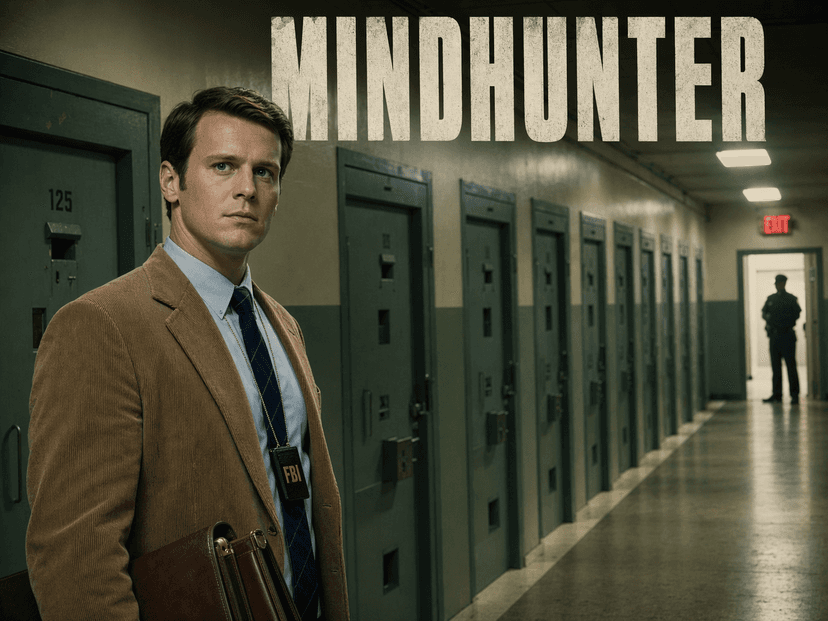
Developed by British playwright Joe Penhall from the 1995 book Mindhunter: Inside the FBI's Elite Serial Crime Unit by John E. Douglas and Mark Olshaker, the show fictionalises the real birth of criminal profiling. It drops you into the late 1970s, into the newly formed FBI Behavioural Science Unit at Quantico, Virginia, where two agents start doing something the Bureau has never formally sanctioned. The job is straightforward and strange. Drive from prison to prison. Sit across from the worst people in America and ask them questions, then try to turn the answers into a system.
Fincher executive produced alongside Charlize Theron and personally directed seven episodes, including the pilot. His fingerprints are on every frame of the show, even the episodes he did not shoot. The result is a procedural that moves with the patience of a feature film and the discipline of a man who shoots forty takes because take thirty-nine was almost right.
Jonathan Groff plays Special Agent Holden Ford, the young hotshot with an instinct for the interview and a growing inability to leave the job at the office. Holt McCallany plays his partner Bill Tench, older, heavier, steadier, a family man who has seen enough to know the work has a cost. The two are a classic double act and the show lives or dies on their chemistry. It lives, easily.
Anna Torv plays Dr Wendy Carr, the Boston-based academic psychologist who joins the unit to put their fieldwork on a scientific footing. Carr is loosely modelled on Ann Wolbert Burgess, the real psychiatric nurse and scholar who helped Douglas and Ressler turn scattered notes into a methodology. Torv gives her a quiet, watchful authority. She is the person in the room who notices everything and says the least.
Around them, a rotating cast of imprisoned killers. Cameron Britton as Ed Kemper is the one everyone remembers. He was Emmy-nominated for the role and deserved to win, a six-foot-nine presence who talks about unspeakable acts in the soft, helpful tone of a man explaining his tax return. Happy Anderson plays Jerry Brudos, locked eye contact and a terrifying stillness. Oliver Cooper turns up as David Berkowitz, the Son of Sam, grinning through his own interview like the whole thing is a game he is winning. Damon Herriman gets a brief, extraordinary cameo as Charles Manson and then played the same character in Tarantino's Once Upon a Time in Hollywood the following year. Across both seasons, Sonny Valicenti haunts the margins as a shadowy figure implied to be Dennis Rader, the BTK killer. A thread the show was setting up for a finale it will probably never get.
Lauren Glazier
Kay Manz
Albert Jones
Jim Barney
Damon Herriman
Charles Manson
Stacey Roca
Nancy Tench
Sonny Valicenti
BTK / Dennis Rader (implied)
Cameron Britton
Edmund Kemper
Michael Cerveris
Ted Gunn
Jonathan Groff
Holden Ford
The domestic cast is smaller but essential. Hannah Gross plays Debbie Mitford, Holden's girlfriend and a sharp corrective to his self-importance. Stacey Roca plays Bill's wife Nancy, running a quiet parallel drama about a family trying to be normal around a father who interviews monsters for a living. Cotter Smith plays the unit's cautious supervisor Shepard. Michael Cerveris joins in season two as Ted Gunn, a more ambitious administrator. Joe Tuttle as Gregg Smith, Albert Jones as Jim Barney and Lauren Glazier as Kay Manz round out the BSU team.
On paper this is a procedural about the founding of a unit. In practice it is a study of the limits of rationality.
The central project of Holden, Bill and Wendy is to apply social science to evil. Codify it. Interview enough killers, catalogue the patterns, and you will have a tool that helps local cops catch the next one before he kills again. That project worked in real life. The Behavioural Science Unit changed American policing. But Mindhunter is fascinated by what the work does to the people doing it, and by the gap between a clean typology and the mess of an actual human being in a prison room.
Each season has a concurrent case Holden and Bill try to crack, and each case pushes on a different part of the method. Does the profile actually help? Does Holden's knack for the interview start to look, from a certain angle, like its own pathology? The show refuses to let its heroes be heroic in the way a lesser procedural would. They are clever. Also worn down, compromised, vain, tired. The job is turning them into versions of themselves they did not plan on being.
Fincher's house style is all over Mindhunter. Static frames and locked-off masters, with very little handheld work anywhere. The camera holds on a conversation until the conversation becomes unbearable, and then it holds for a few beats longer. Interview scenes often run uncut for two or three minutes. No score, no cutaways, just two people and a table and the slow arrival of something the agent came to find.
The palette is deliberate and cold. Late-70s browns and beiges everywhere, cut with the government-issue greens of federal buildings. Fluorescent-lit prison rooms, wood-panelled motel offices. Period cars and period hair without the usual nostalgic sheen. The soundtrack drops in real pop music sparingly and always for a reason. A Talking Heads needle drop here. A Led Zeppelin cue there. Mostly what you hear is the hum of strip lights and the tape recorder.
The pace is unfashionably patient. Episodes run a full hour and often use most of that hour on two or three long scenes. It is the opposite of modern "must hook in ten seconds" streaming editing. It expects you to sit with it. If you do, it rewards you with some of the best interrogation writing on television.
Critics loved it. The show sat in the mid-to-high 90s on Rotten Tomatoes across both seasons and collected multiple Emmy nominations, with Britton's nod the most talked about. Audience reception was quieter, partly because Netflix famously refused to release viewing figures and partly because the show demanded a patience the platform's recommendation engine does not reward. Word of mouth carried it. Reddit threads and YouTube video essays carried it. It became the kind of show people press on each other.
Then, in 2020, Fincher put it on hold. The agents' contracts were released. The cast moved on. Fincher went to make Mank and The Killer. Occasionally he gives an interview saying the show was never profitable enough for Netflix at the budget he wanted to shoot it. Occasionally he hints at a possible return. Neither seems to be happening.
"It's a very expensive show and, in their minds, not enough people watched it. I go, well, I understand that." Fincher, on why it stopped.
What Mindhunter left behind is a template. Every interrogation scene in prestige crime television since 2017 has been compared to its Kemper scenes. More than that, the show's specific approach to the psychology of the interviewer rippled out across the genre. So did its insistence on procedural patience. And its refusal to thrill you with murder.
Because it trusts you. Because Fincher will hold a shot until you forget you are watching television. Because Cameron Britton makes a monster plausible without ever asking you to sympathise. Because Groff and McCallany are one of the best buddy-cop duos of the decade without either one ever throwing a punch.
I came to Mindhunter late, after everybody already knew it was not coming back, and I still felt the loss at the end of season two. Fans of True Detective will recognise the long takes and the interest in the darker corners of American life. Anyone who loves the way Breaking Bad and Better Call Saul let a scene breathe will be at home in the Kemper interviews. The patient institutional storytelling will land for The Wire devotees, and the period discipline puts it in the same aesthetic neighbourhood as Mad Men.
Two seasons and nineteen episodes, with an ending that is not an ending. Still one of the best things Netflix has ever made.
Joe Tuttle
Gregg Smith
Holt McCallany
Bill Tench
Hannah Gross
Debbie Mitford
Cotter Smith
Shepard
Oliver Cooper
David Berkowitz
Anna Torv
Wendy Carr
Happy Anderson
Jerry Brudos