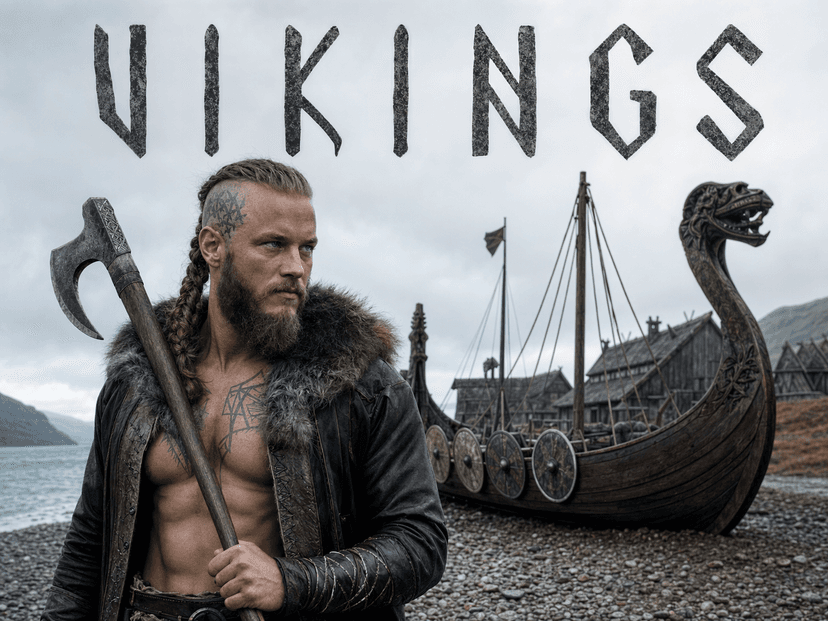
2013 - 2020

Vikings ran on History Channel from 2013 to 2020, six seasons, 89 episodes, with the final stretch debuting on Amazon Prime Video before Canadian broadcast finished the run in early 2021. It was History's first genuine scripted prestige bet, created and almost entirely written by Michael Hirst (Elizabeth, The Tudors) as a 40-hour Norse saga built around one man: Ragnar Lothbrok, a farmer from the fjord village of Kattegat who becomes the most legendary raider of the Viking Age.
Ragnar's story starts small. A restless man, an unhappy earl, a rumoured land to the west that the old routes east cannot match. The first raid on the monastery at Lindisfarne in 793 AD is the match, and everything the series does from there follows from it. Kingdoms in England, Wessex, Frankia, Kievan Rus, the Mediterranean. The map keeps expanding as Ragnar's sons inherit the ambition, and each generation wrestles with what the old gods demand and what the new god is offering.
This is Hirst doing what he did for the Tudors, only with longer hair and better fight choreography.
Travis Fimmel as Ragnar Lothbrok is the reason the show works in seasons one through four. He had done almost no serious dramatic work before this. A Calvin Klein model with a few minor credits. Then he walks on screen with that wide-eyed thousand-yard stare and turns Ragnar into something nobody predicted: funny, frightening, warm, cold, cunning, and tender inside the same scene. Casting directors should still be studying it.
The ensemble that forms around him:
Katheryn Winnick
Travis Fimmel
Alex Høgh Andersen
Jonathan Rhys Meyers
George Blagden
Gustaf Skarsgård
Clive Standen
David Lindström
Marco Ilsø
Peter Franzén
Skarsgård is a revelation. Winnick does more with a braid and a stare than most actors manage with a monologue. Høgh Andersen arrives in season four and turns Ivar into the most compelling antagonist the show produces, a role defined by physical constraint and psychological volatility in equal measure.
On the surface: raids, shield walls, axes, longships cresting cold water at dawn. Beneath that, Vikings is a show about fate. Every major character carries a version of the same belief, that their path has been set by the gods, their place in Valhalla already decided, every choice a rehearsal of something already written.
The tension between Norse paganism and European Christianity is the real subject. Hirst is careful never to caricature either side. Odin and Thor are treated as real presences in the world of the show, not props. The seers, the rituals at Uppsala, the blood eagle, the whispered invocations before battle. These are not set-dressing. When a character says "skål" they mean it. And when Athelstan finds himself torn between the monastic certainty he came from and the gods he starts to sense in the woods around Kattegat, the show treats his crisis with genuine weight. I came for the longships and stayed for Athelstan.
Family is the other engine. Brothers who love each other and cannot stop competing. Fathers and sons who mirror each other and refuse to admit it. Mothers who carry the grief of the whole saga. If you watch closely, almost every arc is a story about what gets passed down and whether it can ever be set down.
Shot mostly in Ireland, County Wicklow standing in for the Scandinavian coast, with a second unit that knew how to frame a longship. The show's look is cold and wet and beautiful, heavy on natural light, low on CGI, loud on practical effects. The fights are brutal and short. The camera sits low in the shield wall. When bodies fall they fall heavy.
Trevor Morris's score is a huge part of why the show hits. Low drums, Norse horns, Fever Ray's "If I Had a Heart" as the title track (the single best opening credits on television in the 2010s, and I will argue that). The soundtrack tells you what the show thinks of its own subject before a word is spoken. This is a serious saga, treated seriously, by people who cared.
The show pulled consistent ratings for History and enough critical respect to keep the lights on for six seasons. Fimmel's performance in the early years earned Critics' Choice nominations and a cult following that has only grown since. Winnick became a genre-face of the decade off the back of Lagertha. Hirst proved he could build a long-form historical epic that was not Game of Thrones and not trying to be.
The show's actual impact is harder to measure and easier to spot. Streaming shelves were thin on Norse content before 2013. Every Viking show that has come since, including the Netflix sequel Vikings Valhalla, owes this one a debt. So does a lot of the wider "historical men with axes" genre that filled the decade that followed.
Vikings works because Michael Hirst believed in his material. Six seasons of one man's writing, almost every episode, keeps the voice consistent in a way few prestige shows manage. It works because Travis Fimmel was handed a once-in-a-career role and met it. It works because the supporting bench kept producing performances the show did not strictly need but benefited from hugely. Skarsgård, Roache, Rhys Meyers, Høgh Andersen.
Later seasons get patchy. I will not pretend otherwise. The post-Fimmel era takes a while to find its feet and never quite recaptures the voice of the first four years. But the best of Vikings, the Ragnar-and-Athelstan core, the Lindisfarne raid, the confrontation with Ecbert, Lagertha on the battlefield, is as good as the genre has produced.
If you want the Saxon side of the same era, The Last Kingdom is the closest companion piece on the site. If you want pirate lawlessness with the same taste for cold water and long shadows, Black Sails will scratch the itch. And if you simply want more of these characters, Vikings Valhalla picks the saga up a hundred years later.
Odin favours the bold. So does this show.
Jordan Patrick Smith
Linus Roache
Alexander Ludwig
Donal Logue