2015 - 2022

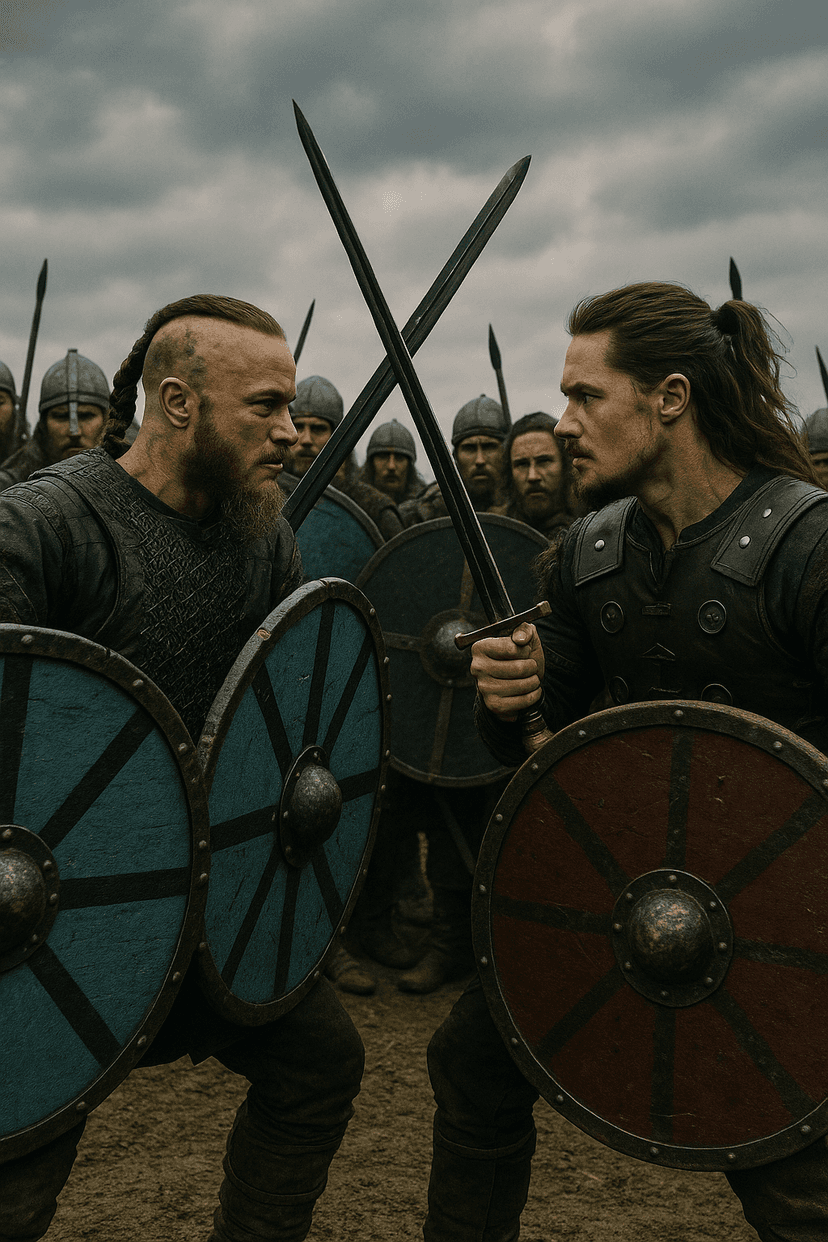
The Last Kingdom arrived on BBC Two in 2015 and was picked up by Netflix from season two onwards, running five seasons and 46 episodes before landing a feature-length finale film, Seven Kings Must Die, in 2023. Stephen Butchard adapted Bernard Cornwell's The Saxon Stories novels into one of the better-looking and better-acted historical dramas of the streaming era. The premise is simple and brutal. A young Saxon noble, Uhtred of Bebbanburg, is orphaned in a Viking raid, captured, and raised by Danes as one of their own. When he comes of age he is caught between two worlds for the rest of his life. Saxon by blood, Dane by upbringing, Uhtred is the perfect outsider to walk us through the making of England.
The show covers roughly the same period as Vikings but from the other side of the shield wall. Where Vikings gives us Ragnar Lothbrok pushing west, The Last Kingdom puts us in the shoes of the people whose villages he is burning, and then the son of one of those villages fighting for a king who is trying to hold a country together. I came to the show expecting a Vikings knockoff and left thinking it might be the better of the two. Quieter, cleaner, less interested in mysticism.
Alexander Dreymon carries the entire show as Uhtred and it is a genuinely impressive central performance. He plays a man whose two cultural halves are always at war inside him, a warrior who would rather not kill, a pagan serving Christian kings. Dreymon is charming, physical, and a little bit haunted by it all, and he earns every one of the 46 episodes he leads.
Around him, the ensemble does the real work of turning what could be a straightforward swords-and-shields show into something warmer. David Dawson is the standout as King Alfred in seasons one to three, a frail, sickly, scholarly king who is also one of the most politically cunning characters on television. Emily Cox as Brida, Uhtred's Danish soul-sister turned adversary, is brilliant across the full run. Ian Hart is an absolute treasure as Father Beocca. The show is stacked with them.
The core supporting cast includes:
Mark Rowley
Finan
Alexander Dreymon
Uhtred of Bebbanburg
Arnas Fedaravicius
Sihtric
David Dawson
King Alfred the Great
Ian Hart
Father Beocca
Harry McEntire
Aethelwold
Millie Brady
Princess Aethelflaed
Eliza Butterworth
Aelswith
Finan and Sihtric are the heart of the Uhtred crew and the show is at its strongest when those three are riding together.
The Vikings and Saxons are the surface. Underneath, The Last Kingdom is a story about identity and loyalty, and whether you can serve a cause you do not fully believe in. Uhtred's constant refrain is "Destiny is all", and the whole show is a slow argument about what that phrase means for a man who was never allowed to choose his own side.
It is also a story about the making of a country. Alfred is the only Saxon king who understands that the four kingdoms of Wessex, Mercia, Northumbria, and East Anglia have to become one country or they will all fall separately to the Great Heathen Army. He sees it. Almost no one else does. Edward and Aethelflaed inherit that impossible project. Uhtred keeps riding north, drawn back to Bebbanburg like a tide, and back south again when a king calls him. The show is quite sharp on the idea that England was not inevitable. It had to be built, and it was built by compromises and unlikely friendships between men who did not like each other very much.
Faith gets a serious and fair hearing here, which is rare. The Saxon Christian world and the Danish pagan world are both treated as real and internally coherent. The show does not pick a team.
Visually The Last Kingdom favours moody greys, wet Northumbrian fields, and firelit timber halls over any kind of fantasy gloss. The battle scenes are close and muddy, with real weight behind the shield-wall set pieces. The Vikings have long hair and tattoos, the Saxons have haircuts and crosses, and the show resists the temptation to make either side cartoonish. The score by John Lunn is low and rhythmic and does a lot of work.
It looks like a show that respects the source material and does not feel the need to oversell itself.
Pacing is the thing that surprised me. Early on the show is relatively compact. Each season is eight to ten episodes and the plot moves. It never gets stuck in its own mythology.
Critically it had a slow start and a strong finish. Season one was respectably reviewed. By season four and five it was regularly appearing on best-of-the-year lists for historical drama, and Netflix kept ordering more of it. It was quickly branded in fan circles as the thinking viewer's alternative to Vikings, and there is some truth to that, even if the comparison does both shows a disservice.
Seven Kings Must Die, the 2023 Netflix film, tied off a remaining stretch of Cornwell's books in one go and gave the show a clean, proper ending. Rare for a streaming drama to exit with dignity. This one did.
What The Last Kingdom gets right is the thing most historical TV gets wrong. It trusts its period. It does not wink at the camera, it does not bend its characters into modern shapes, and it lets its Saxon and Danish worlds speak for themselves in language, violence, faith, and politics. Dreymon is the anchor and the writing respects him enough to let Uhtred be wrong sometimes. Alfred is a difficult, fascinating man and David Dawson plays him as a real human and not a noble monument.
If you loved Vikings and bounced off Vikings Valhalla, this is the one to queue up next. Fans of Game of Thrones looking for grounded medieval politics without the dragons will find a lot to like. And if Wolf Hall hooked you with the idea of a single clever man trying to steer an impossible kingdom, Alfred's arc here is the 9th-century cousin of that story.
Five seasons, one film, a proper ending. Bang on.
Timothy Innes
King Edward
Emily Cox
Brida