2024 - 2024

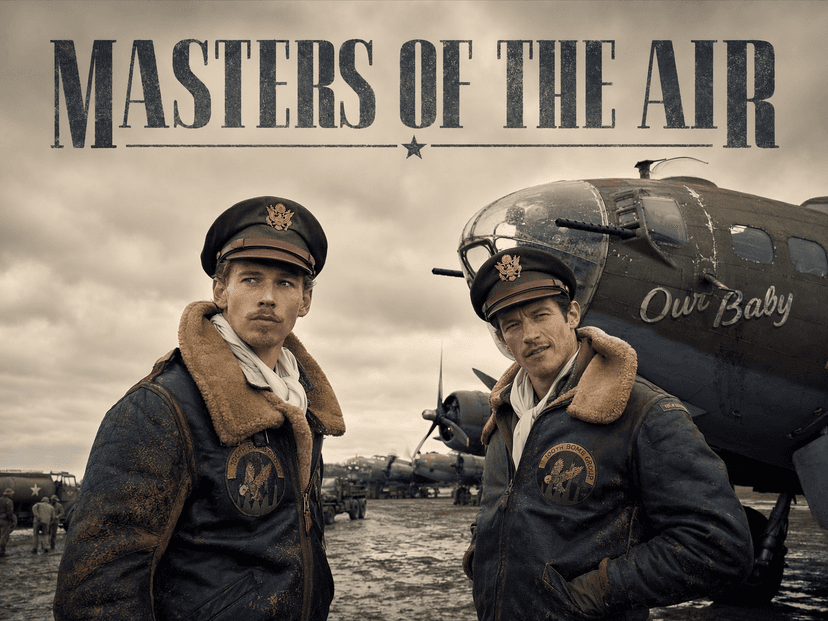
Masters of the Air landed on Apple TV+ in January 2024 across nine episodes. It is the third and (for now) final chapter in the Spielberg and Hanks WWII anthology that began with Band Of Brothers in 2001 and continued with The Pacific in 2010. Steven Spielberg, Tom Hanks and Gary Goetzman produce through Playtone and Amblin, working from Donald L. Miller's 2006 non-fiction book Masters of the Air: America's Bomber Boys Who Fought the Air War Against Nazi Germany.
The subject is the 100th Bomb Group of the US Eighth Air Force, nicknamed the "Bloody Hundredth" for the ruinous losses it took in 1943. Based at RAF Thorpe Abbotts in Norfolk, England, the unit flew B-17 Flying Fortresses on daylight precision-bombing raids over Nazi-occupied Europe. The show opens with the group arriving in England in 1943 and runs through to the end of the war in 1945, widening out from the Norfolk airfield to cover a POW storyline inside Stalag Luft III and a later arc with the Tuskegee Airmen of the 332nd Fighter Group.
This is expensive, prestige television built around a subject that TV has largely left alone. Fighter-pilot stories get told. Bomber crews, less so.
Austin Butler leads as Maj Gale "Buck" Cleven, the quiet, level-headed squadron commander who becomes the moral centre of the group. Callum Turner plays Maj John "Bucky" Egan, Buck's best friend and opposite number. Egan is louder, rowdier, more reckless, and the Buck-Bucky pairing is the spine the first half of the series is built on.
Anthony Boyle plays Maj Harry Crosby, a navigator who struggles with airsickness in early missions and emerges as one of the show's primary viewpoint characters. Crosby narrates much of the story and carries the audience into rooms and briefings the combat pilots never see. Nate Mann plays Robert "Rosie" Rosenthal, a late arrival who turns out to be one of the most skilled B-17 pilots in the Eighth Air Force, and whose Jewish identity gives his fight against the Reich a specific personal weight.
Around them sits a deep bench of supporting players:
The ensemble is enormous. Nine episodes to introduce, develop and send so many crews into the air is the production's single biggest structural problem, and it is fair to say not every face gets the room it needs.
Ncuti Gatwa
2nd Lt Robert H. Daniels
Josiah Cross
2nd Lt Richard D. Macon
Sawyer Spielberg
Supporting airman
Austin Butler
Maj Gale "Buck" Cleven
Anthony Boyle
Maj Harry Crosby
Raff Law
Sgt Ken Lemmons
Callum Turner
Maj John "Bucky" Egan
Nate Mann
Robert "Rosie" Rosenthal
The book the show adapts is not a heroic adventure story. It is a forensic account of a unit that took statistically near-total casualties in its first six months of combat. The 100th Bomb Group earned "Bloody Hundredth" honestly. Crews knew their odds. They flew anyway.
Masters of the Air is less interested in battle tactics than in what sustained men under those odds. Friendship. Superstition. Routine. The refusal to look too closely at the numbers. Officers in their twenties commanding missions with casualty rates that would have broken a ground unit in a week. The show keeps returning to the small rituals that made the unbearable possible, the nicknames, the photographs taped inside cockpits, the drinks waiting in Norfolk pubs on the nights crews came back short.
It is also a show about the cost of winning a bureaucratic war. The Eighth Air Force theory of daylight precision bombing was, on paper, a humane way to cripple German industry. In practice, unescorted B-17 formations over targets like Regensburg and Münster absorbed losses that would embarrass a ground general. The show treats that contradiction straight. Leaders order missions they know will kill most of the men in the briefing room. Men fly them anyway. Nobody gets the luxury of pretending the maths is not what it is.
Visually, this is the most ambitious of the three Spielberg-Hanks productions. The cockpit work is claustrophobic to the point of discomfort, four-engined bombers cramped with crew, frozen glass, oxygen masks, radios screaming, flak bursting close enough to rock the frame. The aerial combat leans heavily on visual-effects work that is mostly excellent and occasionally pushes the uncanny-valley button. When it works, and it works often, you get a genuine sense of what 25,000 feet over the Reich in a B-17 actually looked like.
On the ground, the Norfolk airfield is a specific, lived-in world. Muddy Nissen huts, bicycles on lanes, local pubs, the briefing room with its target maps, ground crews nursing battered airframes back into condition between missions. The production found the texture of an English base in wartime and stayed with it.
Scoring is restrained. The sound design is not. Flak, engine noise and the terrible silence after a crew goes down do most of the emotional heavy lifting.
Critics came in divided. The technical execution, cockpit work, aerial photography, production design, drew near-universal praise. The concern was character development. Nine episodes is not a lot of room for a cast this big, and a number of reviewers felt several of the crews blurred together or exited the story before the audience had properly met them. Compared to the twenty-plus hours Band Of Brothers got to build its platoon, Masters of the Air is trying to do similar work in roughly a third of the time.
What it does have, and what lifts it, is the factual weight of the 100th Bomb Group's story and a handful of performances (Butler, Turner, Boyle, Mann) that punch through the condensed format. The Tuskegee Airmen arc in the final episodes opens a second front the earlier two chapters of the trilogy never touched, and the Stalag Luft III sequences give the series a moral argument its battle scenes could not make alone.
It has not displaced Band Of Brothers in the cultural memory. Very little has. But it sits comfortably alongside The Pacific as a serious, adult piece of war television. Apple spent reportedly north of 250 million dollars making it, and for once the money is on the screen.
I went in sceptical. Nine episodes felt thin for a subject this big, and the Spielberg-Hanks template had a lot to live up to. What the show does very well is respect the audience. It assumes you can keep track of a large ensemble. It assumes you can cope with a tone that is grim without being nihilistic. It assumes you want the facts of the 100th Bomb Group's war, including the parts that complicate the clean narrative of American air power.
Is it as good as Band Of Brothers? No. Almost nothing is. Is it the best bomber-war show television has produced? Comfortably yes, because the competition is thin. For fans of the earlier two chapters it is essential viewing. For anyone interested in what it actually cost to break the Luftwaffe in 1943 and 1944, it is the most honest dramatisation we have.
And it earns its final half hour. That much I will say spoiler-free.
Branden Cook
2nd Lt Alexander Jefferson
Barry Keoghan
Lt Curtis Biddick
Stephen Campbell Moore
Maj Marvin "Red" Bowman