2020 - 2023

Perry Mason landed on HBO in June 2020 and ran for two eight-episode seasons, finishing in April 2023 before the network pulled the plug. Two seasons, sixteen hours of television, cancelled just as most of us were hoping it would find its third gear.
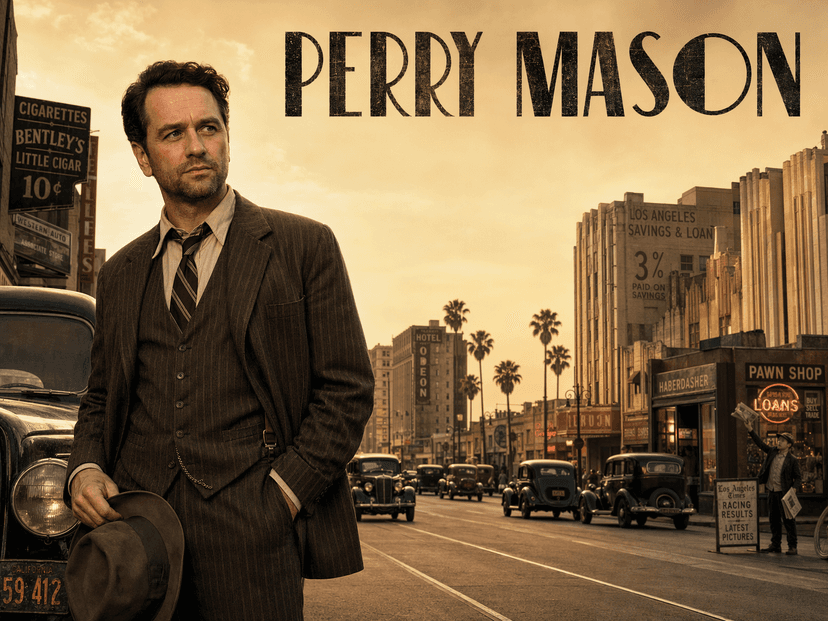
The show is a reboot, and a drastic one. Erle Stanley Gardner wrote Perry Mason novels from 1933 to 1973. Raymond Burr played him on CBS from 1957 to 1966 as a cheerfully unflappable defence attorney who won every week and never broke a sweat. That is not this show. Rolin Jones and Ron Fitzgerald took Gardner's 1933 debut The Case of the Velvet Claws and rebuilt Mason from the ground up as a broken WWI veteran scraping a living as a private investigator in 1932 Los Angeles, years before he ever stood up in a courtroom.
The first season hangs on a single case. An infant abduction that curdles into a murder investigation, the Dodson family at the centre of it, and the True Holiness evangelical movement swirling around the edges. The second season moves on to a new murder and a new client. Same city, same year or two later, broader canvas.
Matthew Rhys plays Perry. This was his first major lead after The Americans and he arrives carrying every bit of that show's watchful, wounded register. His Mason is a man who drinks too much, sleeps in the wreckage of his family's dairy farm, and cannot quite look people in the eye. It is a long way from Raymond Burr and that is the point.
The ensemble is unusually deep for a reboot. The main rotation across both seasons:
Season two brings in Jen Tullock as journalist Anita, Katherine Waterston as Ginny Aimes, Justin Kirk as a young DA Hamilton Burger, and Sean Astin as Sunny Gryce.
John Lithgow
E.B. Jonathan
Sean Astin
Sunny Gryce
Robert Patrick
Herman Baggerly
Tatiana Maslany
Sister Alice McKeegan
Juliet Rylance
Della Street
Lili Taylor
Birdy McKeegan
Chris Chalk
Paul Drake
Stephen Root
DA Maynard Barnes
Rylance is the one to watch. Her Della is the emotional centre of both seasons and probably the best single performance in the whole thing.
Strip away the period wardrobe and the reboot is a trauma study. Perry is a WWI veteran, the kind of broken American that the literature of the period called shell-shocked, and the show treats the war as the unhealed wound under everything he does. He drinks because of the war. He cannot hold a relationship because of the war. He is drawn to cases that let him find a villain to punish because the real one is fifteen years and six thousand miles behind him.
Season one is the more coherent read on this. An orphaned child, grieving parents, an evangelical movement promising consolation, and a private investigator who cannot offer any. The show is measured and patient. It does not sermonise.
Season two broadens into the corruption of Depression-era Los Angeles more generally. Oil money, racial policing, the machinery of the DA's office. Less thematic weight, more plot.
The visual register is serious neo-noir. Dust, sweat, brown suits, cigarette smoke, tungsten light through venetian blinds. Tim Van Patten directed every episode of the first season and his influence is everywhere. He is an HBO lifer with Boardwalk Empire and Deadwood on his CV and the period craft shows. Costumes and sets are the real thing. Nothing on screen feels like dress-up.
A Los Angeles of exhausted people, stained collars, and institutions that do not care who they grind up.
Season two comes from a different creative team. Jack Amiel and Michael Begler took over as showrunners, a different director rotation replaced Van Patten, and the look shifts. Same city, looser framing, more conventional prestige-TV coverage. It is still well made. Just not as controlled. If you loved the specific claustrophobia of season one you will notice the change and probably miss it.
Season one landed well. Critics treated the reboot bravery kindly, the period craft was hard to argue with, and Rhys carried the weight. Season two reviewed less favourably, roughly in the solid-but-diminished bracket, which is where the conversation got interesting. Some viewers were relieved that the plotting was tighter and the mystery more satisfying. Others felt the tonal specificity of season one had been thinned out. HBO cancelled the show shortly after, and the reception to the cancellation was close to unanimous irritation. Most of us wanted a third season where Perry actually became the trial lawyer the Raymond Burr version already was.
A good-not-great prestige genre piece cancelled right when it had earned the runway to become something more.
Honest take. Perry Mason is not a masterpiece and I would not pretend otherwise. Season one is very good. Season two is decent. Neither one is in the top tier of HBO drama.
But I liked it. Matthew Rhys is doing careful, controlled, adult work and there is not enough of that on television. Juliet Rylance should have been a much bigger deal coming out of this and got robbed by the cancellation. The period is handled with the care of people who actually love 1930s Los Angeles as a setting and not as a vibe.
If you liked The Night Of for its slow-burn legal mood, or True Detective season one for its dread-soaked sense of place, or the period commitment of Boardwalk Empire, Perry Mason earns a watch. It is a two-season commitment, it does not overstay, and the first season in particular is better than most people who skipped it realise.
Nate Corddry
Matthew Dodson
Jen Tullock
Anita
Paul Raci
Pete McAllister
Shea Whigham
Pete Strickland
Justin Kirk
DA Hamilton Burger
Katherine Waterston
Ginny Aimes
Gayle Rankin
Emily Dodson
Eric Lange
Detective Ennis
Matthew Rhys
Perry Mason