2004 - 2012

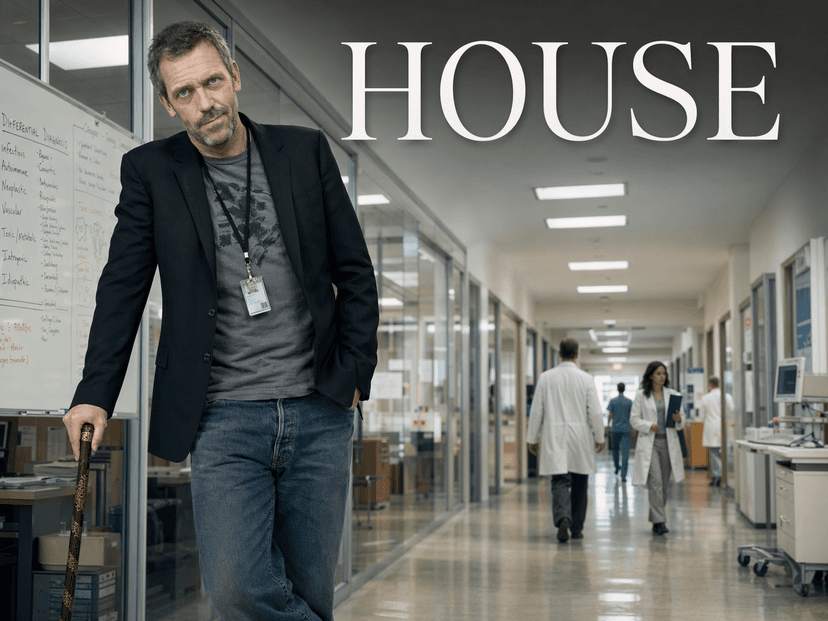
House ran on Fox from 2004 to 2012. Eight seasons. 177 episodes. Created by David Shore. It should not have worked. A medical procedural on a broadcast network, built around a pill-addicted cynic who treats every patient like a crime scene and every colleague like a suspect. Yet it became, for a stretch in the late 2000s, the most-watched drama on the planet.
The premise is a straight lift from Arthur Conan Doyle, and Shore has never pretended otherwise. Dr. Gregory House is Sherlock Holmes with a stethoscope. Dr. James Wilson is his Watson. Princeton-Plainsboro Teaching Hospital is his 221B. The patients are the crimes. The diseases are the criminals. House even lives at apartment 221B. Shore takes the skeleton of a Holmes story, drops it inside a New Jersey teaching hospital, and lets the cases do what mystery plots always do. They give a brilliant misanthrope something to fix while the real drama happens in the margins.
Every episode is a puzzle box. A patient arrives with a symptom that does not match any obvious diagnosis. House and his team throw hypotheses at the whiteboard. They treat. The patient gets worse. They treat something else. The patient gets worse again. Eventually, usually around the 48-minute mark, House has an epiphany in the middle of a completely unrelated conversation and solves it.
It sounds mechanical because it is. Shore built a pattern and ran it for 177 hours without apology. The reason it works is that the medicine is genuinely interesting and House's voice is good enough to carry the repetition. The differential diagnosis scenes are written like courtroom arguments. Every wrong answer costs something. Every right one arrives late enough to hurt.
"Everybody lies" is his working thesis. Patients lie, sometimes about what they ate, sometimes about who they slept with, sometimes about whether they have taken their medicine. Their own bodies lie too, because symptoms are clues and clues can be faked. The job is to ignore what people say and read what the disease is actually doing. It is a philosophy of medicine that happens to double as a philosophy of television. Nothing on screen is reliable. The viewer is a detective too.
Hugh Laurie is the show. He was a British comic actor when Shore cast him, mostly known for Jeeves and Wooster and Blackadder, and he buries the accent so completely that most American viewers spent the first season unaware he was English. His Gregory House is a compound of cruelty, intelligence, physical pain, and the dry comic instinct Laurie has always had in his back pocket. He won two Golden Globes for it. He was Emmy-nominated six times. He should have won at least once.
Robert Sean Leonard plays Dr. James Wilson, the oncologist whose friendship with House is the emotional spine of the whole series. Wilson is the only person who calls House on his nonsense and stays in the room anyway. Every great episode of eventually becomes an episode about Wilson and House, which is a feature, not a flaw.
Robert Sean Leonard
Dr. James Wilson
Olivia Wilde
Dr. Remy "Thirteen" Hadley
Michael Weston
Lucas Douglas
Amber Tamblyn
Martha M. Masters
Jennifer Morrison
Dr. Allison Cameron
Lisa Edelstein
Dr. Lisa Cuddy
Odette Annable
Dr. Jessica Adams
Charlyne Yi
Dr. Chi Park
Lisa Edelstein as Dr. Lisa Cuddy runs the hospital and runs House's romantic life, often against her own better judgement. Omar Epps as Dr. Eric Foreman is the moral counterweight, a neurologist who spent years being told he was the next House and slowly realising he did not want to be. Jennifer Morrison as Dr. Allison Cameron and Jesse Spencer as Dr. Robert Chase complete the original fellowship: Cameron the ethicist, Chase the pragmatist. Each of them exists to push back at something House needs to argue against before he can think.
Season four blew the original team up and brought in a new one. Olivia Wilde as Dr. Remy "Thirteen" Hadley, a neurologist working around a terminal diagnosis of her own. Peter Jacobson as Dr. Chris Taub, the plastic surgeon whose careful lies keep unravelling. Kal Penn as Dr. Lawrence Kutner, the golden retriever of the fellowship, genuinely curious and genuinely haunted. The rotation kept the show alive past the point most procedurals become embalming projects. Later seasons added Amber Tamblyn, Charlyne Yi, and Odette Annable to the fellowship roster as the roles kept shifting around House's orbit.
David Strathairn turned up as a hospital dean in the later years. Andre Braugher arrived for a knockout arc as a psychiatrist who matched House blow for blow, one of the most talked-about stretches of the whole run. Michael Weston as private investigator Lucas Douglas added another species of outsider. For my money the bench in season six is the best of the run.
The opening credits roll over Massive Attack's "Teardrop". The camera pushes through MRI scans and X-ray plates and into the body itself. It is one of the most confident title sequences in network drama, and it tells you exactly what the show thinks it is. A detective story set inside the human body, scored by trip-hop.
Inside the hospital, the aesthetic is clean fluorescent. Glass-walled conference rooms. A whiteboard. That cane. The visual grammar is deliberately plain because the writing and the faces are doing the work. Directors like Greg Yaitanes and Deran Sarafian learned to stay out of the way. When the show does break form, like the black-and-white episode or the season finales that abandon the hospital entirely, it hits hard because the baseline has been so disciplined.
The soundtrack is better than a network medical drama has any business using. Needle drops from Warren Zevon, Leonard Cohen, Iron and Wine, Moby. Laurie himself plays piano and guitar, and the show leans into that, letting House use music the way other characters use therapy.
House was, at its peak, the most-watched TV drama in the world. Over 81 million viewers across 66 countries in 2008, per Eurodata TV Worldwide. Laurie holds a Guinness record for highest-paid actor in a TV drama for a stretch of those years. Five Emmy nominations for Outstanding Drama Series. Two Peabodys. It basically funded Fox's drama slate for the back half of the 2000s.
The show's legacy is more complicated than its ratings suggest. It invented the modern medical procedural as character study. Every difficult-genius doctor since, from the leads of The Good Doctor to New Amsterdam to Dr. Death, is carrying some genetic material from Gregory House. The show also sits inside a broader arc of American TV about opioid dependence that culminates in Dopesick more than a decade later. Vicodin was House's prop before it was a national story, and the show was quietly honest about the cost of that prop long before most of its audience was ready to hear it.
I came to the show late, bingeing seasons out of order on a long flight, and the thing that surprised me was how funny it still is. The jokes land. The riffs work. A show that could have aged like a textbook has aged like a good bar.
Strip away the cases and House is a character study of a man in constant pain who cannot stop being clever. That is a Greek setup. It would work without the medicine. The medicine gives Shore a new plot every week and lets him circle the same wound from a different angle 177 times without ever quite repeating himself.
The anti-hero medical lead has been done to death since, mostly badly. The template looks easy to copy. What nobody has managed to replicate is the chemistry between Laurie and Robert Sean Leonard, or the willingness to let an hour of network television turn into a two-hander about grief, addiction, and the price of being the smartest person in the room. I think fans of heavy character studies like Breaking Bad or Mad Men will find a lot to love here. So will anyone who enjoyed The Patient for the way it uses a single medical professional as a pressure chamber for moral questions.
It is still one of the best network dramas America has ever made. It deserves another generation of viewers.
Kal Penn
Dr. Lawrence Kutner
Peter Jacobson
Dr. Chris Taub
Omar Epps
Dr. Eric Foreman
Jesse Spencer
Dr. Robert Chase
Hugh Laurie
Dr. Gregory House
Andre Braugher
Dr. Darryl Nolan
David Strathairn
Dean of Medicine