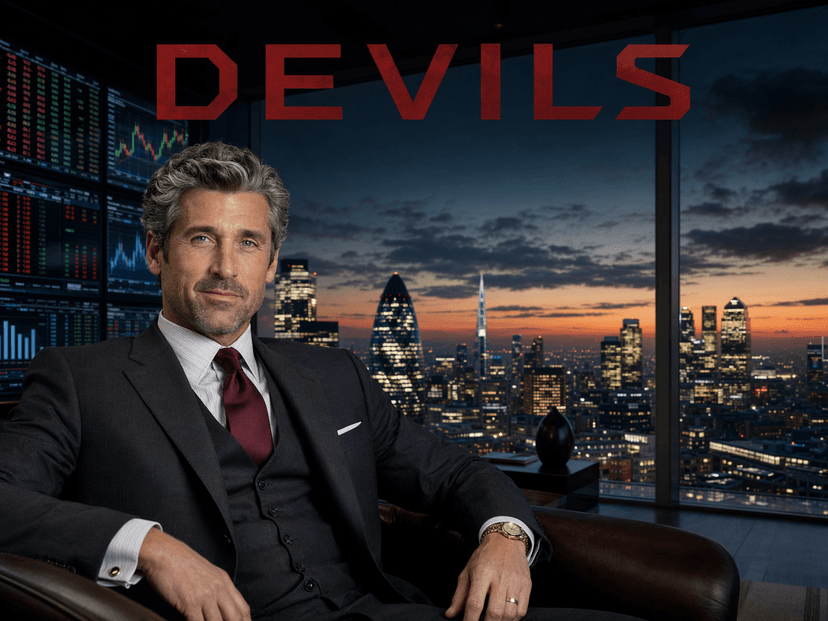
2020 - 2022

Devils is a Sky Italia and NBCUniversal co-production that ran for two seasons from 2020 to 2022, twenty hours of television across eighteen episodes broadcast on Sky Atlantic in Italy and later picked up by the CW in the United States. The source material is I Diavoli, Guido Maria Brera's 2014 Italian novel drawn from his own years inside asset management, with Ezio Abbate leading a writers room that kept the bite of the book while smoothing its rougher Italian specifics for an English-speaking audience. Filming took place in London and Rome. The dialogue is almost entirely in English.
Massimo Ruggero, played by Alessandro Borghi, is an Italian-born head of trading at New York-London Investment Bank, a fictional City of London bank styled after the big American houses that dominate European finance. When his mentor and CEO Dominic Morgan, played by Patrick Dempsey, passes him over for a promotion he has spent a decade earning, the slight opens a crack. Through that crack Massimo starts to see what his bank actually does to the countries whose debt it trades. Season one tracks the 2011 sovereign debt crisis across Europe. Season two fast-forwards to 2016, Brexit, and the rise of big tech as a new kind of geopolitical power.
Borghi carries the show. A David di Donatello winner for On My Skin and a genuine leading man in Italian cinema, he brings a kind of held-back, watchful intelligence to Massimo that makes the character more than a standard trading-floor anti-hero. He barely raises his voice. He watches, he calculates, and when he moves he moves hard. The performance alone is worth the watch.
Patrick Dempsey is the other half of the engine. Stepping well clear of Derek Shepherd, he plays Dominic Morgan as a charming, American-accented father figure whose generosity is always shot through with something colder underneath. Kasia Smutniak, the Polish-Italian lead of Perfect Strangers and Paolo Sorrentino's Loro, plays Nina Morgan with composed menace. Laia Costa, best known for Sebastian Schipper's one-shot thriller Victoria, plays journalist Sofia Flores in season two and injects welcome moral clarity into a show that can otherwise feel suffocated by its own cynicism. Malachi Kirby, a BAFTA winner for Small Axe: Mangrove, plays Oliver Harris, Massimo's loyal deputy, and gets some of the show's best quieter moments.
Supporting the leads:
Lars Mikkelsen
Daniel Duval
Kasia Smutniak
Nina Morgan
Paul Chowdhry
Kalim Chowdrey
Malachi Kirby
Oliver Harris
Patrick Dempsey
Dominic Morgan
Pia Mechler
Eleanor Bourg
Harry Michell
Paul McGuinnan
Laia Costa
Sofia Flores
It is a properly international ensemble. Italian, American, Polish, Spanish, British-Jamaican, German, Dutch, Danish. That casting choice is also the thematic choice.
Underneath the glass-and-steel polish, Devils is a show about who actually runs Europe. The argument the series quietly makes, and it grows louder as the seasons progress, is that elected governments are no longer the primary actors in their own economies. Investment banks are. Hedge funds are. And behind the banks sit a small number of individuals whose bets on a country's debt can force austerity, topple administrations, or bend entire continents to their position.
The sovereign debt crisis storyline in season one is the clearest articulation of this. When a trader shorts Greek or Italian bonds at scale, the bond market moves, and the bond market moving forces real political choices on the ground in Athens or Rome. Devils wants you to feel the asymmetry of that power. It wants you to notice that the person making the bet is sitting in a glass office in Canary Wharf with a family in Kensington, and the person living with the consequences is a pensioner in a Mediterranean country he may never have visited.
Season two pushes the same argument into the Brexit referendum and the encroachment of Silicon Valley capital into territory banks used to own. It is less tightly written than season one, but the ambition is larger. There is genuine interest in how the internet, the dark web, and a new generation of tech billionaires are carving influence away from the old houses.
The direction leans corporate and cold. Long tracking shots through glass-walled floors, Bloomberg terminals glowing blue in dark rooms, helicopter pans over London's financial district at dusk. John Paesano's score is pulsing electronic stuff that gives even mundane meetings the weight of a thriller. The visual vocabulary is clearly indebted to Billions, but where the American show is loud and quippy, Devils is cooler and more European. More whispers, fewer speeches.
The production design is a genuine treat. Real penthouses, real restaurants, real London. Expensive watches and tailoring you can almost feel. Anyone who enjoys the grown-up decor of Succession will find plenty to look at here.
Where the show occasionally struggles is tone. The English-language dialogue written by an Italian writers room can creak, and a few of the supporting performances feel imported rather than native. It is not The Night Manager in terms of verbal polish. But the central pairing of Borghi and Dempsey holds everything together, and when the show remembers it is a thriller about real money and real consequences, it is genuinely gripping.
Critics were divided. Italian reviews were largely positive, with praise for Borghi's performance and the ambition of the premise. Anglophone reviews were more mixed. Some found the globe-trotting plot too glossy, others thought it a welcome counterweight to American-made finance dramas. Indiewire noted the show was glossier than its themes strictly warranted. Viewers, particularly in Italy and across mainland Europe, were more enthusiastic. NBCUniversal sold the series into more than 160 territories, a rare reach for an Italian-originated drama.
Within the broader finance-drama canon, Devils sits alongside Billions as a mainstream attempt to put the trading floor on screen. It is chillier than Billions, less concerned with rivalry and more concerned with structure. It pairs well with Succession as a study of the wealth and access that financial power brings, and it rhymes thematically with Gomorrah and Suburra: Blood on Rome, two other Italian prestige dramas obsessed with power that flows outside the law. For viewers who like their espionage with a financial edge, The Night Manager is the nearest cousin on this site.
The reason I keep coming back to Devils, despite its unevenness, is that it is almost the only prestige drama willing to name the mechanism. Most finance shows use the trading floor as a backdrop for a personal feud. Devils uses the personal feud as a way to show you the mechanism. The Brera novel gives the show an intellectual spine, and Borghi and Dempsey give it a pulse.
A serious drama about who actually runs the continent, dressed up as a thriller about who betrayed whom in the boardroom.
It is not perfect. Season one is the stronger, tighter run of episodes, and season two reaches further than it quite grasps. A planned third season would have tackled artificial intelligence and crypto, and the fact it never materialised is a small tragedy. But what is there is worth watching, especially for anyone who suspects, and I think most of us suspect, that the people with the real power are the ones whose names never appear on a ballot.
Sallie Harmsen
Carrie Price
Ben Miles
Edward Stuart
Alessandro Borghi
Massimo Ruggero