2022 - Present

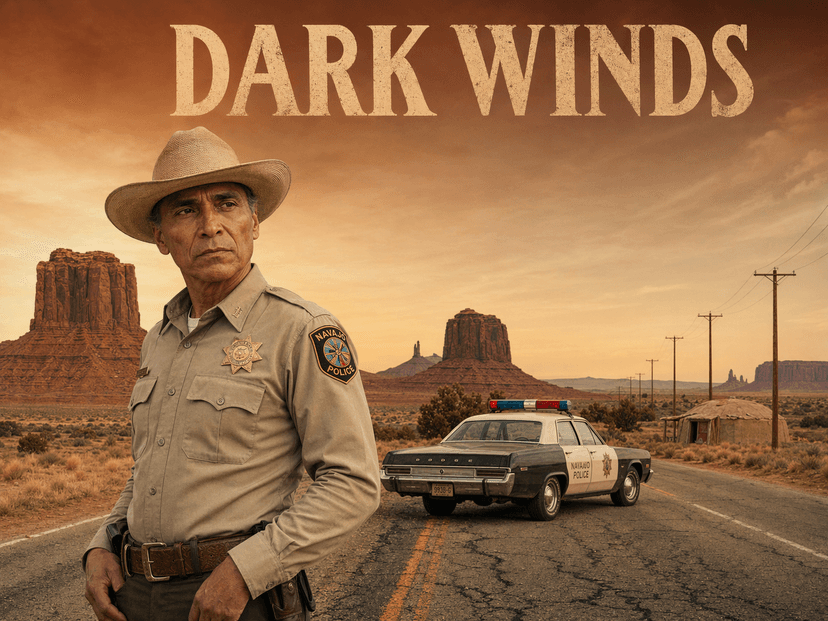
Dark Winds premiered on AMC in June 2022 and is, by some distance, the most prominent Native-American-led prestige drama any major US network has put into production. The first season ran six episodes and adapted elements of Tony Hillerman's novels Listening Woman and People of Darkness. A second six-episode run arrived in July 2023 drawing from The Dark Wind. A third season followed in March 2025, a fourth is confirmed, and the show has quietly become one of AMC's most reliable critical performers since Better Call Saul wrapped.
The setting is the Navajo Nation in the early 1970s, roughly a decade after the source novels were first published. Monument Valley, high desert, Diné communities scattered across what the federal government drew as a reservation and what the people who live there know as something older than any map. Lieutenant Joe Leaphorn of the Navajo Tribal Police runs the show's criminal investigations. His younger partner, Sergeant Jim Chee, is training as a hataali, a Diné medicine man, which creates a quiet ongoing tension between Chee's two vocations that the books always loved and the series carries forward faithfully.
Zahn McClarnon is the reason the show exists in the form it does. After two decades of strong supporting work in Longmire, Westworld, and Reservation Dogs, McClarnon finally gets top billing as Leaphorn, and he holds it with a stillness most lead actors would kill for. The grief he plays is specific. The anger is specific. He does not need a monologue to tell you what his character is carrying.
Around him:
The writers room includes Diné and other Indigenous voices. The crew was hired locally in New Mexico where possible. Filming happens on the Navajo Nation and around Santa Fe rather than on a Vancouver sound stage pretending to be the Southwest. You can see the difference.
Zahn McClarnon
Lieutenant Joe Leaphorn
Graham Roland
Creator / Showrunner (S1-S2)
Jessica Matten
Officer Bernadette "Bern" Manuelito
Deanna Allison
Emma Leaphorn
Roseanne Supernault
Recurring
Kiowa Gordon
Sergeant Jim Chee
George R.R. Martin
Executive Producer
Noah Emmerich
BJ Vines
On paper, Dark Winds is a procedural. Body of the week. Pattern of crimes. Two cops putting pieces together. Hillerman's novels worked because the procedural was the delivery mechanism for something much larger, and Graham Roland's adaptation (John Wirth took over showrunning from season three) honours that. The crimes are windows into the aftermath of boarding schools, uranium mining on reservation land, FBI overreach, the tension between traditional medicine and Christianity, between the Tribal Police and the federal agencies that periodically stomp through their jurisdiction.
Leaphorn carries a private grief that the first season circles without ever landing on cheaply. Chee is wrestling with whether to stay in law enforcement at all when his hataali training is pulling him the other way. Bern is negotiating a path as a woman in a small department in the 1970s. Emma is doing casework with children the federal system has failed. Nobody on this show is a symbol. Everybody is a person with something specific to lose.
"The show treats the reservation as a place where people live, not a backdrop."
Visually this is a slow-burn 35mm-feeling show that uses its setting instead of leaning on it. The desert is often empty and occasionally enormous. Interiors are warm and lived-in. There is no CSI-style forensic glow. The pace is closer to True Detective season one than to a network procedural, and the editing rhythm trusts the audience to sit with a conversation longer than most broadcast drama would allow.
The soundscape matters. Diné is spoken on screen without subtitling it into hand-holding oblivion. Traditional ceremony, when it appears, is filmed with the respect of people who consulted properly rather than imported a visual effects team. Some of the supernatural-adjacent material from Hillerman's books is kept, but played straight. I bounced between "this is a mystery with a ghost" and "this is a show about people who live with their ancestors" and I think the show is happy for you to sit in both at once.
Critical response has been consistently warm across three seasons. Reviewers have been unusually careful to credit the specific thing the show is doing with representation rather than flattening it into a checkbox. Ratings have never been Walking Dead numbers, but AMC has backed it for a fourth season, and the executive producer roster tells you how much institutional weight is behind it. Robert Redford held the film rights to Hillerman's novels for decades and spent a long time trying to get them made properly. George R.R. Martin, who lives in Santa Fe and has put considerable personal money into local production, is on the credits too. Hillerman's daughter Anne, who has continued writing Leaphorn and Chee novels since her father's death, is a consulting producer.
The upshot is a Native-American-led prestige drama that has outlasted several bigger-budget attempts at the same terrain. It was never going to be Yellowstone in terms of eyeballs, and it was never trying to be. But it sits on a shelf alongside 1883, 1923, and Hell on Wheels as one of the more serious-minded American-West-on-TV projects of the last decade, and it is the one written from the inside.
Zahn McClarnon. I'll say it plainly. Give a good actor a role worth his time and a showrunner who trusts him, and you get a performance that quietly restructures what you thought the genre could do. Fans of detective fiction who liked Mare of Easttown or The Night Of or Bosch will find the same attention to place and character here, just pointed at a part of America that prestige TV has mostly ignored. And if you enjoyed Fargo or Mayor Of Kingstown for the way a region can become a character, Dark Winds is operating in the same register.
Short seasons. No filler. Real landscapes. A cast who know the culture from the inside. It does not need to be bigger than it is. It needs to keep being this.
Terry Serpico
Recurring
Rainn Wilson
Antagonist (Season 3)
Robert Redford
Executive Producer
Raoul Trujillo
Recurring