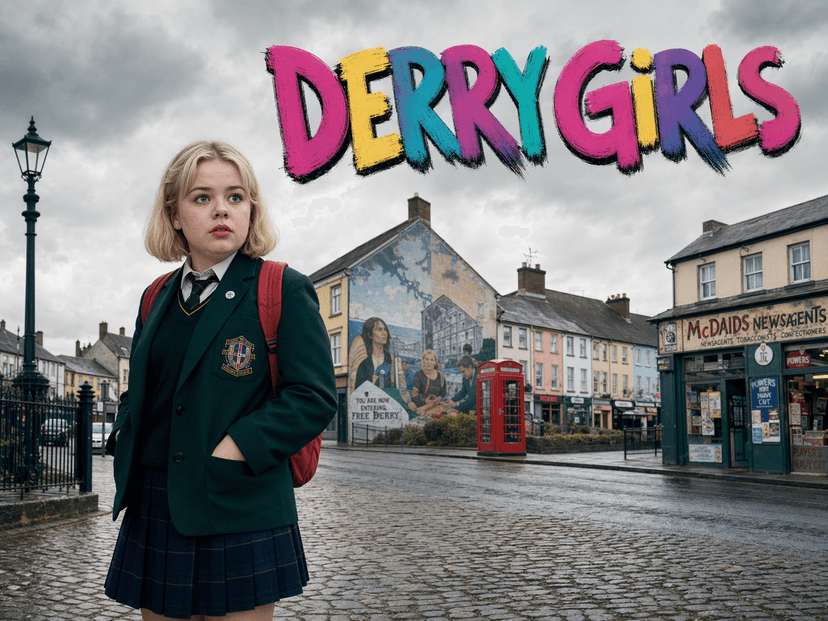
2018 - 2022

Derry Girls ran on Channel 4 from 2018 to 2022 across three short, tight series, just 19 episodes total. Created and written by Lisa McGee, who grew up in Derry during the same period, the show drops you straight into 1990s Northern Ireland at the tail end of The Troubles and refuses to explain the politics. The characters don't explain it either. They're teenagers. They've got a geography mock on Friday and Michelle has smuggled vodka into Sister Michael's morning assembly and nobody has time for the bulletins about another ceasefire.
The setup: five fifteen-year-olds at Our Lady Immaculate College, a Catholic girls' school in Derry (or Londonderry, depending on your politics, which is precisely the kind of gag the show keeps running on). There's Erin Quinn, the self-important diarist, with a diary she reads aloud as if the nation depends on it. Her cousin Orla McCool floats through at a separate angle. Clare Devlin is the neurotic swot. Michelle Mallon is the foul-mouthed engine of every bad decision. And then there is James Maguire, Michelle's English cousin, shipped over from London and parked in the girls' school because the lads' school would batter him for the accent alone. He is the wee English fella. That is how the show refers to him and that is how the show treats him.
The casting is near miraculous. Saoirse-Monica Jackson plays Erin with the kind of earnest vanity only a teenage girl who thinks she is the main character can produce, and she is from Derry herself, so the accent isn't performance. Louisa Harland's Orla is a genuinely new comedic creation. She floats through each episode on a separate frequency, half-observing her own cousin's catastrophes and half-obsessing over a Richard Marx poster or a step-aerobics routine. One of the most fully inhabited physical comedy turns in recent British TV.
Nicola Coughlan plays Clare, the top-of-class overthinker whose panic drives half the plots. This was pre-Bridgerton, pre-global fame, and watching her here, wound like a spring, is a different register from Penelope Featherington and every bit as good. Jamie-Lee O'Donnell gets Michelle, the engine of most bad decisions, and delivers the show's funniest lines at a velocity that makes them land before you've fully processed them. Dylan Llewellyn's James is the straight man from England, quietly bewildered, which is the correct posture for an English teenager dropped into a Derry Catholic girls' school in 1994.
The adult ensemble is just as sharp. Tara Lynne O'Neill and Kathy Kiera Clarke play the Quinn sisters, Mary and Sarah. One is all fret and washing-machine trauma. The other is permanently at the hairdresser and somehow more informed about the peace process than any of them. Tommy Tiernan, one of Ireland's best stand-ups, plays Gerry Quinn as the long-suffering da, a mild man trying to keep a household upright. Ian McElhinney's Grandda Joe hates Gerry on principle and lives with them anyway. And Siobhán McSweeney's Sister Michael is something else entirely. She runs Our Lady Immaculate with a permanent glare, a bone-dry delivery, and an open contempt for the teenagers in her care that somehow reads as love. McSweeney won a BAFTA for it. She earned it twice over.
Dylan Llewellyn
James Maguire
Nicola Coughlan
Clare Devlin
Louisa Harland
Orla McCool
Saoirse-Monica Jackson
Erin Quinn
Tara Lynne O'Neill
Mary Quinn
Siobhán McSweeney
Sister Michael
Jamie-Lee O'Donnell
Michelle Mallon
Kathy Kiera Clarke
Sarah McCool
The regulars who circle the gang:
Here is what makes Derry Girls more than a nostalgia sitcom. Every episode is staged against the actual news of the day. A soldier at a checkpoint. A bomb scare cancelling a school trip. Cross-border gossip about who knows whose cousin in the RUC. The Good Friday Agreement build-up in the third series. McGee plays it all deadpan in the background while the girls argue about who snogged whom at the under-18s disco. The gag is never The Troubles. The gag is that The Troubles are happening and the kids genuinely do not care, because they are fifteen and a geography test feels bigger than history.
It is a clever trick and it doesn't wear thin. The show earns sudden tonal shifts because of it. A punchline can land and then thirty seconds later the camera holds on something real and quiet, and you feel the weight of a place that was raising these kids through checkpoints and soldiers and peace walls. McGee never lectures. She just lets you see both things at once.
The result is a comedy that works whether or not you know anything about Northern Ireland. If you do, it hits deeper. The cross-community episode in the first series, in which the Catholic girls and a Protestant boys' school are brought together for an awkward bonding weekend, is the cleanest single example. A whiteboard listing "things in common" that stays almost empty is worth more than an hour of political commentary. I laughed and then sat with the quiet bit after. That's the show.
Derry is not set dressing in this show. It is the lead. Shot extensively on location in the city and around Belfast, the murals, the terraced streets, the specific green-grey light of the North, all of it is in the frame. The accents are uncut. Channel 4 aired the first episode with subtitles on international streams because producers genuinely worried some viewers wouldn't follow. The accents stay. So does the slang. So do the specific 1990s references: Take That, Macaulay Culkin, My So-Called Life, the Spice Girls, a Richard Marx obsession that becomes a running gag.
I'm a Derry Girl! James, I'm a Derry Girl.
That line, delivered late in the show, became shorthand for what the whole project is doing. Identity, rendered as a punchline, then turned around so you see it is not a punchline at all.
On Channel 4, the first series became the most-watched series in Northern Ireland since modern records began in 2002. Across its run, Derry Girls became Channel 4's biggest comedy hit in decades, often cited in the same breath as Father Ted. Each series holds a near-perfect critical score across the three runs: 100%, 97%, and 100% on Rotten Tomatoes. The third and final series won Best Scripted Comedy at the 2023 BAFTA TV Awards, with Siobhán McSweeney winning Best Female Performance in a Comedy Programme. Lisa McGee won the comedy writing trophy at the BAFTA Craft Awards the same year.
Netflix gave the show a second life internationally. It dropped onto the platform in the US and elsewhere and suddenly an ensemble of Northern Irish unknowns had a global audience. Coughlan rode that wave into Bridgerton. McSweeney into presenting The Great Pottery Throw Down. Jackson, Harland, O'Donnell, and Llewellyn all kept working across British and Irish drama.
I came to Derry Girls expecting a competent regional comedy and left thinking it is one of the best British sitcoms since The Office UK, and I do not say that lightly. For teen ensemble writing, it belongs in the same conversation as Skins, with a political substrate that Skins never attempted.
19 episodes. No filler. A finale that manages to be funny and moving about something real, and that knows when to stop. The show understood exactly what it was. That kind of discipline is rare. Watch the pilot. If the accents haven't won you over by the end of it, you're not the audience. Most people are.
Leah O'Rourke
Jenny Joyce
Ian McElhinney
Grandda Joe
Tommy Tiernan
Gerry Quinn