Antonio Jaramillo
About Antonio Jaramillo
Antonio Jaramillo is a Mexican-American actor whose weathered charisma, soft gravel of a voice, and capacity for both menace and tenderness have made him one of the most recognisable character players working in contemporary American television. Born in Tijuana, Mexico, he came into the industry by an unusually circuitous route, and that route has shaped almost everything about the way he performs: the patience, the economy of gesture, the sense that every line has been paid for rather than simply learned.
His early life was difficult in ways that he has, over the years, spoken about with unusual candour. Jaramillo spent much of his childhood in an orphanage in Tijuana, an experience he shared with a brother and one that he has described as formative rather than defining. The two boys made a pact to look after each other, and the mix of stoicism and fierce loyalty that runs through so many of his on-screen characters has its roots in that small, bonded world. In his teens he crossed the border into San Diego, where he juggled work and schooling and began the slow process of building an adult life in English as well as Spanish.
Acting was not an early ambition. It arrived, almost by accident, in his mid-twenties, when Jaramillo stumbled across the writings of Anton Chekhov and then Arthur Miller and Tennessee Williams. The discovery hit him hard. The combination of naturalism and tragic grandeur seemed to offer a language for the kind of interior life he had until then carried around without a name, and he began pursuing the craft with the zeal of a late convert. He trained in Los Angeles, became a proud ensemble member of the Antaeus Theatre Company, and has continued to return to the stage across his career. His favourite theatrical roles include the lead in the West Coast premiere of Stephen Adly Guirgis's dark comedy Our Lady of 121st Street, Konstantin in Chekhov's The Seagull, and Jacques Casanova in Williams's Camino Real, a trio that gives a fair picture of his range from street-level comedy to romantic melancholy.
Jaramillo moved full-time to Hollywood in 2004 and spent the following decade assembling the kind of working actor's résumé that rarely makes headlines but quietly builds a reputation inside casting offices. He appeared in episodes of CSI: Crime Scene Investigation, CSI: Miami, CSI: Cyber, The Mentalist, Burn Notice, Arrested Development, Outlaw, Meet the Browns, Rosewood, Devious Maids, Gang Related and TNT's revived Dallas. The roles varied enormously, from cartel lieutenants to grieving fathers, but the through-line was a refusal to play any of them as types. Even in single-episode appearances he tended to find a small, specific piece of behaviour that gave the character dignity.
His breakthrough on the big screen came in 2012 with Oliver Stone's Savages, in which he appeared alongside Benicio del Toro, Salma Hayek and Demián Bichir. Stone's violent border-cartel thriller was the first project to use Jaramillo on the scale his physical presence seemed to warrant, and he held his own within a formidable ensemble. It opened doors that had, until then, been stuck. He moved steadily into larger television arcs, most notably a recurring turn as Miguel Zepeda opposite Jennifer Lopez and Ray Liotta on NBC's Shades of Blue, where his mix of suppressed fury and weary charm gave the show one of its more quietly magnetic supporting figures.
During the same period he continued to work prolifically across prestige cable and streaming. He took parts in projects including Goliath, Amazon's legal drama starring Billy Bob Thornton; Colony, the USA Network science-fiction series created by Carlton Cuse and Ryan Condal; and the crime epics Narcos and El Chapo, both of which drew on the Spanish-language bench of Latino character actors that he had by then become a part of. He also turned up in Clint Eastwood's American Sniper, a small role in a vast war picture, and continued adding guest appearances in Snowfall, SEAL Team, NCIS, Lucifer, The Rookie, Magnum P.I., Notorious and Queen of the South. The cumulative effect is a filmography in which, at some point in the last decade, almost every American viewer has seen his face without necessarily being able to place it.
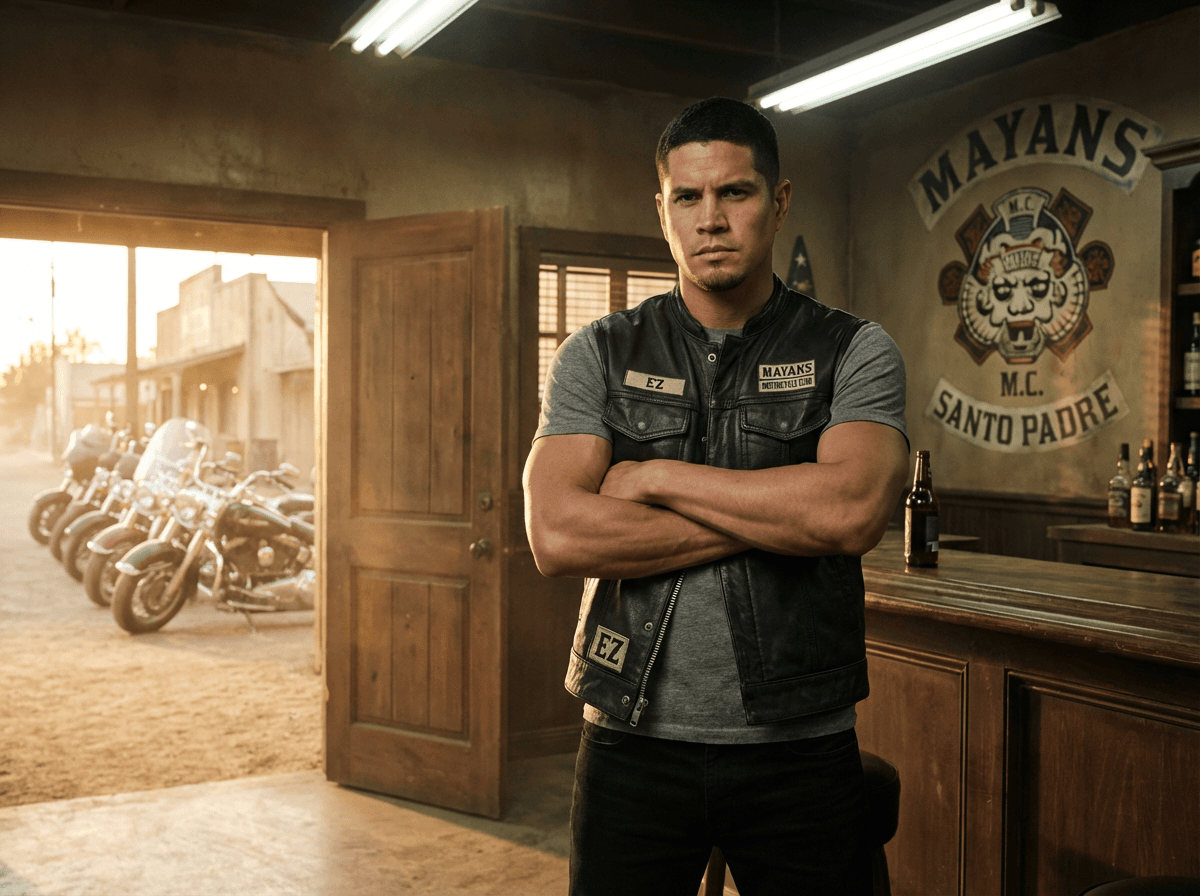
The role that finally gave him a fixed address in the popular imagination arrived in 2018, when Kurt Sutter and Elgin James cast him as Michael "Riz" Ariza in Mayans M.C., the long-incubating spin-off of FX's Sons of Anarchy. As El Secretario of the Santo Padre charter, Riz became the club's moral ballast, a soft-spoken, thoughtful biker whose loyalty was tested repeatedly across the show's five-season run. Jaramillo played him with a stillness that cut through the series's otherwise combustible ensemble, and he has spoken in interviews about how much of his own biography and brother-bond he poured into the character. For fans of the Sons of Anarchy universe, Riz is now inseparable from his face.
Alongside that series regular work he has continued to pick up feature credits, including supporting roles in Encounter (2021) opposite Octavia Spencer and Memory (2022) with Liam Neeson and Monica Bellucci. He remains active in theatre when schedules permit and has publicly set his sights on eventually working on Broadway.
Away from the set, Jaramillo is an advocate for charities and programmes supporting children in institutional care, a cause rooted unmistakably in his own childhood. He speaks warmly about the teachers and mentors who guided him out of early precarity and is known in the Los Angeles acting community as a generous scene partner and a patient collaborator with younger performers. He lists boxing, tennis, theatre and animal training among his private interests, a combination that squares neatly with the contained physicality of his on-screen work.
Watching him across a career now stretching past two decades, what stands out is how little he performs and how much he simply inhabits. Whether playing a cartel operator, a conflicted cop or an outlaw biker with a conscience, Antonio Jaramillo treats acting as a form of attention, and that attention is what lingers after the credits roll.