Aaron Douglas
About Aaron Douglas
Aaron Douglas is a Canadian character actor best known for his role as Chief Galen Tyrol in the reimagined Battlestar Galactica, a performance that anchored one of the twenty-first century's most acclaimed prestige dramas and established him as one of Canadian television's most recognisable working character actors. Born on 23 August 1971 in New Westminster, British Columbia, a suburb of Vancouver, he grew up in a household shaped by academic work: his father, Michael, was a professor, and his mother, Arlene Elliot, was a psychologist. He has a younger brother, Chris. When Douglas was ten, the family relocated to Creston, a small town in the Kootenay region of eastern British Columbia.
He attended Prince Charles Secondary School in Creston, where he was drawn to performance through school productions, community theatre and a teenage stint playing in a local rock band. Unlike many performers who commit to acting in their late teens, Douglas spent several years after high school working a string of unrelated jobs, a period he has frequently described as formative for the working-class sensibility he would later bring to blue-collar characters on screen. It was only at the age of twenty-six that he made a concerted decision to pursue acting professionally, returning to Vancouver and enrolling in a year-long programme at the William Davis Centre for Actors' Study, the conservatory run under the umbrella of VanArts and named for the X-Files actor William B. Davis. After completing the programme he sharpened his stage craft with the Okanagan Shakespeare Company.
His earliest screen opportunities came, characteristically, through the unglamorous work of auditioning. Douglas took jobs as a reader, performing the opposite side of scenes for actors coming in to audition, and directors began offering him minor roles on the productions he had been quietly feeding lines for. That pipeline delivered his first credited screen appearance, in the 2000 Showtime television movie The Inspectors 2: A Shred of Evidence, and a string of small roles that followed on Vancouver-shot genre television, including Dark Angel, The Outer Limits, Smallville, Stargate SG-1, The X-Files and Steven Spielberg's miniseries Taken. He also secured bit parts in studio features shot in British Columbia, among them Bryan Singer's X2: X-Men United, the sequel Final Destination 2 and the Will Smith vehicle I, Robot.
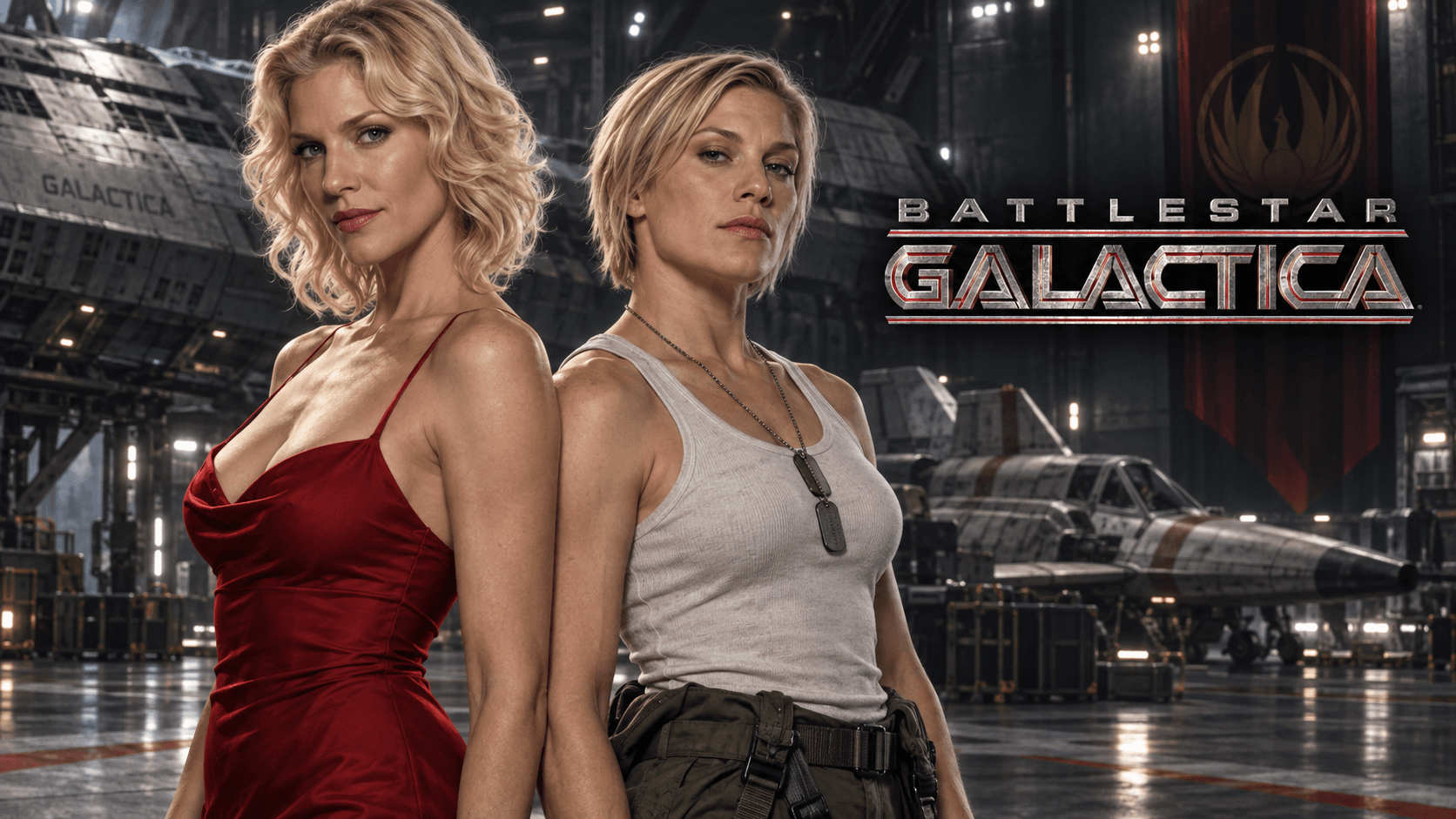
The role that transformed his career arrived in 2003, when Ronald D. Moore and David Eick cast him as Chief Petty Officer Galen Tyrol in the Sci Fi Channel miniseries that would become the reimagined Battlestar Galactica. When the miniseries expanded into a full series the following year, Douglas became a member of an ensemble that included Edward James Olmos, Mary McDonnell, Katee Sackhoff, Jamie Bamber and James Callis. Across sixty-nine episodes between 2004 and 2009, he shaped Tyrol from a loyal hangar-deck NCO into a character whose arc encompassed bereavement, political radicalisation, labour organising and one of the series' most destabilising identity revelations. The part, written with a deliberately unromantic view of military labour, gave him room to embody grief, exhaustion and the grinding compromises of life under occupation, and his performance was repeatedly singled out by critics as one of the show's emotional foundations. Battlestar Galactica itself won a Peabody Award and multiple Saturn Awards during its run and is now routinely listed among the defining prestige dramas of its era alongside contemporaries such as The Wire, The Sopranos and Breaking Bad. Douglas reprised Tyrol in the prequel series Caprica in 2010.
During and after Battlestar Galactica, Douglas became a fixture of the Vancouver-based production industry. In 2010 he headlined the CTV police drama The Bridge, which was subsequently acquired for American broadcast by CBS; he played Frank Leo, a charismatic officer turned union leader modelled on the real-life Toronto police figure Craig Bromell. Although the network cancelled the series after a handful of aired episodes, it remains one of the clearest showcases for Douglas as a leading man. He went on to accumulate substantial guest and recurring work on a cross-section of genre and prestige-adjacent series, including The Killing, Hemlock Grove, Falling Skies, The Strain, iZombie, Supernatural, The Flash, Once Upon a Time, Dirk Gently's Holistic Detective Agency and Hellcats. He earned a Canadian Screen Award nomination in 2013 for a dramatic guest performance on Flashpoint.
Beyond live-action television, Douglas has carved out a parallel career as a voice actor, most prominently as the mercenary hacker Jordi Chin in Ubisoft's Watch Dogs, a role he reprised in later entries in the franchise, as well as voice work in Dead Rising 3. He has also moved into writing, contributing to the early volumes of the Shock anthology series for AfterShock Comics and publishing his debut original graphic novel, 10 Years To Death, in October 2021. He is a frequent, gregarious guest on the science-fiction convention circuit, where he is known for tribute panels to former castmates, and he co-hosts podcasts revisiting Battlestar Galactica episode by episode.
His personal life has occasionally surfaced in public in ways he has spoken about candidly. His first wife, Debbie, died of breast cancer on 1 November 2004, during the early run of Battlestar Galactica; he has a son, Taylor, born in 1996. He married Jenny Douglas in August 2011. A lifelong hockey enthusiast who plays the game as a goaltender, he is a vocal Vancouver Canucks supporter and often speaks about the sport in interviews.
In recent years he has continued to work steadily on North American television, with recurring roles including General Devanney in the Syfy comedy Resident Alien and Sergeant Sid Sokolowski in the Fox mystery series Murder in a Small Town, the latter renewed for further seasons. Now in his mid-fifties, Douglas remains one of Vancouver's most reliable working actors, a performer whose craft was forged in the grind of audition rooms and whose career is defined by a single, durable piece of prestige-era television.