2018 - 2018

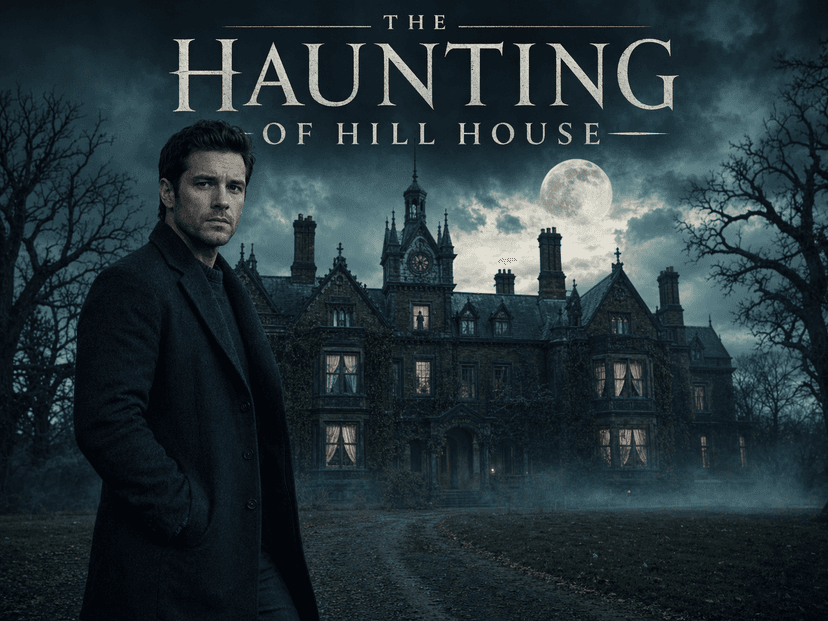
A ten-episode Netflix limited series, dropped in October 2018. The Haunting of Hill House is Mike Flanagan's loose reimagining of Shirley Jackson's 1959 novel. The house stays, the family is new, the plot is almost entirely invented. Seven Crains. One summer in 1992 spent renovating a crumbling mansion. Twenty-six years later the adult siblings are still broken from what happened inside it, and a fresh tragedy drags them back to each other and back to the house.
The structure is the trick. Every episode crosscuts between 1992 and 2018, between children who don't yet understand what they're living through and adults who have spent decades failing to get over it. Steven the eldest turned his childhood into bestselling ghost memoirs. Shirley runs a funeral parlour. Theo, a child psychologist, does not like being touched. Luke is an addict. Nell, the youngest, is the one the house never stopped calling back. Hugh the father is a wreck in both timelines. Olivia the mother is the absence around which everything else is built.
I came in expecting a haunted-house show. What I got was a family drama with a haunted house in it, and that inversion is the whole reason it works.
Flanagan casts for ensemble chemistry rather than marquee names, and it pays off. The adult siblings all come with a child counterpart, and both halves have to land for the character to work. Most of them do.
Michiel Huisman plays adult Steven as a writer who has turned his family's pain into product and cannot admit that is what he has done. Paxton Singleton does the 1992 version as a sceptical kid half-listening to things he does not want to hear. Elizabeth Reaser's Shirley is all control, mouth set in a tight line, with Lulu Wilson giving the young version a streak of hardness that tracks forward cleanly. Kate Siegel's Theo is the standout of the adult ensemble, a psychologist whose "gift" makes physical contact a job hazard, written with enough wit that she is not just her damage. Mckenna Grace plays the 1992 child version and does more with a look than most actors do with a monologue. Oliver Jackson-Cohen and Julian Hilliard get the hardest arc as Luke, whose addiction is tied to a specific childhood horror. Victoria Pedretti and Violet McGraw share Nell. Pedretti's performance is the one critics kept coming back to and she earns it. She is the emotional centre.
The parents anchor it. Henry Thomas plays young Hugh in 1992, Timothy Hutton plays him in 2018, and the handoff between the two is one of the show's quietest feats. Two different performances read as the same broken man two decades apart. Carla Gugino's Olivia lives almost entirely in the earlier timeline and gives the show its central tragedy. She is warm, she is unravelling in slow motion, and by the time 2018 arrives she is unforgettable.
Michiel Huisman
Steven Crain (adult)
Paxton Singleton
Steven Crain (1992)
Elizabeth Reaser
Shirley Crain (adult)
Lulu Wilson
Shirley Crain (1992)
Kate Siegel
Theodora "Theo" Crain (adult)
Mckenna Grace
Theodora "Theo" Crain (1992)
Oliver Jackson-Cohen
Luke Crain (adult)
Julian Hilliard
Luke Crain (1992)
The recurring support:
This ensemble is where the Flanagan Troupe began. Kate Siegel, Henry Thomas, Carla Gugino, Oliver Jackson-Cohen, Victoria Pedretti, Samantha Sloyan, Annabeth Gish, Robert Longstreet and Catherine Parker all came back for The Haunting of Bly Manor, and most of them turn up again in Midnight Mass. Watching Hill House as a standalone is fine. Watching it knowing you are meeting a repertory company that will carry Flanagan's next five years of work is better.
The argument of the show, stated and restated: the ghosts are grief. The haunting is how grief refuses to stay in the past.
Each sibling has a signature ghost and it maps to the specific shape of their damage. Steven's haunting is denial. Shirley controls. Theo keeps people at arm's length. Luke's is addiction, and the thing he thinks is worth running from. Nell's ghost everyone knows by its nickname, the Bent-Neck Lady, and episode five is a piece of structural screenwriting that hundreds of horror series have been trying to match since.
The house is not a location. It is the family's psychology externalised. Every creak is a shared wound. The Red Room, the show's central architectural-metaphorical idea, is the room that becomes whatever each Crain most needs it to be, which means the room becomes whatever each Crain most needs to avoid. A lesser show would have made that cute.
The Haunting of Hill House helped define what prestige horror TV looks like. The palette is cold blues and sickly greens in the 1992 timeline, warmer browns and yellows in 2018. Scene transitions bleed the two eras into each other so you sometimes do not notice the cut until a child's face becomes an adult's. Flanagan shoots the house as a character. Doorways hold shapes. Backgrounds reward a freeze-frame. The show is famously full of ghost figures standing still in the edges of frames, most of them unremarked, waiting for the audience to clock them on a rewatch.
The big formal flex is S1E6, "Two Storms." Several long unbroken takes flow between a 1992 tragedy and its 2018 echo. Actors move from past to present mid-sentence. The camera tracks through hallways and rooms that are the same room twenty-six years apart. It is the kind of television that makes you put your phone down. Plenty of prestige TV is visually inert now. Two Storms is still the benchmark for horror as a craft discipline.
If The Terror is the gold standard for atmospheric period dread on TV, Hill House is its contemporary domestic equivalent. Both shows understand that horror works when you care who survives.
On release, Hill House was the kind of hit that rewrites a platform's strategy. Critics called it the best horror television of the streaming era. It pulled a roughly 93 percent audience on Rotten Tomatoes, earned several Emmy nominations, and gave Netflix the confidence to bankroll the rest of Flanagan's horror run. Bly Manor, Midnight Mass, The Midnight Club and The Fall of the House of Usher all trace their budget back to this show's viewership numbers. It also did for horror what Stranger Things had done for nostalgia-genre work a couple of years earlier. It made a scary show a mainstream prestige object.
The critical consensus has mostly held. The final episode is where opinion splits. The closing monologue goes all the way in on sincerity and hope, and depending on who you ask that is either the exact emotional landing the show has been earning for nine hours or a softer note than the preceding material deserved. Both readings are fair. I lean toward the first. After this much grief, a show gets to choose what it believes. But I understand viewers who feel the final beat pulls too neatly. It is the rare horror show where the ending argument is the argument about the ending.
Most haunted-house stories are about real estate. The Haunting of Hill House is about families. It takes the literal ghost, the thing horror usually uses as a cheap metaphor, and makes the metaphor the actual subject of the show. The Crains are not fleeing Hill House. They are Hill House. That is the move. Everything else, the long takes, the Red Room, the ensemble that would go on to anchor a decade of Flanagan television, is in service of that idea.
Seven years on it still reads as the show that made streaming horror respectable. I rewatched the first two episodes recently. The trick of Two Storms is still breathtaking. The Crain kids still wreck me. Some shows win the moment. This one kept winning.
Victoria Pedretti
Eleanor "Nell" Crain (adult)
Violet McGraw
Eleanor "Nell" Crain (1992)
Henry Thomas
Hugh Crain (1992)
Timothy Hutton
Hugh Crain (2018)
Carla Gugino
Olivia Crain
Annabeth Gish
Mrs. Dudley
Robert Longstreet
Mr. Dudley
Anthony Ruivivar
Kevin Harris
Samantha Sloyan
Leigh
Catherine Parker
Poppy Hill
Mike Flanagan
Creator / Writer / Director