2022 - 2022

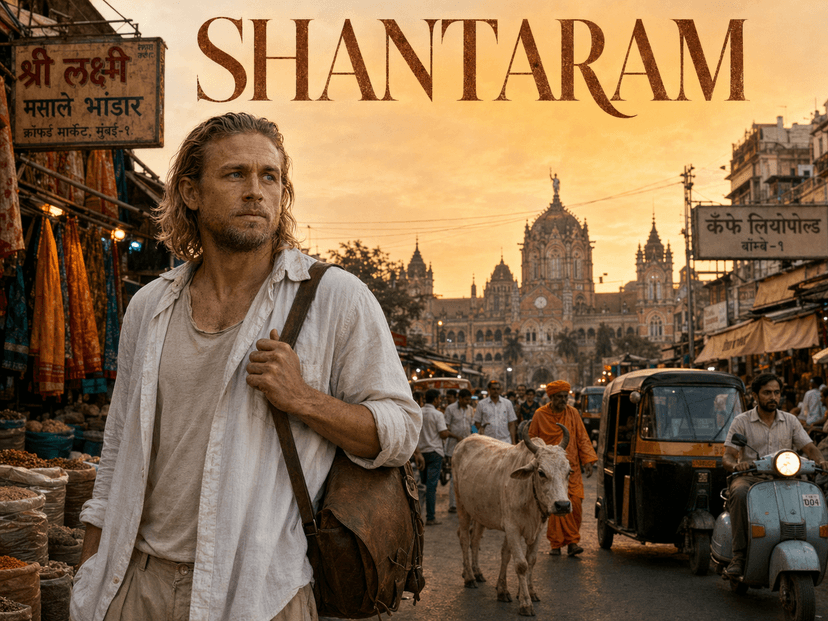
Shantaram arrived on Apple TV+ in October 2022 after more than a decade stuck in development hell. The story had, at various points, been attached to Johnny Depp, Russell Crowe, Joel Edgerton, and the director Mira Nair. It finally landed as a 12-episode limited drama, built by showrunner Steve Lightfoot (the man behind The Punisher and most of Bryan Fuller's Hannibal), based on Gregory David Roberts' 900-page cult novel of the same name.
Roberts wrote Shantaram from a biography he lived. Escaped Australian armed-robbery convict, on the run, washes up in 1980s Bombay, ends up treating patients in a slum clinic while drifting deeper into the city's criminal underworld. Charlie Hunnam plays the fictional stand-in, Lin Ford (real name Dale Conti), a man wearing a new identity like a cheap suit and hoping nobody notices.
The show follows Lin from the moment he steps off the plane with a fake Kiwi passport. He meets Prabhu, a Bombay taxi-driver-slash-fixer, who pulls him into the orbit of the expat bar scene at Reynaldo's in Colaba, a mysterious Swiss-German woman named Karla, and eventually Khader Khan, the philosophical don of the Bombay mafia. I came to this one expecting another failed prestige swing and got something warmer than I bargained for.
Hunnam is a strange choice and, for my money, a good one. He has always done better as the brooding physical presence than as the talky intellectual, and the novel's Lin is far more the former than the latter anyway. His Dale is a man who has already made every bad decision by the time we meet him and is just trying to stop bleeding.
The ensemble does most of the heavy lifting.
Every Indian speaking role went to an actual Indian actor. Marathi and Hindi are spoken throughout with subtitles, not English stand-in. Small thing. Important thing.
Charlie Hunnam
Lin Ford / Dale Conti
Elham Ehsas
Habib
Shubham Saraf
Prabaker "Prabhu" Kharre
Sujaya Dasgupta
Kavita Singh
Elektra Kilbey
Lisa Carter
Alyy Khan
Walid Shah
Alexander Siddig
Abdel Khader Khan
Luke Pasqualino
Maurizio Belcane
On paper it is a crime story. In practice it is about who you become when nobody from your old life can reach you. Lin in Australia was Dale, a heroin-addicted armed robber with a mother who does not know if he is alive. Lin in Bombay is a free clinic doctor, a friend, a man sleeping in a hut with a straw roof and finding he is calmer than he was in a prison cell.
The show is interested in the moral question the novel chewed on for 900 pages. If redemption is possible, is it possible in flight from justice? Can you become a better man while living as a lie? The series does not give you a clean answer. The slum where Lin treats patients for free is also, quietly, the place where Khader Khan's money touches him for the first time. Every good deed costs something. Usually the cost is paid by someone Lin cannot save.
Friendship gets equal weight to love. The Prabhu-Lin dynamic is the engine, and the show knows it. Some of the warmest TV moments of the year came out of a white Australian convict and a young Bombay taxi-driver figuring each other out.
Shot across Melbourne, India, and Bangkok after Covid forced the production to relocate mid-shoot. You can see the seams if you look, but mostly it hangs together. Colaba is rendered as a sensory overload of neon signage, monsoon rain, kerosene lamps, and a street traffic ballet that looks like it would kill a tourist on day one. Reynaldo's feels lived-in, the kind of expat dive where everybody owes somebody money and nobody quite trusts the bartender.
The slum sequences avoid the two traps a Western production would usually fall into. No poverty-porn wallow, and no saccharine nobility. Just people getting on with life in a place that is both unbelievably hard and full of functional community.
The best visual moments are small. Prabhu's face when he realises Lin means to stay. Karla walking away from a conversation she wanted to finish. A pavement dweller using Lin's stethoscope for the first time.
Reviews split. Variety called it messy but watchable. The Hollywood Reporter said the adaptation buckled under the novel's scale. Fans of the book were the loudest defenders and the loudest critics, depending on how precious they were about specific pages. It landed around 7.4 on IMDb, which is a fair score, and it built a slow-burn word-of-mouth over its 12-episode run.
Apple cancelled it in December 2022. The reported budget was around $100 million. At those numbers, a show has to either smash global viewing records or win a prestige-awards season, and Shantaram did neither. The cancellation was taken badly by the book's fans, who pointed out (correctly) that the series ends with the main narrative arc only half-resolved. You finish season one wanting a season two that is not coming.
That is frustrating. It is also not a reason to skip the 12 episodes that exist. A half-cathedral is still a cathedral.
Shantaram is the kind of ambitious, slightly baggy, warm-blooded prestige drama that would once have been a slam-dunk commission and is now a casualty of streaming math. Hunnam gives his most committed TV work since Sons of Anarchy. Saraf announces himself as a leading man in waiting. And Siddig? Siddig makes every scene better, which is what he has always done. The Bombay setting is beautifully realised by a largely Indian cast in an industry that usually cannot be bothered to cast Indian actors in Indian stories.
If you liked the expat-in-a-foreign-underworld pull of Tokyo Vice, or the Mumbai crime world of Sacred Games, or the 1980s-India period texture of Scam 1992: The Harshad Mehta Story, Shantaram is an easy recommend. It stops mid-sentence. That is Apple's fault, not the show's.
Vincent Perez
Didier Levy
Fayssal Bazzi
Abdullah Taheri
Shiv Palekar
Vikram
Antonia Desplat
Karla Saaranen