2011 - 2012

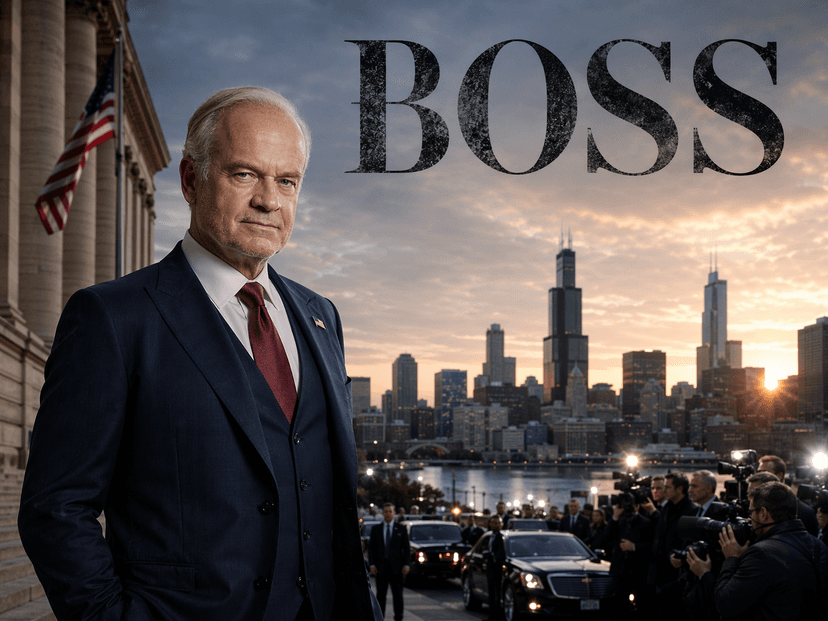
Boss ran on Starz from October 2011 to October 2012, a tight two-season run of 18 episodes from creator Farhad Safinia. The premise is the kind of thing that either works on the page or dies in the room. Kelsey Grammer plays Mayor Tom Kane, the undisputed patriarch of the Chicago political machine, a man who has spent decades turning Cook County into a private fiefdom. Twenty minutes into the pilot he is told, in a back-alley doctor's office, that he has Lewy body dementia. A degenerative neurological disease with no cure and a brutal trajectory. Tremors. Hallucinations. Lost time. Kane's first instinct is to hide it, from his wife and his aides and his rivals, and eventually from the city itself.
What follows is a two-season slow burn about a man running out of time while refusing to loosen his grip on power. I came to this one late, after a friend told me Grammer was doing work nobody talked about, and he was right.
This is Kelsey Grammer's show in every conceivable way. After eleven seasons of Frasier, after decades of being the erudite, comic psychiatrist, Grammer walks into this role and delivers something nobody thought he had in him. Kane is granite. Cold, contained, the kind of man who calmly dismantles an opponent's career in one breath and hides a tremor in the next. Grammer won the Golden Globe for Best Actor in a TV Drama Series in early 2012 and he earned every inch of it.
Around him, Safinia built an ensemble that feels genuinely dangerous:
Hannah Ware
Emma Kane
Rotimi Akinosho
Darius Morrison
Troy Garity
Sam Miller
Kathleen Robertson
Kitty O'Neill
Sanaa Lathan
Mona Fredricks
Jonathan Groff
Ian Todd (Season 2)
Francis Guinan
Ian Todd
Martin Donovan
Ezra Stone
Grammer is the engine. Nielsen and Robertson are the live wires. Donovan brings a quiet menace that anchors every scene he plays, and I spent most of season one waiting for him to reappear.
On the surface, Boss is a show about Chicago politics. About ward captains and patronage jobs and the horse-trading that keeps a city running. About a mayor manoeuvring his chosen candidate into the governor's seat while a rival state senator mounts an insurgent campaign against him. That material is reason enough to watch.
The real subject is further down. Boss is a show about a man who has spent his entire adult life accumulating power, and who is now being asked, slowly and without his consent, to give it up. The dementia is not metaphor. It is the engine. Every episode Kane wakes up slightly less himself. Every episode the people around him get a little better at reading the cracks. The question the show keeps circling is whether a man defined entirely by his will to dominate can survive losing his mind, and whether the city he built in his own image can survive him.
Grammer's performance turns what could have been a gimmick into something closer to tragedy.
It is a show about hubris. Shakespearean hubris, which is the frame Safinia openly reached for. The Lear parallels are deliberate and mostly earned. Kane has two daughters in the narrative sense, his actual estranged daughter Emma and his surrogate political daughter Kitty, and the show is interested in how both of them fail him and are failed by him.
Gus Van Sant directed the pilot and his fingerprints are all over the early look of the series. Boss is shot cold. Grey light through glass. Brutalist interiors. Kane's office is a fortress of wood panelling and bourbon glasses. The hospital scenes, when Kane's illness flares, are rendered in a woozy subjective style that drops the viewer inside his disintegrating perception.
Chicago itself is shot like another character. The lake gets its establishing beats. The skyline anchors more interiors than you'd notice the first time through. The neighbourhoods are where Safinia's outsider eye shows most, a fact critics pointed out at the time, since the creator is not from the city and occasionally reaches for the mythic version of Chicago rather than the lived-in one. What the production does get right is the texture of power. The way a mayor's limousine moves through a crowd. The choreography of a press conference. The body language of men deciding other men's careers over whisky in private rooms. I noticed the sound design as much as the look, the hum of a motorcade in particular.
Critics largely loved it. Rotten Tomatoes shows 76 percent for season one and 86 percent for season two, with reviewers consistently pointing to Grammer's lead performance and the supporting ensemble as reasons to keep watching. Time called it powerful if messy. Slate put it in The Wire's territory of ambitious urban drama. The comparison is generous but not absurd. Boss is reaching for the same kind of systems-level storytelling about a city, just told from the top of the pyramid rather than the street.
Ratings, unfortunately, never matched the reviews. The season one premiere pulled decent numbers for Starz. The season two premiere collapsed to 317,000 viewers, less than half of what the show opened with a year earlier. In November 2012 Starz pulled the plug. Safinia had a third season planned. There was talk of a wrap-up film. Neither happened.
The show is one of the great cancelled-too-soon casualties of the prestige drama era. It lives on as Grammer's most serious dramatic performance and as a reminder that ambitious cable drama does not always find its audience in time.
The core of Boss is the gap between what Kane projects and what Kane is becoming. That gap carries two seasons of television. Grammer is ruthless in how he plays it. You see the mask in one scene and the man cracking underneath it in the next, and the transition is so controlled you rarely catch him doing it.
The supporting cast matches him. Nielsen in particular is doing sly, patient work as Meredith, the wife who knows more than she lets on about almost everything. Donovan's Ezra Stone is the kind of lieutenant every political drama wants and rarely gets right.
If you came to Boss from Frasier expecting comfort, you will bounce off hard. If you came from The West Wing, Boss is its dark mirror. Aaron Sorkin's Washington was a place where good people tried to do the right thing. Safinia's Chicago is a place where a dying man breaks the law for sport because he can. Both versions of politics are true. This one is the uglier one.
Kelsey Grammer
Mayor Tom Kane
Connie Nielsen
Meredith Kane
Jeff Hephner
Ben Zajac