Anton Lesser
About Anton Lesser
Anton Lesser is a British actor whose career stretches across more than four decades of stage, screen, and radio work, marked by an unusual combination of classical rigour and quiet contemporary menace. Born on 14 February 1952 in Birmingham, England, to a Jewish family, he grew up in the West Midlands before training at the Royal Academy of Dramatic Art in London, where he won the Bancroft Gold Medal upon graduating in 1977. That early recognition signalled a particular gift for verse-speaking and intellectual roles that would come to define his subsequent reputation, particularly in the British theatrical establishment.
Lesser's formative professional years were spent at the Royal Shakespeare Company, where he became one of the defining classical actors of his generation. Joining the company in the late 1970s, he tackled an extraordinary range of leading roles over successive seasons, including a celebrated Richard III, Romeo, Petruchio in The Taming of the Shrew, Troilus in Troilus and Cressida, and Edgar in King Lear. His Hamlet, performed for the RSC in the early 1980s, was widely admired for its psychological detail and clarity of thought, and he returned repeatedly to the company across the decades, later playing Brutus in Julius Caesar and a series of Shakespearean elders. Beyond Stratford and the Barbican, he worked extensively at the National Theatre, the Almeida, the Donmar Warehouse, and on tour, building a stage CV that placed him among the most respected verse actors in the country.
Although theatre formed his bedrock, Lesser developed a parallel career in radio drama that became almost as substantial as his stage output. The BBC made repeated use of his exact, slightly austere voice across Radio 3 and Radio 4, where he became a fixture of literary adaptations, poetry readings, and audiobooks. He recorded vast tracts of Shakespeare, Dickens, and the canonical poets, and was frequently chosen to narrate complex historical and philosophical material. Audiobook listeners came to know him through his unabridged readings of Hilary Mantel's Wolf Hall trilogy, work that earned him significant acclaim and helped cement his association with Tudor-era material long before he appeared on screen in the same world.
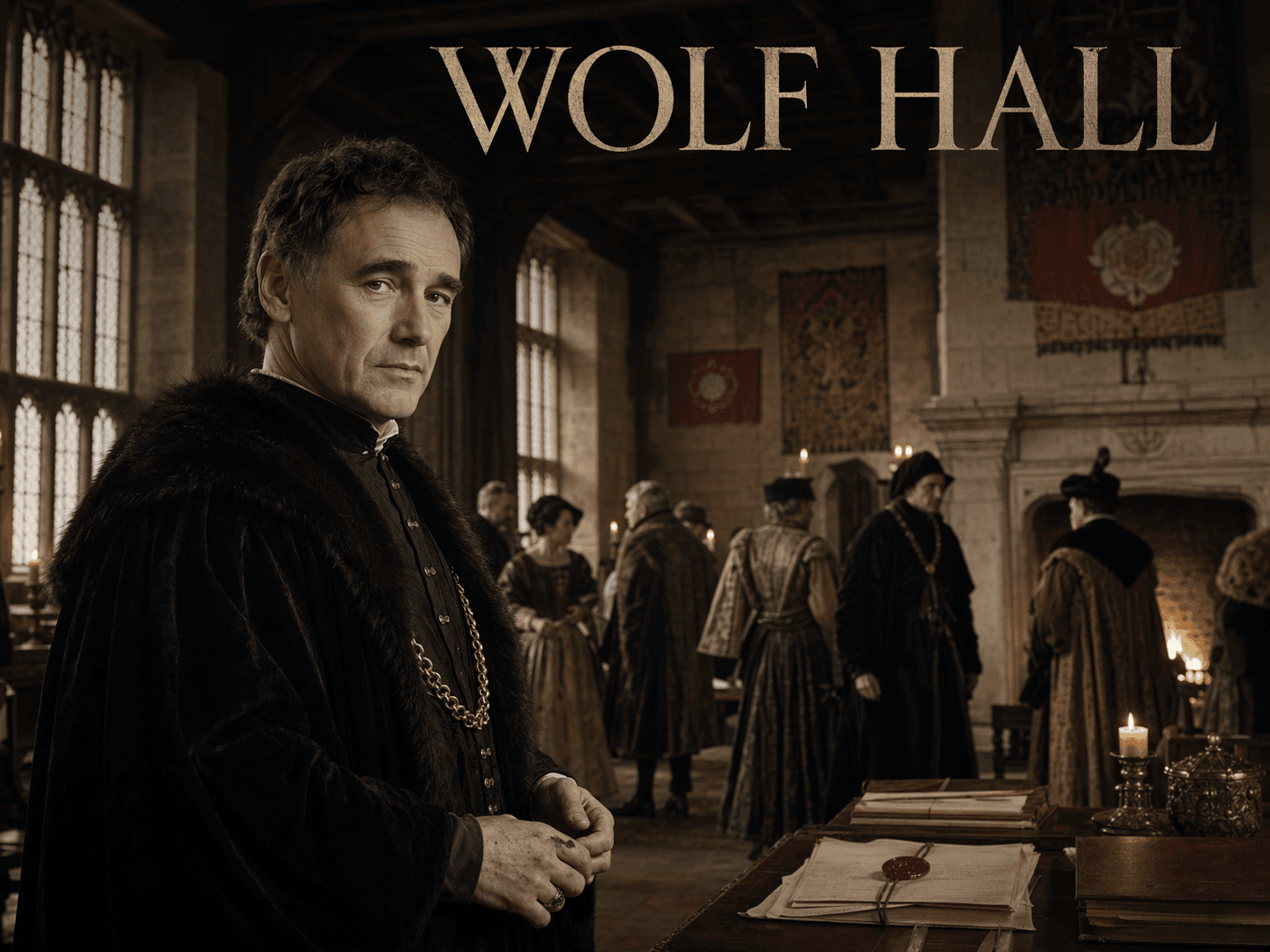
That association deepened when the BBC and Company Pictures adapted Wolf Hall for television in 2015, with Lesser cast as Sir Thomas More opposite Mark Rylance's Thomas Cromwell. His performance, balancing piety, scholarly elegance, and a streak of cruelty, was singled out by critics as one of the production's quiet triumphs and earned him a wider international audience than any previous role. The part suited his particular ability to suggest a powerful inner life beneath a still surface, a quality that producers had already begun to exploit in genre television.
To global audiences, Lesser is most readily identified as Qyburn, the disgraced maester turned Hand of the Queen in HBO's Game of Thrones. Introduced in the show's third season and recurring through to the eighth, his Qyburn was a study in soft-spoken malevolence, a courtier whose gentle tone and faint smile concealed a willingness to perform any experiment or arrange any betrayal Cersei Lannister required. The role placed him at the heart of one of the most-watched television dramas of the 2010s, and his understated style provided a distinctive counterweight to the series' more theatrical villains. He filmed across Northern Ireland, Croatia, and Spain over several years and remained one of the production's most reliable supporting presences until the character's death in the final season.
In British television, his other defining recent role has been Chief Superintendent Reginald Bright in ITV's Endeavour, the long-running prequel to Inspector Morse. From the show's first series in 2012 through to its conclusion in 2023, Lesser charted Bright's evolution from a starchy, by-the-book senior officer into a more wounded and humane figure, particularly in storylines exploring his wife's illness and his relationship with the young Morse. The character's gradual softening across more than a decade of episodes gave him one of the most sustained arcs of his screen career and won him considerable affection from the show's audience.
He has also appeared in The Last Kingdom as Bishop Erkenwald, a politically astute cleric in the court of Alfred the Great, contributing to the series' depiction of ninth-century Wessex as a place of intricate ecclesiastical and dynastic manoeuvring. Other notable television credits include Spooks, Foyle's War, New Tricks, Dickensian, in which he played Fagin, and The Crown, where he appeared as Harold Wilson's adviser. His film appearances have been more sporadic but include the historical drama The Young Victoria, the British comedy Mr Holmes, and the science-fiction feature Voyagers, alongside earlier work in productions such as Fairytale: A True Story.
Lesser's craft has been recognised with several honours over the years. He was made a Commander of the Order of the British Empire in 2017 for services to drama, a recognition that reflected the range of his contribution across stage, television, and radio rather than any single role. He has also received nominations and awards from the Royal Television Society and the Audie Awards for his audiobook work, and his RSC seasons have been preserved in archive recordings that continue to be cited in studies of late twentieth-century British classical acting.
Off screen, Lesser is known as a notably private figure who rarely discusses his personal life in interviews, preferring to talk about texts, directors, and the technical demands of long runs. He has spoken occasionally about the influence of his teachers at RADA and about his enduring interest in poetry, which feeds back into his readings for radio. Now well into his seventies, he continues to take on substantial work in both prestige drama and classical revivals, and remains one of those character actors whose name regular British viewers may not always recall but whose face and voice carry the weight of half a century of disciplined craft. His career stands as a reminder that a generation of actors trained primarily for the stage can still find their richest later chapters in the long-form television that has come to dominate the cultural landscape.