Alexander Dreymon
About Alexander Dreymon
Alexander Dreymon is a German-British actor best known for his decade-long portrayal of the displaced Saxon warrior Uhtred of Bebbanburg in the historical epic The Last Kingdom, a role that transformed him from a working actor moving between European productions into a leading man with a global fanbase. Born Alexander Doetsch on 7 February 1983 in Germany, he spent a peripatetic childhood shuttling between his birth country, Switzerland, the United States and France, an upbringing that left him fluent in several languages and gave him the multicultural sensibility that would later help him slip between English, American and continental roles with equal ease.
Dreymon's path into acting was not preordained. Raised in part by his mother after his parents separated, he developed an early interest in storytelling and performance, and as a teenager in France he joined a small theatre group that toured modest venues. He has spoken in interviews about the formative effect of that early stage work, which gave him a grounding in live performance before he ever faced a camera. After leaving school he eventually made his way to London, enrolling at the Drama Centre London, one of the city's most demanding conservatoires and an institution with a reputation for turning out intensely physical, technically rigorous screen actors. His time there sharpened the craft he had picked up on the road and placed him on the radar of British casting directors.
His early screen work was eclectic and international. He appeared in the French crime series Ni reprise, ni échangée and took small parts in European productions before landing the role that first brought him to English-speaking audiences' attention, playing the young Christopher Isherwood in the BBC Two television film Christopher and His Kind in 2011. The drama, adapted from Isherwood's memoir and starring Matt Smith, was set in the decadent, doomed Berlin of the early 1930s, and Dreymon's turn as Caspar, one of Isherwood's lovers, showed a performer comfortable with sensual, emotionally exposed material. The same year he appeared in the indie film Resistance, a wartime drama set in an alternate-history Welsh valley, opposite Andrea Riseborough and Michael Sheen.
American audiences first took real notice of him in 2013, when Ryan Murphy cast him in the third season of American Horror Story, subtitled Coven. Playing Luke Ramsey, the earnest neighbour and love interest to Taissa Farmiga's young witch Zoe, Dreymon spent a season inside the show's New Orleans coven and worked opposite a formidable ensemble that included Jessica Lange, Kathy Bates, Angela Bassett and Sarah Paulson. The role introduced him to a mainstream American fanbase and marked the beginning of a working life that would straddle the Atlantic. He followed it with a small part in the Hallmark production Christmas at Cartwright's in 2014 and guest work on other television projects while continuing to audition for larger roles.
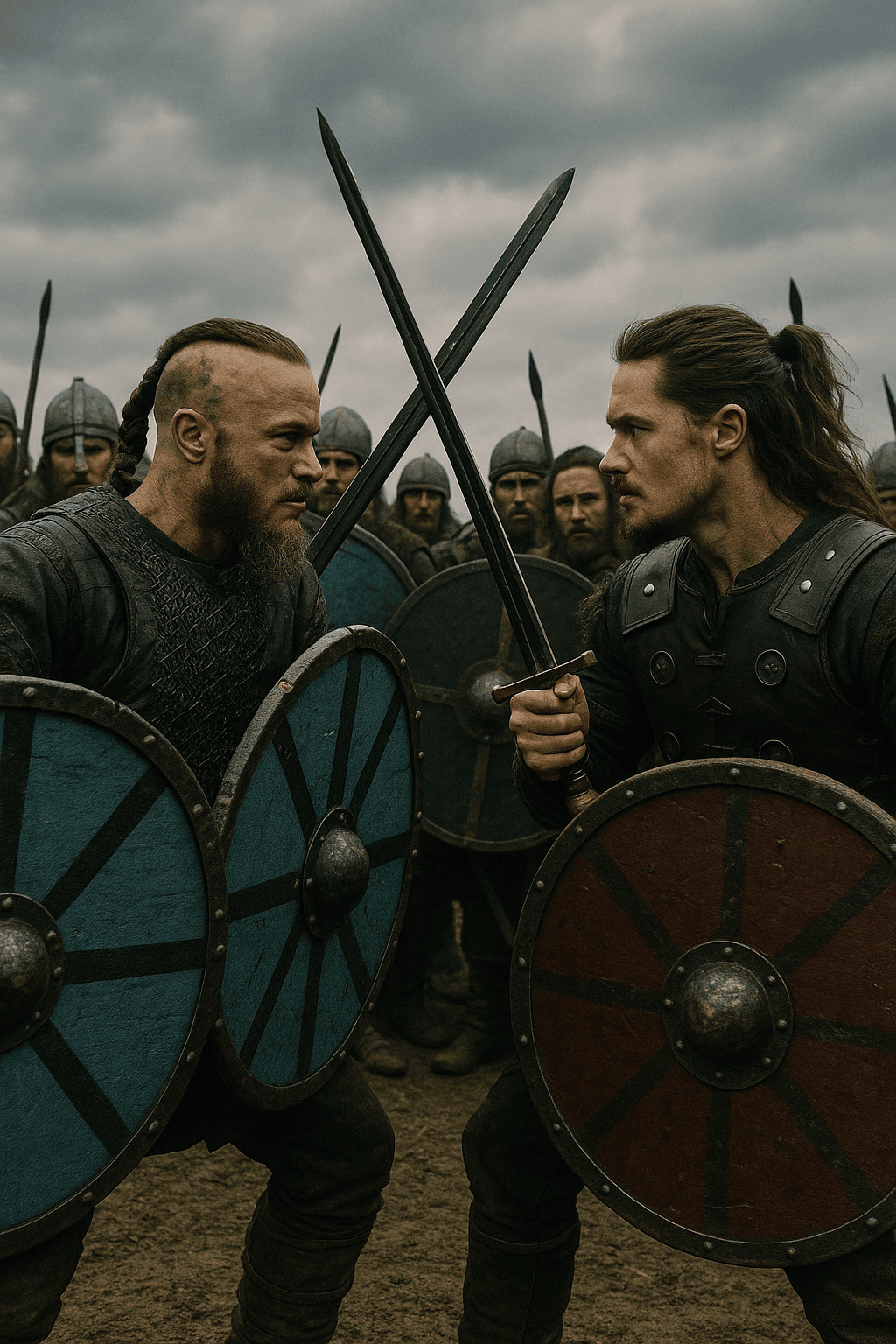
Everything changed in 2015 when the BBC and Carnival Films cast him as Uhtred in The Last Kingdom, Bernard Cornwell's Saxon Stories adapted into a sprawling television saga about the unification of what would become England. Uhtred, a Saxon noble stolen as a boy and raised by Danes, is a sprawling, tormented role that demanded horseback stunts, sword-fighting, brooding interiority and a consistent emotional spine across five seasons. Dreymon, who had grown up riding, threw himself into the physical preparation and became known among cast and crew for doing a large share of his own stunts. The series built a devoted audience first on the BBC and then on Netflix, which took over production from season three, and it ran from 2015 to 2022, concluding its story with the feature-length Netflix film Seven Kings Must Die in 2023, in which Dreymon returned for a final chapter. On the movie he also took an executive producer credit, his first significant step behind the camera on a project of that scale.
Outside the saga, Dreymon has chosen his screen appearances selectively. He played real-life French farmer Jean Rochette in the war drama Resistance earlier in his career and has taken occasional independent-film roles, including the thriller Heartlock, in which he starred opposite Lesley-Ann Brandt as a charming, manipulative inmate. He has spoken in press interviews about wanting to direct, and he made his directorial debut with an episode of the final season of The Last Kingdom, a milestone he described as both terrifying and creatively invigorating after so many years inside the world of the show.
His private life has drawn attention in part because he has tried to keep most of it offstage. He began a relationship with the American actress Allison Williams, known for the HBO series Girls and the Jordan Peele horror film Get Out, in the late 2010s. The couple welcomed a son in 2021 and were married in 2024 in a private ceremony. Dreymon splits his time between Europe and the United States, and he has been candid about how quickly his life recalibrated around fatherhood after the wrap of The Last Kingdom.
Now in his early forties, Dreymon sits in an enviable position for a character-leading man, with the physical credibility of a decade spent in chainmail, the linguistic range of a European upbringing and a conservatoire-trained technique underneath it all. He has spoken about his interest in developing material as a producer and director, and his choices since Uhtred suggest an actor willing to wait for roles that test him rather than chase the next franchise. Whether his next defining part comes in another sprawling historical drama, a contemporary thriller or a project he shepherds himself, he has already accomplished the rarest feat in television: inhabiting a single character so completely that audiences struggle to imagine anyone else in the part. Colleagues who have worked with him tend to describe the same qualities, a seriousness about preparation, a willingness to take physical risks on set, and an old-fashioned privacy about the life he leads when the cameras are not rolling. In an industry that rewards visibility, Dreymon has built a career on the opposite instinct, letting the work speak and letting the man behind it remain largely his own.