Álex Pina
About Álex Pina
Álex Pina is a Spanish television creator, screenwriter, and producer whose work transformed the international perception of Spanish-language drama in the late 2010s. Born on 23 June 1967 in Pamplona, the capital of Navarre in northern Spain, he grew up in a household where both parents worked and an older brother attended school in France, leaving him long stretches of solitary childhood that he has often credited with shaping his imagination. The quiet hours pushed him toward books, and the appetite for narrative he developed in those years would eventually underpin a career built on intricate, propulsive storytelling. He studied Information Sciences at the University of Navarra, a programme that steered him first into newsrooms rather than writers' rooms.
Pina began his professional life as a journalist, writing for the regional daily El Diario Vasco in the Basque Country and for Diario de Mallorca, and later filing copy for the national wire service Europa Press. The rhythms of reporting, the discipline of short deadlines, and the habit of observing ordinary people under pressure would prove to be unexpectedly useful training for the kind of television he later made. Between 1993 and 1996 he shifted from journalism into scriptwriting and editorial work at the production house Videomedia, and in 1996 he joined Globomedia, then one of the most influential independent production companies in the Spanish television landscape. It was there, in 1997, that he broke into screenwriting on the sitcom Más que amigos, and it was there that he spent nearly two decades learning the craft of running long-running domestic hits.
Across his Globomedia years Pina became a reliable architect of prime-time Spanish television, creating or executive producing a string of series that anchored the schedules of terrestrial broadcasters. He was central to the family drama Los Serrano, a ratings juggernaut on Telecinco during the mid-2000s, and to the police procedural Los hombres de Paco, which blended comedy, action, and ensemble melodrama in ways that pointed toward the tonal mash-ups he would later push further. He also oversaw the adolescent adventure series El barco and co-created the women's prison drama Vis a Vis, known internationally as Locked Up, which premiered on Antena 3 in April 2015 and quickly distinguished itself with its brutal tone, stylised violence, and morally complicated heroines. Vis a Vis was a clear pivot point, signalling a creator more interested in high-concept thrillers than in the cosy family formats that had defined much of his early output.
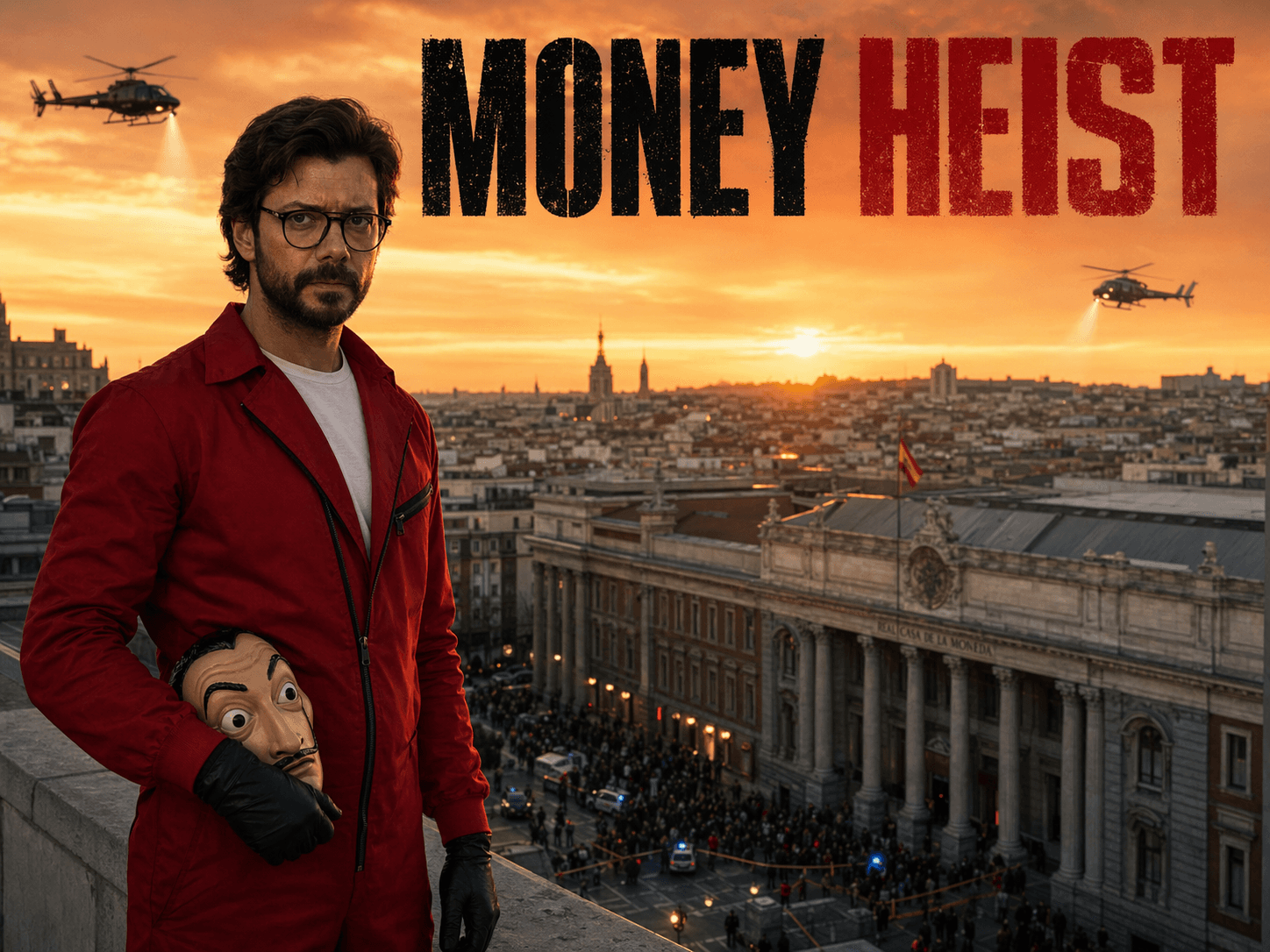
At the end of 2016 Pina left Globomedia and, together with longtime collaborator Esther Martínez Lobato, founded Vancouver Media, a Madrid-based production company intended to give him greater creative control over increasingly ambitious projects. The studio's first major undertaking was La Casa de Papel, known in English as Money Heist, a heist thriller about a band of robbers in red jumpsuits and Salvador Dalí masks who seize the Royal Mint of Spain under the direction of a cerebral mastermind called the Professor. The series premiered on Antena 3 on 2 May 2017 and drew more than four million viewers for its opening episode, a strong domestic launch that nonetheless gave little hint of the global phenomenon to come.
The turning point arrived when Netflix acquired international distribution rights, recut the existing episodes into shorter instalments, and released the show worldwide. By 2018 Money Heist had become the most-watched non-English-language series on the platform, a cultural touchstone whose red jumpsuits and Bella Ciao chant migrated from television into protests, football terraces, and Halloween costumes around the world. That same year the show won Best Drama Series at the 46th International Emmy Awards, a landmark moment for Spanish television on the global stage. Netflix responded by signing Pina to an exclusive global overall deal, effectively turning Vancouver Media into one of the streamer's marquee European suppliers. In 2019 The Hollywood Reporter placed him on its list of the top international showrunners, formal recognition of a career that had moved in a handful of years from domestic prime time to worldwide reach.
The years that followed saw Pina use his Netflix partnership to explore increasingly varied territory. El Embarcadero, known internationally as The Pier, ran from 2018 to 2020 and offered a melancholic mystery set among the canals of Valencia's Albufera. White Lines, a 2020 co-production shot largely on Ibiza, blended crime thriller with a hedonistic portrait of the island's club scene. Sky Rojo, created with Esther Martínez Lobato and premiering in March 2021, was a frenetic, short-form action drama about three women fleeing a brothel, running for three seasons before concluding in January 2023. After Money Heist wrapped its fifth and final season in 2021, Pina shepherded the spin-off Berlin, which arrived in December 2023 and returned to the universe of the original show through the eyes of one of its most charismatic thieves. Billionaires' Bunker, announced as part of his continuing relationship with Netflix, extended his run of high-concept premises into the middle of the decade.
Taken together, Pina's output is marked by a recognisable set of preoccupations: morally ambivalent outlaws, charismatic leaders holding together fragile groups, propulsive plotting punctuated by operatic set pieces, and a willingness to push tonal extremes from romance to slapstick to graphic violence within a single scene. He has been open about his distrust of traditional network caution and his preference for serialised storytelling that treats television as closer to a long novel than a collection of episodes. His collaboration with Martínez Lobato has been creatively and personally central, and Vancouver Media has grown into a recognisable brand attached to titles that travel well beyond Spain. With Money Heist he demonstrated that a Spanish-language series could command a genuinely global audience, and the body of work he has assembled since has solidified his standing as one of the most influential figures in twenty-first-century European television.