Aleksey Serebryakov
About Aleksey Serebryakov
Aleksei Valeryevich Serebryakov was born on 3 July 1964 in Moscow, into a family that was comfortably connected to Soviet cultural life without being part of its elite. His father worked as an aircraft engineer, and his mother was a doctor at Gorky Film Studio, a setting that gave the young Serebryakov his first glimpses of sets, actors, and the peculiar backstage world of Soviet cinema. As a child he studied accordion at music school, and his earliest brush with public attention came at thirteen, when his music teacher arranged for his photograph to appear in the Moscow evening newspaper Vechernyaya Moskva. That modest piece of exposure proved unexpectedly decisive.
Directors Valery Uskov and Vladimir Krasnopolsky spotted the boy and cast him as Dima in their sprawling Soviet television epic Eternal Call, which had begun in 1973 and continued through 1983. Working on a prestige state television production throughout his adolescence gave Serebryakov a practical apprenticeship long before formal training. In 1986 he graduated from the Lunacharsky State Institute for Theatre Arts in Moscow, having studied under Oleg Tabakov, one of the great Russian acting teachers of the late Soviet period. He then joined Tabakov's Moscow Theatre-Studio, the celebrated Tabakerka, where he remained until 1991. His early screen work included Silent Outpost and Accused of the Wedding, both released in 1986, but his breakthrough arrived with Vladimir Feoktistov's tough, street-level crime drama Fan in 1989, in which his wiry physicality and unvarnished intensity caught the mood of a disintegrating Soviet society.
The transition years at the end of the Soviet Union proved to be a creative high point. In 1990 he appeared in Vladimir Bortko's Afghan Breakdown and in Svetlana Proskurina's Accidental Waltz, a performance that carried him to the Locarno Film Festival, where he won the Best Actor prize at the age of twenty-six. Sergei Livnev's Hammer and Sickle in 1994 brought him the best male role award at the Kinoshock Film Festival and confirmed him as one of the most interesting actors of the post-Soviet generation.
Through the 1990s and 2000s, Serebryakov became a reliable presence across the full span of Russian drama, ranging from genre television to serious auteur cinema. He appeared in Bandit Petersburg, Empire Under Attack, and a screen version of The White Guard, and took parts in Aleksei Balabanov's Dead Man's Bluff in 2005 and the polarising Cargo 200 in 2007. He was part of Fyodor Bondarchuk's hit Afghan War drama 9th Company in 2005, appeared in Andrei Konchalovsky's Gloss in 2007, and played a villain in The Apocalypse Code the same year. He received the title of Merited Artist of the Russian Federation in 1998 and was elevated to People's Artist of the Russian Federation in 2010, the highest honorific the state could bestow on a performer.
In 2011 he played Sergei Mamontov, a thinly veiled version of the notorious MMM pyramid-scheme operator Sergei Mavrodi, in The PyraMMMid. Then came the role that redefined his international standing. In Andrey Zvyagintsev's Leviathan, released in 2014, Serebryakov played Kolya, a provincial mechanic crushed by a corrupt mayor, a crumbling marriage, and an indifferent Orthodox Church. His portrait of a man whose rage can neither save him nor be extinguished is one of the defining Russian screen performances of the century so far. He won the IFFI Best Actor Award at the International Film Festival of India and was nominated for the European Film Award for Best Actor, and the role won him the Golden Eagle in Russia. Leviathan itself took the Golden Globe for Best Foreign Language Film and a nomination at the Academy Awards.
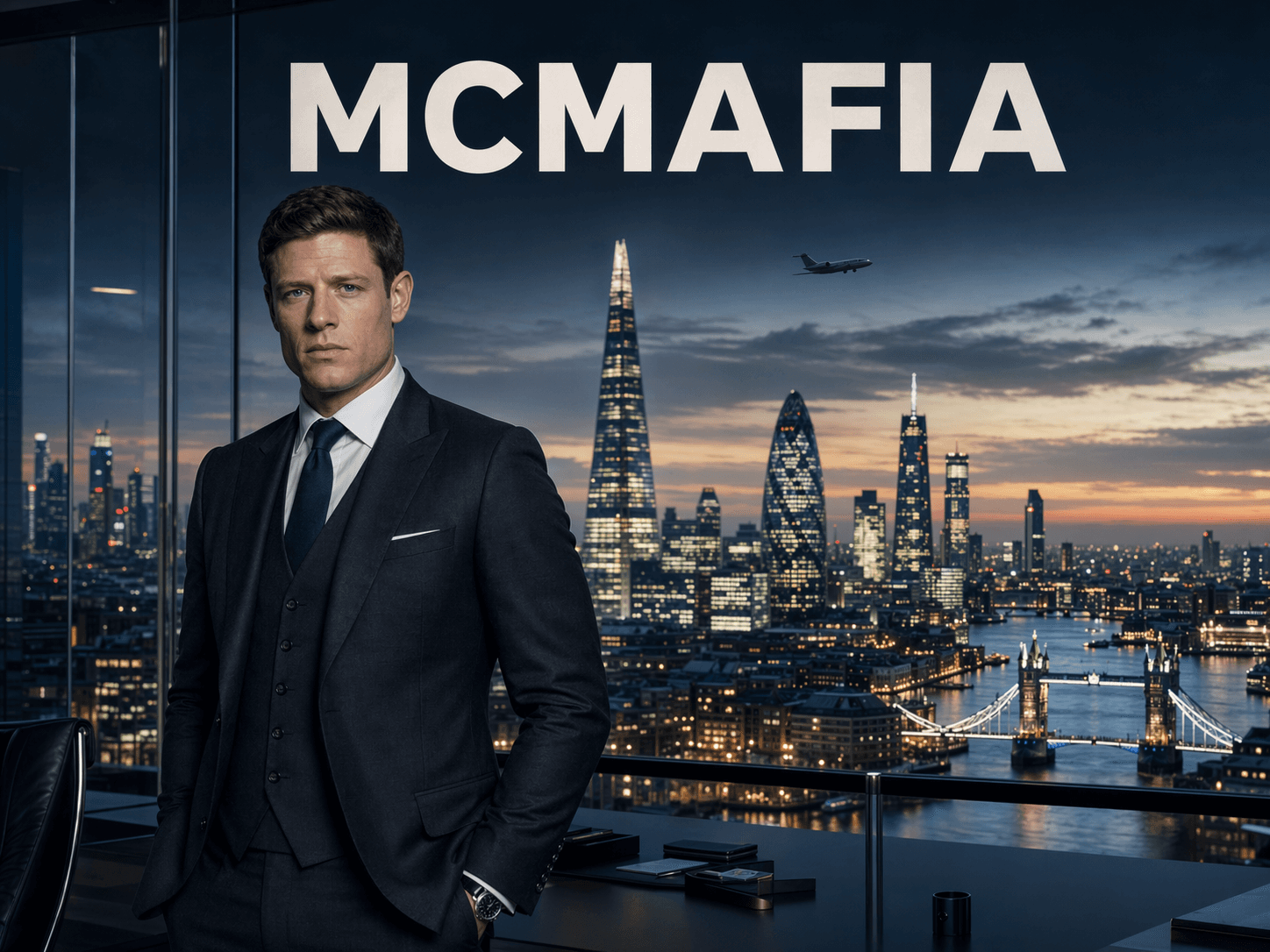
International producers took notice. In 2018 he was cast as Dimitri Godman in the BBC and AMC co-production McMafia, the exiled patriarch of a Russian crime family now living in careful, bitter respectability in London. Serebryakov brought a weary, suspicious authority to the part, and the role introduced him to a global English-speaking audience. In 2021 he crossed fully into Hollywood as Yulian Kuznetsov, the sadistic, karaoke-loving Russian mobster whose bad luck is to cross Bob Odenkirk in the action thriller Nobody. In between he continued to work steadily in Russia, playing the lead in the Russian adaptation of House, titled Doctor Richter, taking major roles in The Method, Furious, and Legend of Kolovrat, and winning the Nika Award for Best Actor for his performance in Van Goghs in 2019. In 2024 he appeared as the oligarch father Nikolai Zakharov in Sean Baker's Palme d'Or winner Anora.
Serebryakov's personal life has been shaped by a long partnership with his wife Maria, whom he has been with since the 1980s and married in the 1990s. They have three children, one from her previous marriage and two adopted. In March 2012 the family moved to Canada, settling in a Toronto suburb. Serebryakov was blunt about his reasons, citing corruption and political instability in Russia as obstacles to raising children, and the move signalled a growing distance from official Russian cultural life.
That distance hardened into open controversy in 2018, when he told the interviewer Yuri Dud that the dominant traits of the contemporary Russian national character were, in his view, brutal force, rudeness, and arrogance. Asked about Vladimir Putin, he said simply that he disliked two things, lies and thieving. The remarks provoked denunciation from nationalist commentators and calls, mostly symbolic, for his People's Artist title to be revoked. Later the same year, speaking at a business forum in London, he accused Russia of instigating multiple conflicts beyond its borders, producing a fresh wave of domestic outrage. He stood by the comments rather than soften them.
Despite the friction, Serebryakov has kept one foot in the Russian industry while continuing to accept international work. He divides his time between Canada and Moscow, and in 2021 clarified that he had not emigrated in any permanent sense but had simply moved the children abroad for schooling. From the doomed mechanic of Leviathan to the exiled patriarch of McMafia, the gangster of Nobody, and the oligarch father of Anora, his career traces the full arc of modern Russian screen history.