Scam 1992: The Harshad Mehta Story
2020 - 2020
Watch & Release Status
Open full watchlistEnded · Season 1 (confirmed) · Final season (confirmed)
This one-season limited series is complete.
Status checked 4 Sept 2026
About This Show
🎬 The Setup
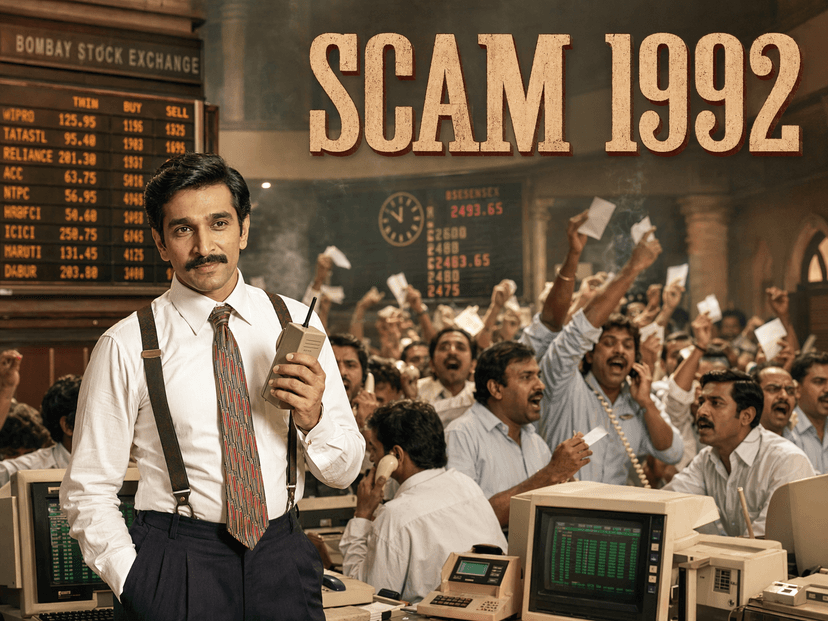
Scam 1992: The Harshad Mehta Story premiered on SonyLIV on 9 October 2020. Ten episodes. One season. Hindi-language with subtitles. Directed by Hansal Mehta, with Jai Mehta as co-director, it dramatises the rise and ruin of Harshad Mehta, the Bombay stockbroker whose manipulation of the Indian securities market crashed the Bombay Stock Exchange (BSE) in 1992 and triggered the Securities Scam of 1992.
The source material is the 1993 book The Scam: Who Won, Who Lost, Who Got Away, co-written by journalists Debashis Basu and Sucheta Dalal. Dalal is the reporter whose Times of India exposé broke the story open in April 1992. The show runs two storylines in parallel. One follows Harshad, a small-time jobber climbing the hierarchy of Dalal Street until he is being called the "Big Bull" and the "Bachchan of BSE". The other follows Sucheta Dalal, a financial journalist asking uncomfortable questions about where his money is actually coming from.
The mechanism at the centre of it all is the "Ready Forward" system, or BR scam, a short-term inter-bank lending trick involving Bank Receipts that Harshad weaponised to route public sector bank money into the stock market. Most viewers will not have heard of a Bank Receipt before episode three. By episode six they will understand it well enough to argue about it. That is the show's great trick.
🎭 The Cast
Pratik Gandhi plays Harshad Mehta and the performance more or less rewrote his career. Before this he was a Gujarati theatre and regional film actor in his forties, respected in Surat and Mumbai stage circles, virtually unknown to a national audience. Afterwards he was a headline name. What he does with Harshad is the trickiest kind of biographical performance. He plays a con man who is also, in some genuine sense, a believer. The swagger is not put on. The charm is not a mask. And yet every scene is laced with the knowledge that the whole thing is running on fumes.
Shreya Dhanwanthary plays Sucheta Dalal and is given the second lead, not a decorative one. Her Dalal is a reporter built out of stubbornness, shoe leather, and a refusal to be patted on the head by the men around her. She and Gandhi share almost no screen time, which is the structural gamble of the whole series. The show trusts that their parallel arcs will generate a gravitational pull without ever needing the two of them in the same room.
The supporting bench is deep:
- Hemant Kher as Ashwin Mehta, Harshad's younger brother, the family conscience who loves his brother and also loses himself in the operation
- Anjali Barot as Jyoti Mehta, Harshad's wife, a quieter performance that gives the domestic scenes their spine
- Sharib Hashmi in a pivotal reporter role
- Satish Kaushik as Manu Mundra, the old-guard bear operator who sees Harshad's game coming before anyone else
- Rajat Kapoor as the CBI officer investigating the fraud
- Nikhil Dwivedi as a scheming banker inside the system
- K. K. Raina, Anant Mahadevan, and Chirag Vohra rounding out brokers, bankers, and Harshad's inner circle
Nearly every one of these performers is a theatre lifer or a seasoned character actor. The result is an ensemble without a weak seam.
🧠 What It Is Really About
On the surface it is a financial thriller about a man who gamed the market. Below that it is a story about caste, class, and the specific rage of a Gujarati outsider who grew up watching rich men operate a system that was not designed to include him. The scene in which Harshad explains his philosophy to his brother, the "risk hai toh ishq hai" speech, has since passed into Indian meme folklore. It also carries most of the show's thesis. Risk as romance. Greed as liberation. The pursuit of wealth as a form of revolt against people who told you that you were too small to play.
The show does not excuse Harshad. It also does not hide from the fact that the man became a folk hero. Middle-class Indians in 1992 watched a guy from Kandivali take the old Marwari and Parsi broker dynasties for a ride and many of them, rightly or wrongly, enjoyed it. The series sits with that tension and asks the viewer to sit with it too.
Institutional failure is the other main subject. Every scam of this size needs enablers. The bankers looking the other way, the regulators asleep at the switch, the politicians collecting on a favour owed, the journalists who were too friendly with the people they were covering. The show takes time with each of them.
🎨 Style and Atmosphere
The period work is outstanding without ever turning into a nostalgia reel. Bombay in the late 80s and early 90s is captured in fabric and texture rather than museum detail. Wide-lapel suits. Off-white kurtas. Yellow light from tungsten bulbs in cramped broker offices. Trading floors that are literal pits of shouting men with paper chits. The BSE trading ring at full volume, before the screens took over, is a piece of social anthropology as much as set design.
Achint Thakkar's score is a character on its own. The main theme, a brassy bombastic horn line that punches in every time Harshad is climbing another rung, became a phenomenon in its own right. It has since been used in a thousand finance-adjacent reels across Indian social media. The show earned that.
Hansal Mehta's direction is patient. He trusts boardroom scenes and phone calls to carry weight that flashier editing would try to force. He lets Gandhi's face do a lot of the work. A lot of the best moments are just someone on a landline, calculating odds.
📈 Reception and Legacy
At the 2021 Filmfare OTT Awards the series picked up 14 nominations and won 11, including Best Drama Series, Best Director in a Drama Series for Hansal and Jai Mehta, and Best Actor in a Drama Series for Pratik Gandhi. On IMDb it has sat at a 9.2/10 user rating for years. Indian audiences, critics, and the Bollywood trade press are in rare unanimous agreement. It is one of the best things India has made for television.
Its cultural footprint is bigger than its viewership numbers. It made Pratik Gandhi a bankable lead. It made Hansal Mehta one of the most respected showrunners in the country. It turned the phrase "risk hai toh ishq hai" into shorthand that anyone under forty will recognise. And it opened the door for a franchise. Scam 2003: The Telgi Story, covering Abdul Karim Telgi's counterfeit stamp paper scam, followed in 2023 under Hansal Mehta's creative supervision, though with a different director. The Scam universe is now a thing.
It is not simply the story of a stockbroker. It is the story of the country that produced him.
🏆 Why It Works
I came into this one cold, with no prior attachment to the story and no particular interest in Indian financial history, and I was hooked by the end of the first episode. That is the mark of it. The show does not require you to know what a Bank Receipt is, or which ministry regulates what, or who the Reserve Bank of India governor was in 1991. It teaches you on the way. And it teaches you in the voice of a man selling you something.
If you liked the moral rot of Billions or the institutional failure investigations of The Dropout and The Playlist, you will find Scam 1992 in the same league and arguably better written. For fellow admirers of Indian prestige crime drama, Sacred Games is the closest comparator on the site, though Scam 1992 is the more disciplined piece of storytelling.
Ten episodes. One complete arc. No filler. A genuine high-water mark for Indian television and, frankly, for the financial biographical drama as a form anywhere in the world.
Cast & Crew
Rajat Kapoor
CBI Officer K. Madhavan
K. K. Raina
Pranav Sheth
Pratik Gandhi
Harshad Mehta
Satish Kaushik
Manu Mundra
Shreya Dhanwanthary
Sucheta Dalal
Sharib Hashmi
Debashis Basu
Hemant Kher
Ashwin Mehta
Chirag Vohra
Bhushan Bhatt
Nikhil Dwivedi
Tyagi
Anjali Barot
Jyoti Mehta
Anant Mahadevan
SBI Chairman